Why Each Artwork Revision Round Adds More Than Just Review Time to Custom Drinkware Orders
Key procurement answer
Buyers assume artwork revisions add only review time to project timelines. In reality, each revision triggers cascading preparation resets across factory departments, extending timelines by 2-3x the expected duration.
There is a pattern we encounter in nearly every custom drinkware project that involves logo or design customization. The buyer submits initial artwork, receives a digital proof, requests changes, and expects the revised proof within a day or two. When the second proof arrives, there are additional adjustments—perhaps the logo needs to be slightly larger, or the text positioning should shift by a few millimetres. This cycle repeats two, three, sometimes four times before final approval. What buyers rarely understand is that each revision round does not simply add review time. It triggers a cascade of internal workflow disruptions that extend the project timeline far beyond what the revision itself would suggest.
From the production floor perspective, artwork is not merely a visual file. It is a technical specification that determines tooling setup, colour mixing, screen preparation, and quality control parameters. When a buyer approves initial artwork, the factory begins parallel preparation work. Screens are prepared for printing. Laser parameters are calibrated for engraving. Colour formulations are mixed and tested. Jigs and fixtures are configured for precise logo placement. This preparation happens while the buyer reviews proofs, because waiting for absolute final approval before beginning any preparation would add weeks to every order.
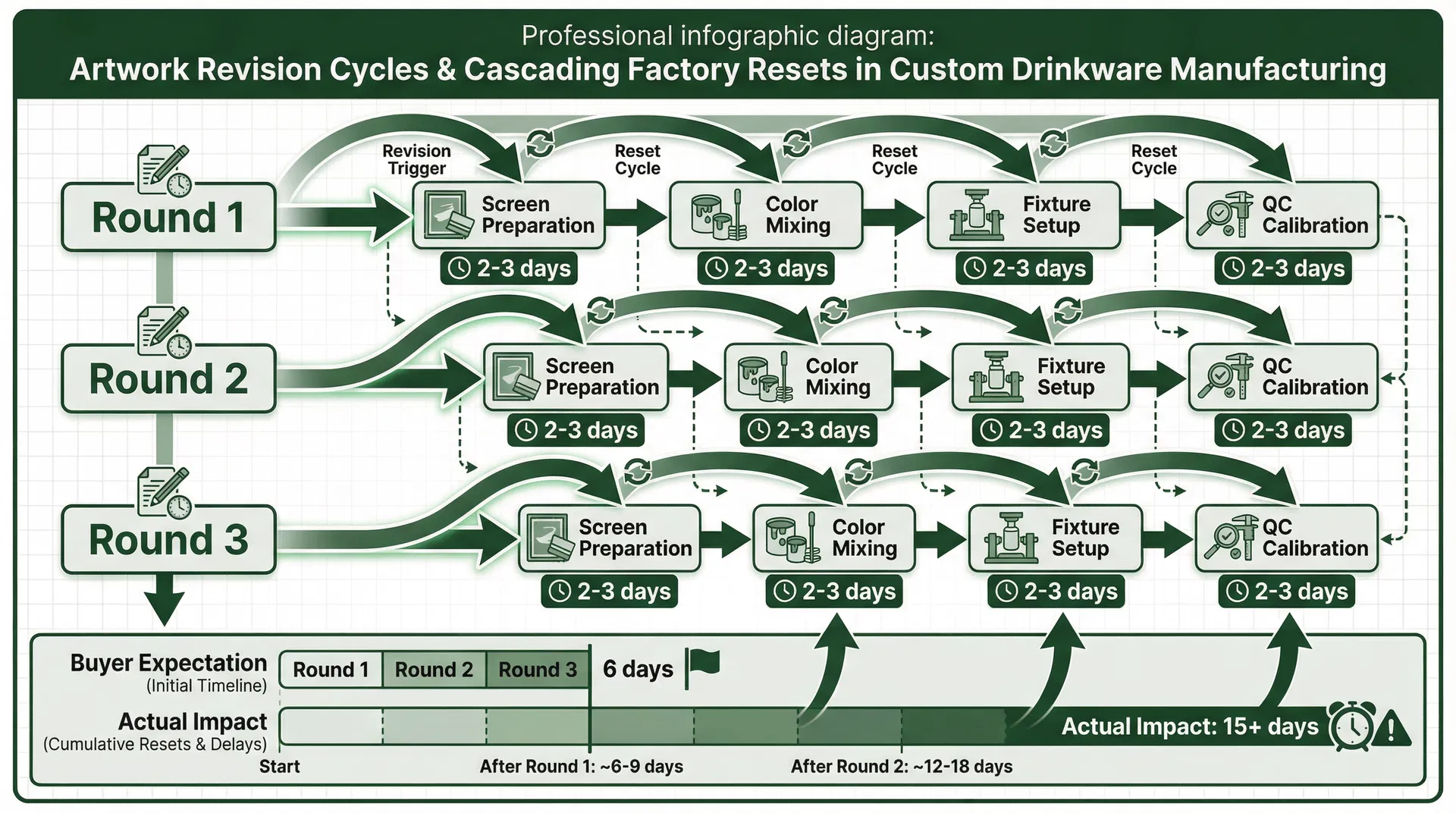
The challenge emerges when artwork changes arrive after preparation has begun. A request to increase logo size by 15% is not a simple file edit. It requires recalculating the screen mesh, potentially re-exposing the screen entirely, adjusting fixture positioning, and recalibrating quality control measurement points. A colour adjustment—even a subtle shift in shade—means discarding the current colour batch and mixing a new formulation. These are not hypothetical scenarios. They are standard consequences of what buyers perceive as minor refinements.
In practice, this is where customization process decisions start to create timeline extensions that appear disproportionate to the change requested. A buyer who asks for three revision rounds, each taking two days for review and response, assumes they have added six days to the project. The actual impact is closer to twelve to fifteen days, because each revision resets portions of the preparation workflow. The factory cannot simply pause mid-preparation and resume when the new artwork arrives. Work in progress must often be scrapped or set aside, and the preparation sequence restarts from specific checkpoints.

The compounding effect becomes more pronounced when revisions arrive after the artwork lock-in date. Most factories establish a cutoff point—typically five to seven working days before production begins—after which artwork changes trigger formal timeline extensions. This is not arbitrary bureaucracy. It reflects the point at which production scheduling commits resources that cannot be easily reallocated. A revision request after lock-in does not simply delay the current order. It may require rescheduling the production slot entirely, pushing the order behind other committed jobs.
There is a particular type of revision that creates disproportionate disruption: changes to branding position or size after physical samples have been produced. When a buyer approves a pre-production sample and then requests adjustments to logo placement, the factory faces a choice between producing a new sample (adding another 5-7 days) or proceeding with the change and accepting increased quality risk. Neither option is ideal, and both add cost or timeline that the buyer did not anticipate when requesting what seemed like a straightforward adjustment.
The gap between digital proof approval and production-ready artwork approval is where many projects encounter unexpected delays. A design that looks correct on screen may require modification when translated to physical production constraints. Minimum line thickness for screen printing differs from laser engraving. Colour gradients that render beautifully in digital format may not reproduce accurately on curved metal surfaces. These technical limitations often surface only when the factory prepares production files, triggering revision requests that the buyer did not anticipate.
For organisations managing the complete customization workflow, establishing artwork specifications early and minimising revision rounds after initial submission significantly reduces timeline risk. The most effective approach involves providing production-ready files from the outset—vector formats with outlined fonts, specified Pantone colours, and clear positioning dimensions. When revisions are necessary, consolidating all changes into a single round rather than iterating through multiple small adjustments prevents the cascading preparation resets that extend timelines beyond buyer expectations.
The underlying principle is straightforward but frequently overlooked: in physical production, artwork is not just a design file. It is a manufacturing instruction set that triggers preparation activities across multiple departments. Each revision does not simply require someone to update a file. It requires coordination across screen preparation, colour mixing, fixture setup, and quality control calibration. Understanding this operational reality helps explain why seemingly minor artwork changes can extend custom drinkware project timelines by weeks rather than days.