B2B Drinkware Procurement Insights
Evidence-led guidance for New Zealand organisations planning custom drinkware, from specifications and branding to quality, lead time, MOQ, and gifting decisions.
Procurement insights for New Zealand organisations
Understanding Minimum Order Quantities for Custom Drinkware in New Zealand
A complete business guide to MOQ for custom drinkware in NZ. Learn optimal order quantities, pricing tiers, and strategies for businesses of all sizes.
304 vs 201 Stainless Steel: The Hidden Supply Chain Reality
A procurement manager's field notes on material grades, corrosion risks, and why 'food grade' on a spec sheet doesn't always mean what you think it means.
The Hidden Cost of Ordering at Minimum Quantities
Why ordering exactly at MOQ often results in higher total costs. A procurement perspective on quantity decisions for corporate drinkware.
Why Approved Samples Don't Guarantee Production Quality
Understanding the gap between sample production conditions and bulk manufacturing—and why this distinction matters for procurement decisions.
Why Reordering Custom Bottles Creates Colour Matching Challenges
The hidden risk of splitting drinkware orders across time—and why your second batch of branded stainless steel bottles may not match the first.
How Rush Orders Transform What MOQ Delivers for Custom Drinkware
The same order quantity under compressed timelines produces different results. Understanding why time pressure changes production outcomes for branded bottles and mugs.
Why Your Supplier's MOQ Reflects Production Line Economics
The setup fee on a quote is visible. The two to four hours of line downtime during changeover is not. Understanding why minimum order quantities exist to recover hidden costs.
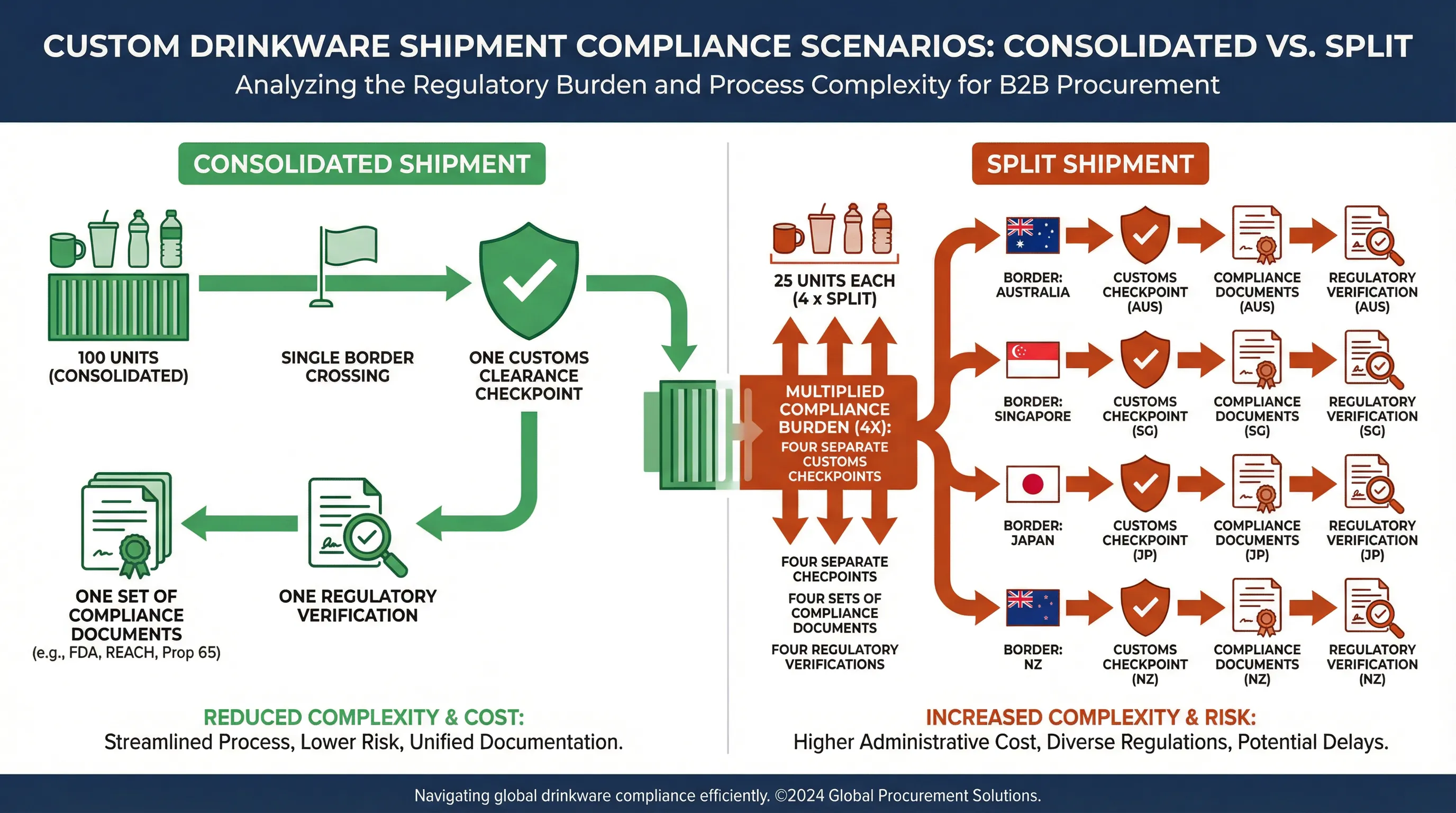
Why Split International Distribution Changes MOQ Compliance Risk
How ordering at minimum quantity and splitting shipments across borders multiplies compliance exposure for custom branded drinkware.
When Storage Costs Erase MOQ Savings on Custom Drinkware
Why the per-unit advantage of ordering at minimum quantity disappears when storage duration extends beyond the break-even point. A procurement consultant's perspective.
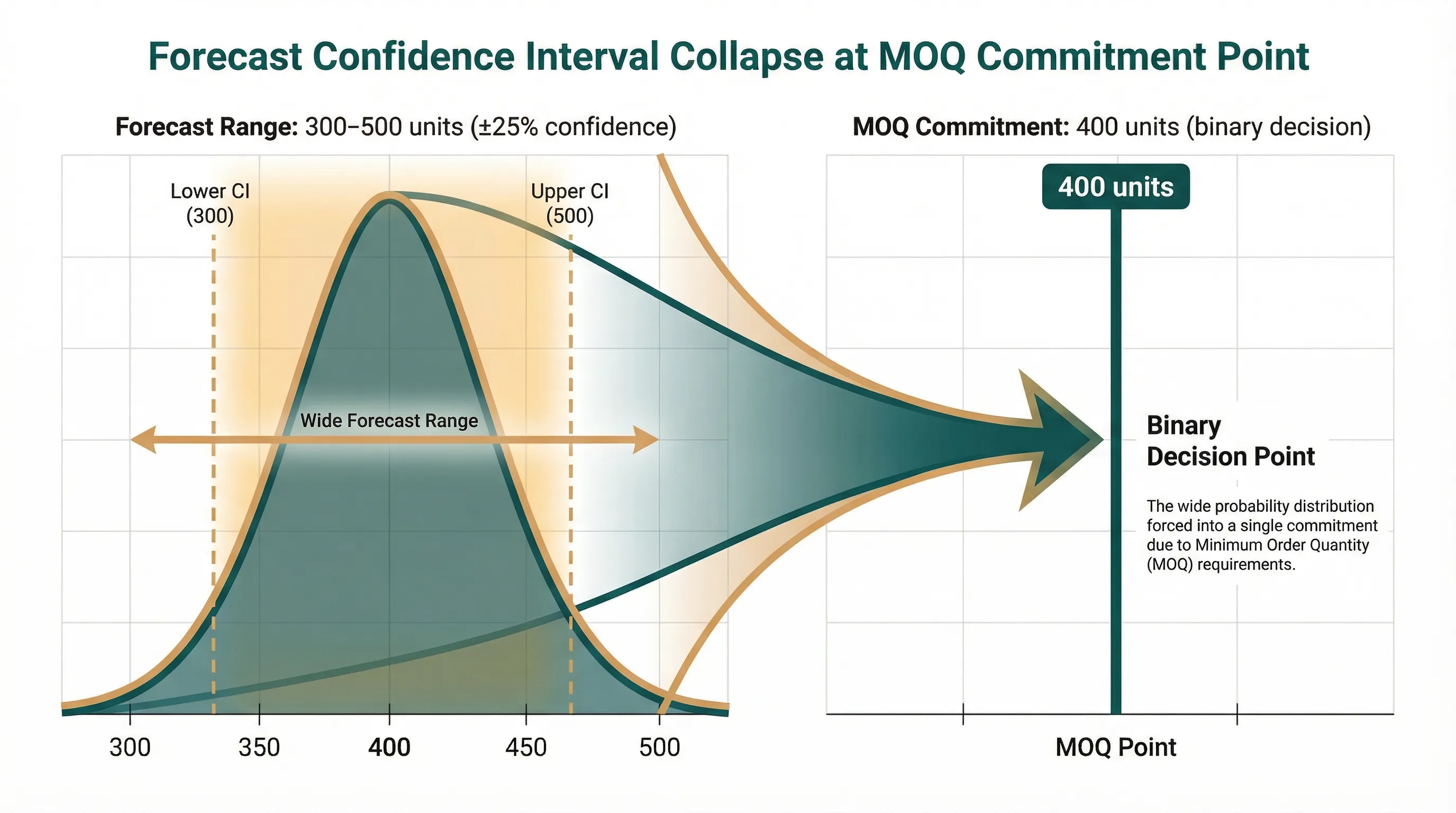
Why Forecast Confidence Intervals Disappear When Ordering Custom Drinkware at MOQ
The forecast range that informs every other procurement decision disappears the moment a supplier's minimum order quantity forces a commitment. Understanding why confidence intervals collapse to binary choices reveals hidden risks in custom branded drinkware orders.
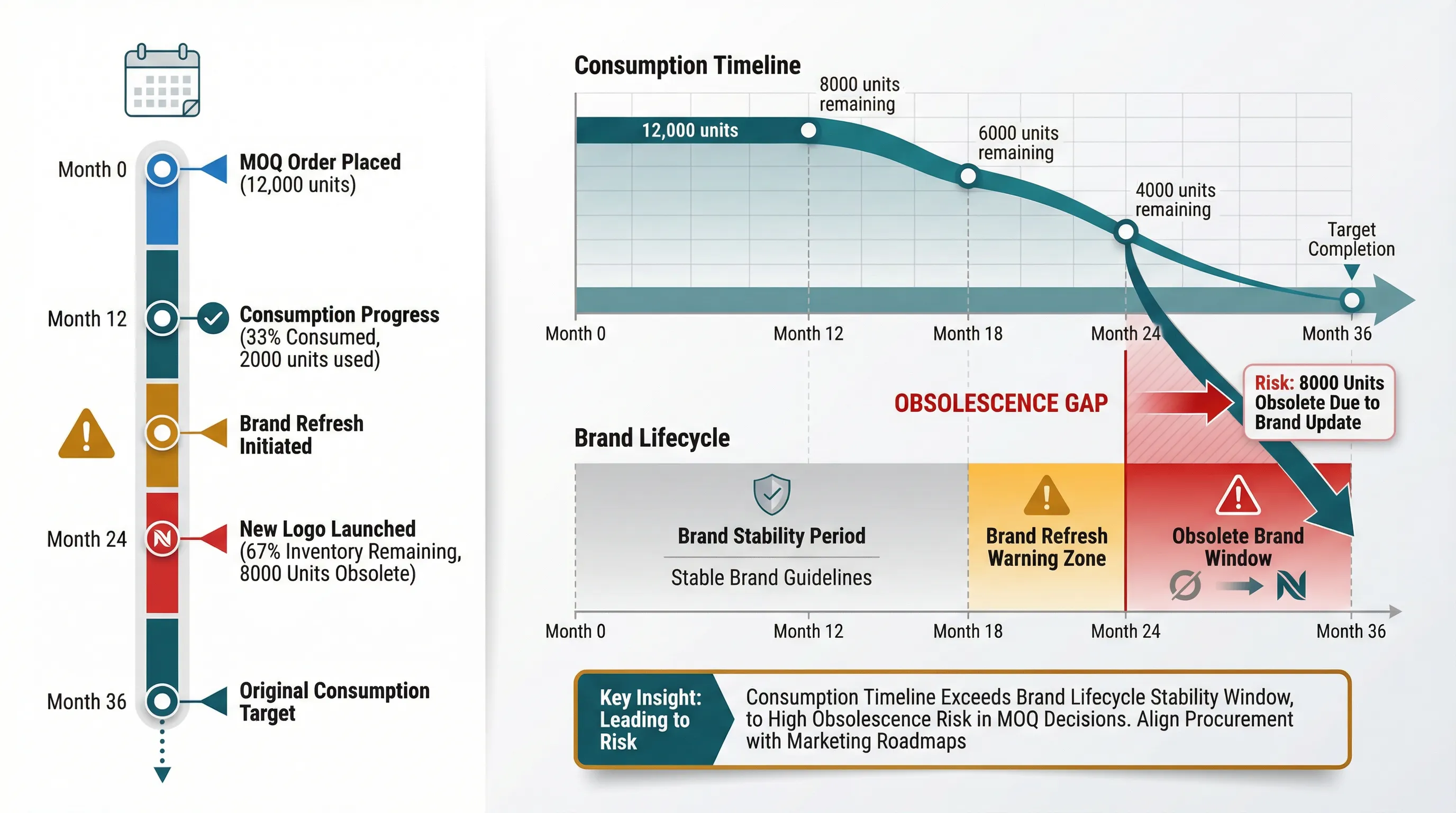
When Consumption Timelines Outlive Brand Lifecycles in Custom Drinkware Orders
The calculation shows three years to consume the order. The branding might not last eighteen months. Understanding why procurement teams evaluate consumption duration but not brand stability reveals a structural blind spot in minimum order quantity decisions.
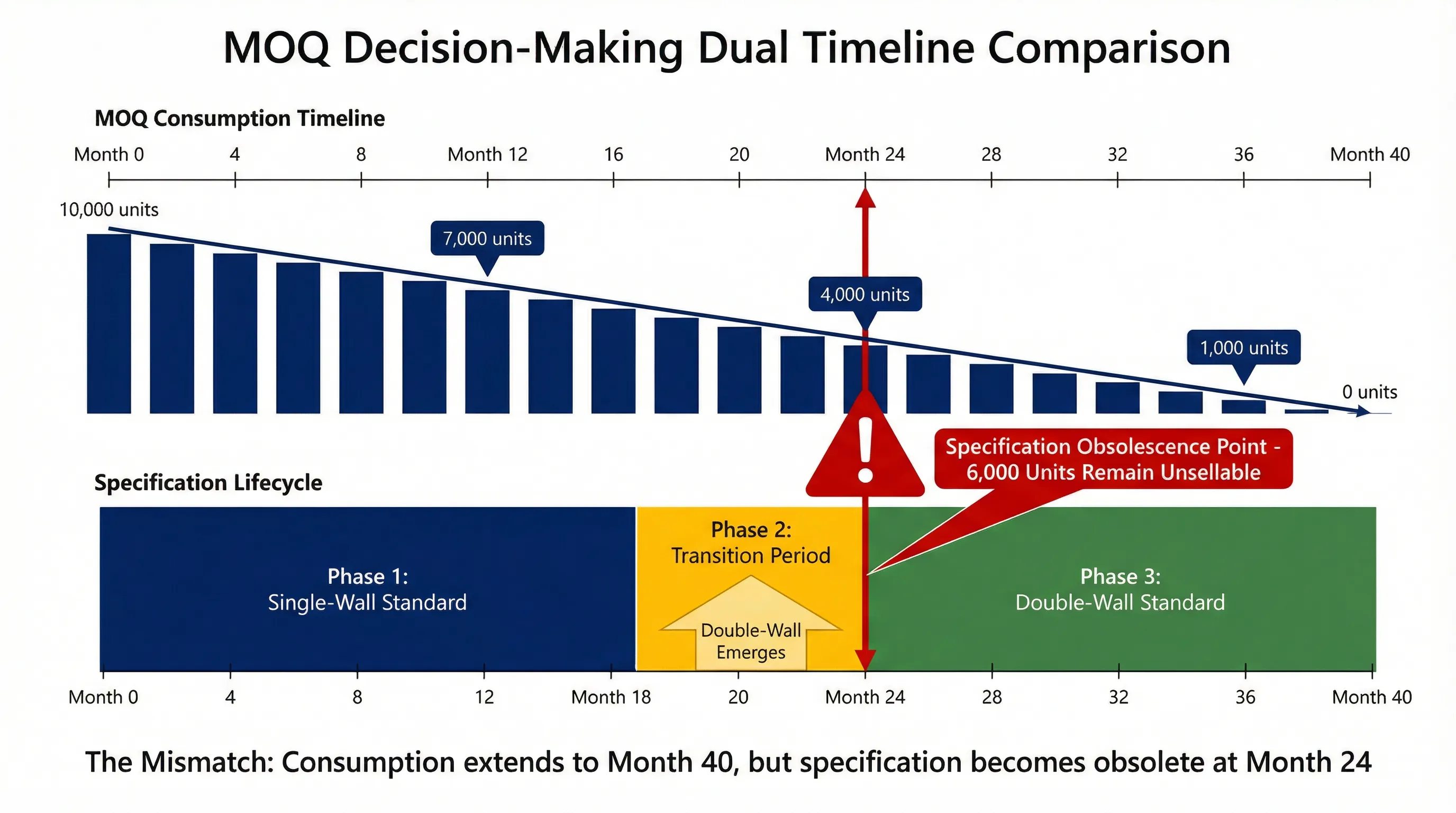
When Product Specification Upgrades Outpace MOQ Consumption Timelines in Custom Drinkware
The calculation shows 3.3 years to consume the order. The specification remains unchanged. Yet eighteen months later, six thousand units remain unsellable. Understanding why technical standards evolve faster than inventory depletion reveals a critical blind spot in minimum order quantity planning.
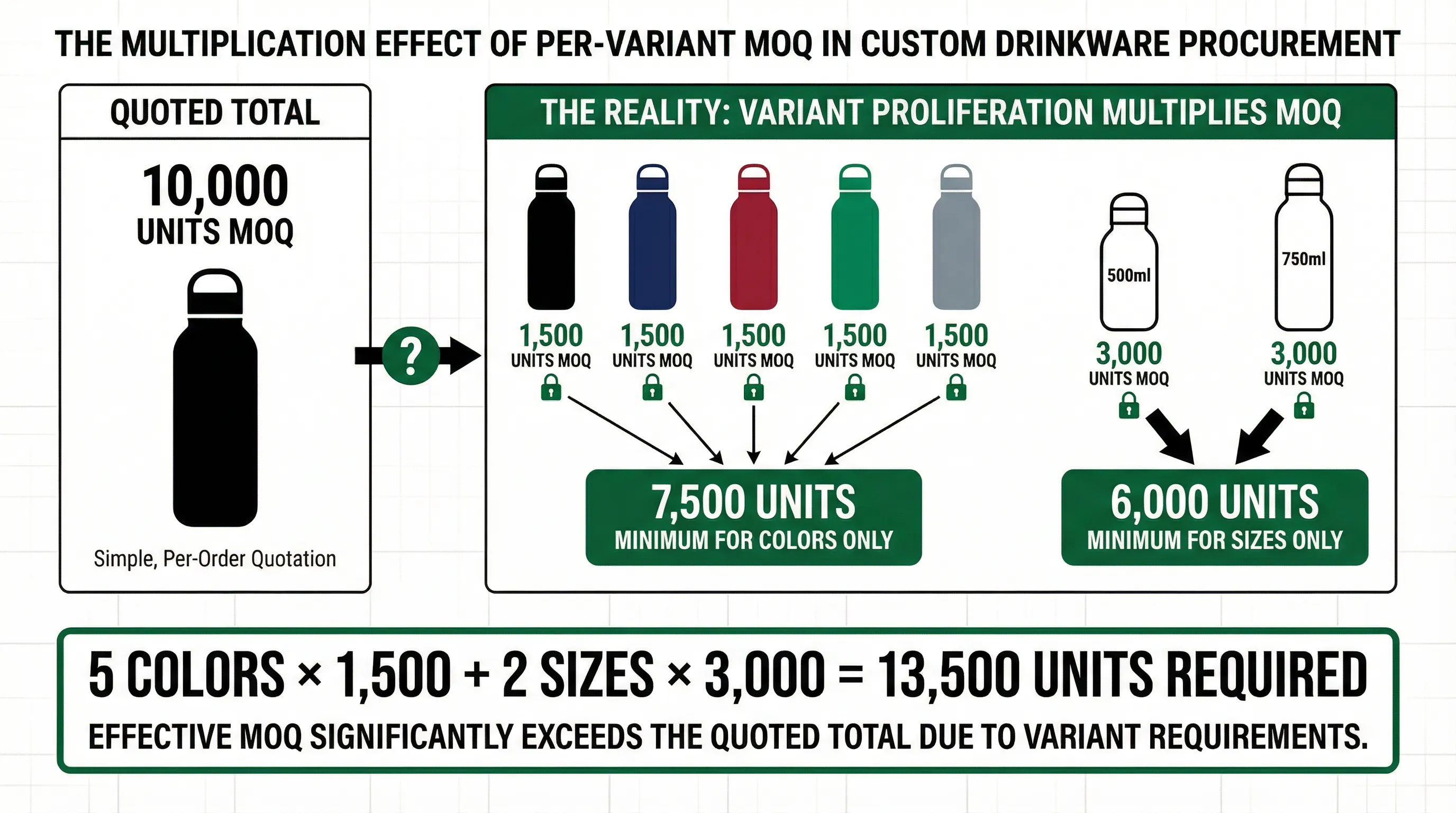
When Product Variant Proliferation Multiplies MOQ Requirements for Custom Drinkware
Factory project managers explain why designing 10 product variants doesn't mean you can split 10,000 units freely—and how per-SKU minimums multiply effective MOQ requirements for custom drinkware orders.
How Long Does It Take to Produce Custom Drinkware for New Zealand Businesses?
Custom drinkware production timelines in New Zealand range from 10 working days for stock items with logo printing to 60-90 working days for fully custom designs requiring new tooling. The timeline depends on three critical factors: order complexity, order size, and shipping method...
Why Artwork Approval Windows Expand Beyond Supplier Timelines in Custom Drinkware Orders
Factory project managers explain why the 3-day proof delivery promise becomes a 23-day approval window when multi-stakeholder workflows and revision cycles are factored into custom drinkware lead time calculations.
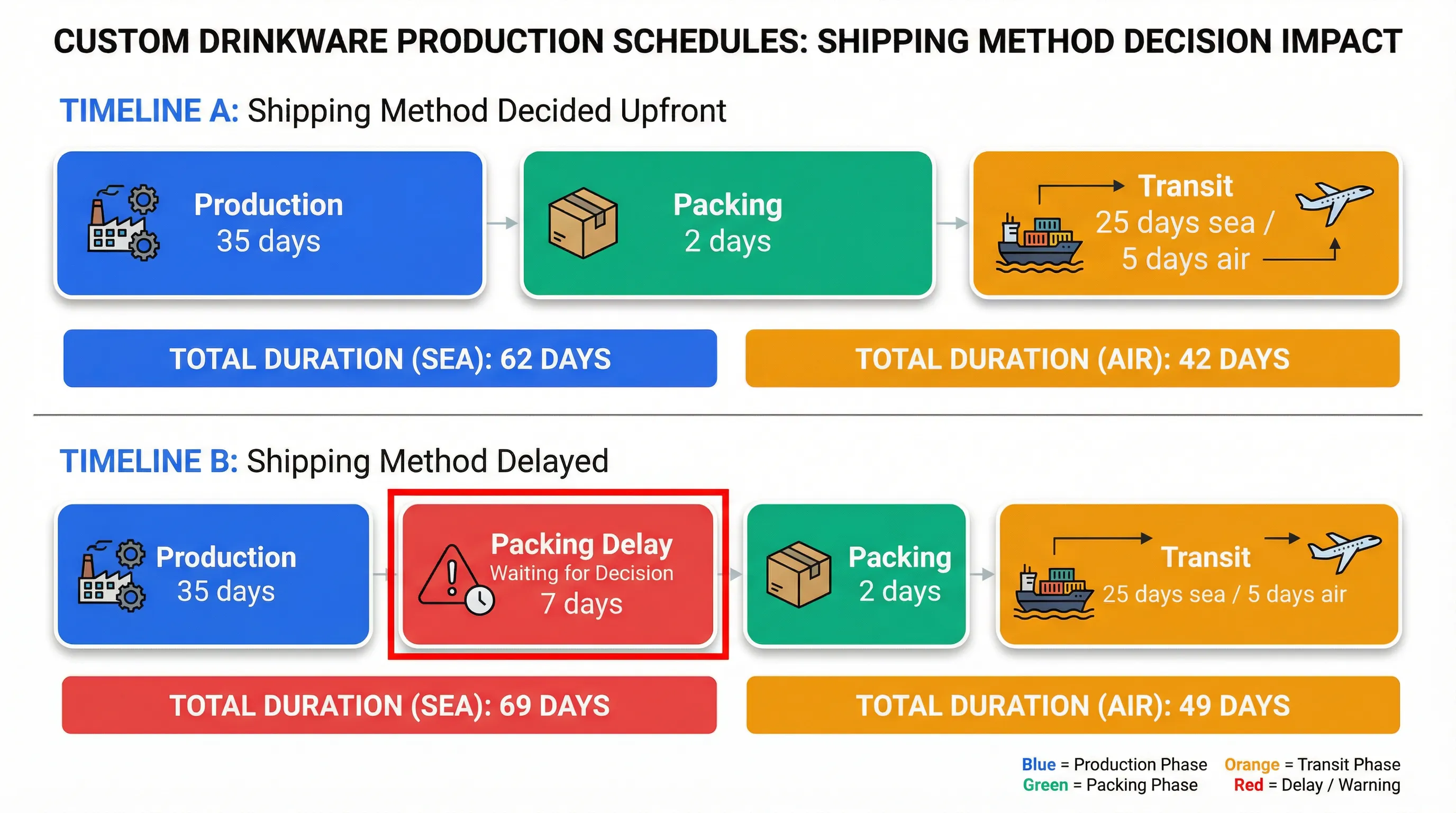
Why Shipping Method Indecision Extends Custom Drinkware Production Timelines
Procurement teams often delay sea freight vs air freight decisions until production completes, not realizing this choice affects packing specifications and adds hidden weeks to custom drinkware lead times.
Why Peak Season Orders Arrive Later Than Non-Peak Orders Despite Earlier Placement in Custom Drinkware
Buyers assume placing custom drinkware orders in September guarantees November delivery, but factory capacity constraints during peak season mean order placement date matters less than specification readiness and payment status.
Why Multi-Location Delivery Requests Extend Custom Drinkware Production Timelines
Factory project managers explain why requesting delivery to three separate offices transforms a single 10,000-unit order into three separate fulfillment projects that extend lead times by 1-2 weeks beyond standard production schedules.
Why Mid-Production Specification Changes Trigger Quality Control Revalidation in Custom Drinkware Orders
Quality control consultants explain why requesting quantity increases or color changes after production begins invalidates statistical sampling plans and triggers a complete revalidation cycle that extends lead times by 2-3 weeks.
Why Order Quantity Tier Changes Trigger Production Line Rebalancing in Custom Drinkware Manufacturing
Buyers assume increasing order quantities from 5,000 to 10,000 units is simple arithmetic. In reality, quantity tier changes trigger a complete production line rebalancing cycle extending lead times by 1-2 weeks.
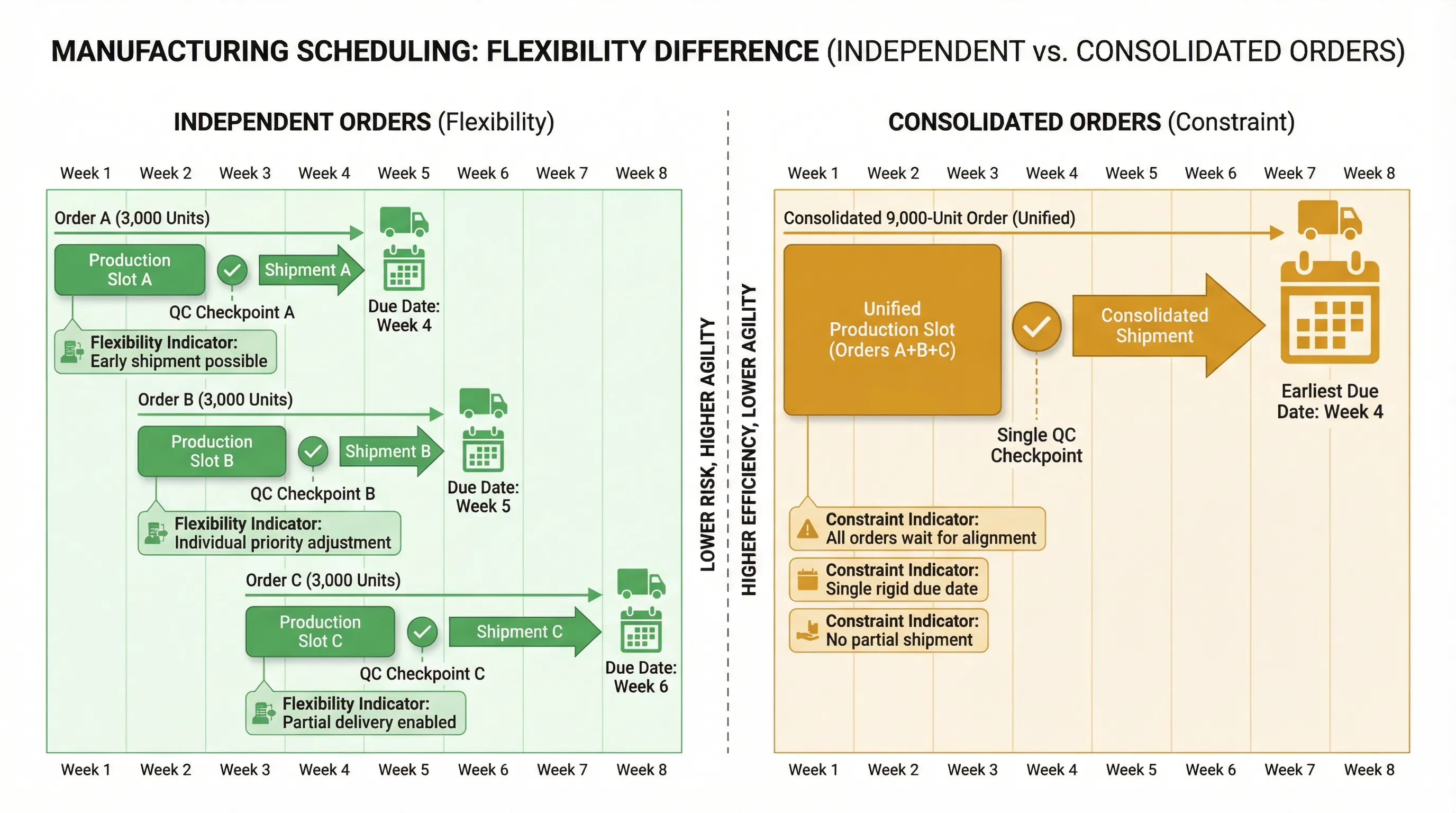
When Order Consolidation Extends Custom Drinkware Lead Times
Buyers request order consolidation expecting faster delivery, but consolidation transforms three independent production slots into a single rigid production run where scheduling flexibility disappears and lead times extend by 1-2 weeks.

Why Buyer Procurement Decision Delays Extend Custom Drinkware Lead Times by 2-4 Weeks
When procurement managers receive a factory quote stating '8-week lead time,' they often overlook that their own internal decision processes (design approval, budget sign-off, supplier selection, order processing) consume 2-4 weeks before the factory even begins production. This 'invisible lead time' causes organisations to believe they have 8 weeks of buffer when they actually only have 4-6 weeks.

Why Supplier Switching Extends Custom Drinkware Lead Times by 3-5 Weeks—Even When Product Specifications Are Identical
When organisations switch custom drinkware suppliers, they often assume that as long as product specifications remain the same, the new factory can immediately begin production. However, even when technical drawings, material specifications, and quality standards are clearly defined, the new factory must still undergo four stages: production parameter rebuilding, quality standard calibration, process flow adaptation, and first batch trial production verification—typically requiring 3-5 weeks because product specifications and production parameters operate at completely different levels.
Why Raw Material Shortages Extend Custom Drinkware Production Lead Times by 2-4 Weeks
Factory procurement teams explain why material sourcing delays for stainless steel, injection molds, and silicone gaskets extend custom drinkware production timelines by 2-4 weeks before manufacturing even begins.
The Complete Customization Process for Corporate Drinkware in New Zealand: A Step-by-Step Guide for Business Buyers
Complete guide to customizing corporate drinkware in New Zealand. Learn the 6-step process from requirements confirmation to delivery logistics, avoid common pitfalls like color inconsistency and supplier switching delays, and manage lead times effectively for your business.

Why Buyers' Logo Files Are Rarely Production-Ready for Custom Drinkware
Most logo files provided by buyers are optimized for digital use, not physical imprinting. Understanding the gap between web display files and production-ready artwork can prevent 1-2 week delays in custom drinkware projects.
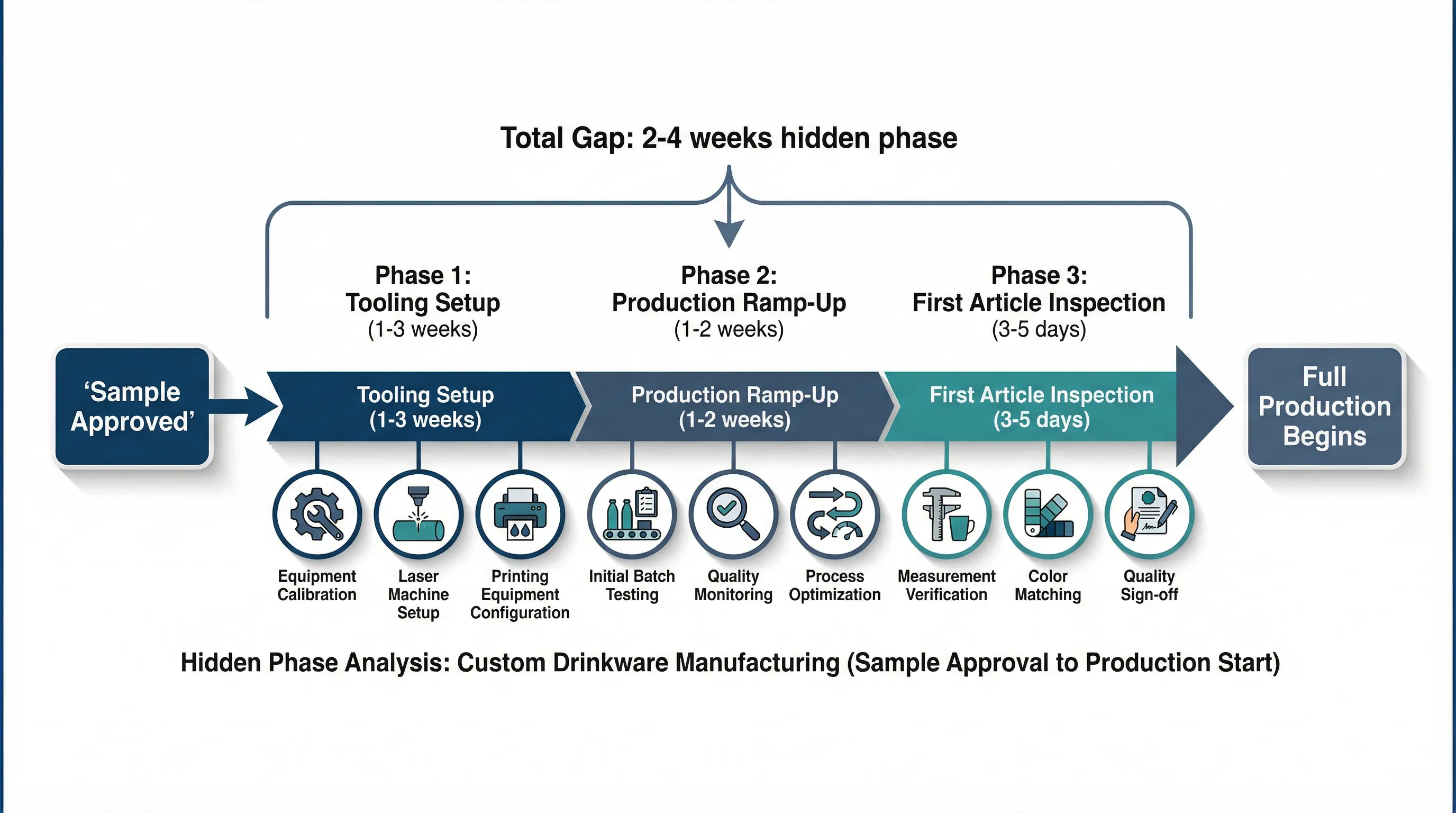
Why Sample Approval Doesn't Mean Your Custom Drinkware Production Starts Tomorrow
The gap between sample approval and production start is one of the least discussed phases in custom drinkware manufacturing. Understanding this hidden 2-4 week phase prevents timeline misjudgments.

Why Pantone Codes Don't Guarantee the Color You Expect on Custom Drinkware
Providing a Pantone code to your supplier feels like a precise specification. In reality, the same Pantone reference produces visibly different results depending on substrate material, coating method, and lighting conditions during approval.

Why Waiting for Final Inspection to Verify Custom Drinkware Quality Costs More Than Earlier Checkpoints
Most buyers request quality inspection only when production is complete. By that point, defects have already propagated through the entire order, making corrections expensive and time-consuming.

Why Packaging Specifications Are Finalised After Product Approval Creates Hidden Costs in Custom Drinkware Orders
Buyers invest considerable effort specifying product details but treat packaging as an afterthought. Late packaging specification changes create costs and timeline extensions that could have been avoided entirely.
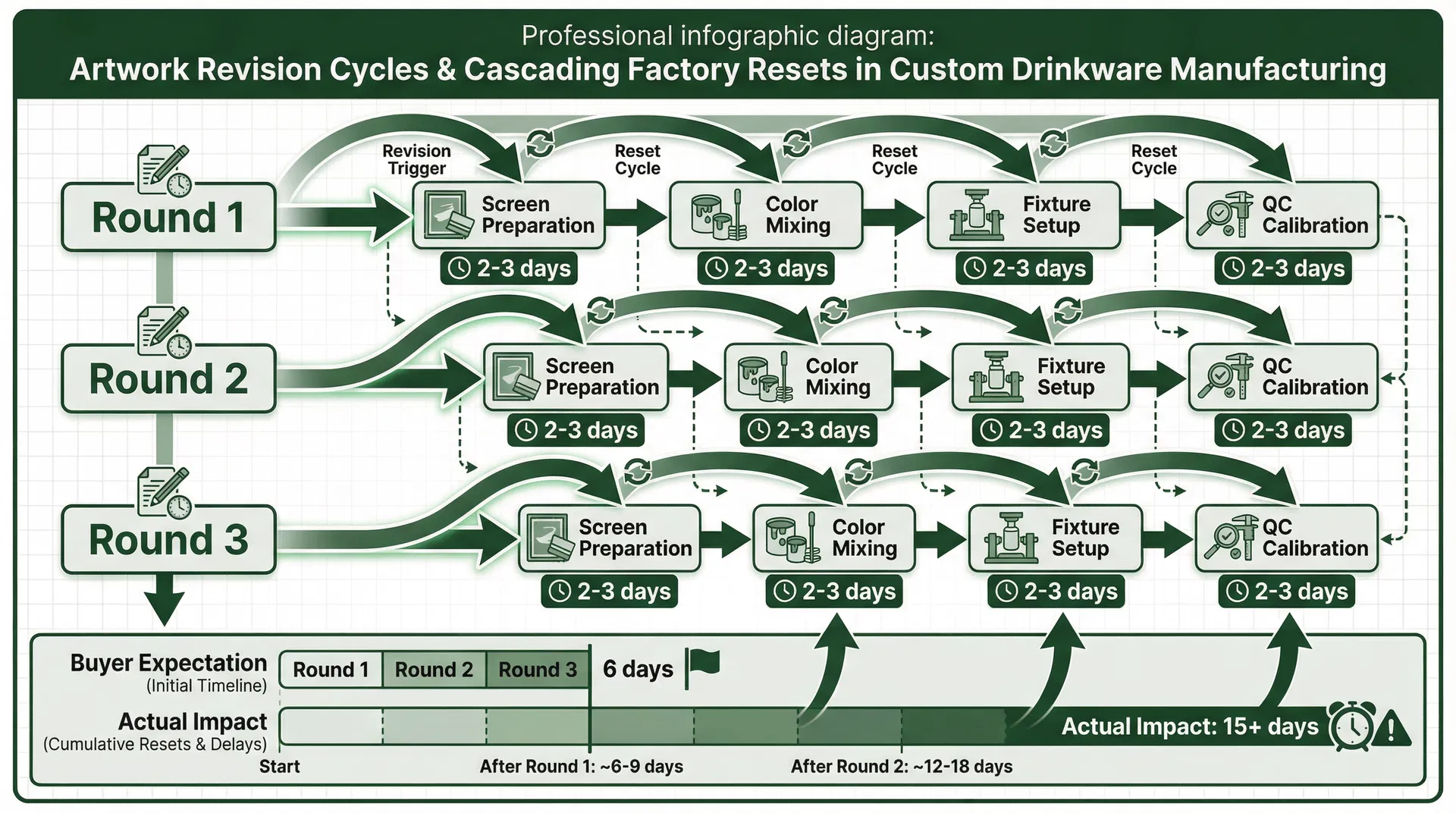
Why Each Artwork Revision Round Adds More Than Just Review Time to Custom Drinkware Orders
Buyers assume artwork revisions add only review time to project timelines. In reality, each revision triggers cascading preparation resets across factory departments, extending timelines by 2-3x the expected duration.

Why Approving a Flat Artwork Proof Doesn't Guarantee Logo Position Accuracy on Curved Custom Drinkware
Buyers approve flat artwork proofs expecting exact logo placement on finished products. However, curved drinkware surfaces introduce positioning variables that flat proofs cannot represent, leading to disputes at final inspection when 'centered' means different things to different parties.

Why Accepting 'Equivalent' Material Substitutions Mid-Production Creates Unexpected Quality Gaps in Custom Drinkware Orders
When specified materials become unavailable during production, suppliers offer 'equivalent' alternatives. Most buyers evaluate substitutions based on visual similarity alone, missing technical differences that affect durability, branding quality, and compliance certification validity.

Why Choosing a Decoration Method Based on Sample Room Appearance Leads to Field Failures in Custom Drinkware
Decoration methods for custom bottles and cups are routinely selected based on how samples look in a meeting room, but the real test is how branding survives months of daily use in actual working environments.

Why Surface Finish and Decoration Method Are Not Two Separate Decisions in Custom Drinkware Orders
Buyers routinely select a surface finish for aesthetics and a decoration method for branding as independent choices. In production, these two specifications form a single interdependent system where incompatible combinations cause adhesion failures, colour shifts, and costly re-runs that neither party anticipated.

Why Specifying One Pantone Code Across a Branded Drinkware Set Does Not Guarantee Colour Consistency
Corporate buyers ordering branded sets of bottles, mugs, and tumblers assume a single Pantone reference will produce uniform colour across all products. In reality, each substrate material interacts differently with pigment, coating, and light, creating visible inconsistencies that fall within factory tolerance but outside buyer expectations.

Why Multi-Colour Logo Designs Create Compounding Alignment Risk on Custom Drinkware
Buyers approve multi-colour logos based on digital mockups where colour layers align with pixel-level precision. On a production line, each additional colour is a separate mechanical pass through the decoration equipment, and registration tolerance compounds with every layer—creating visible misalignment that falls within factory specification but outside the buyer's visual expectation.

Why Fine-Detail Logos That Look Sharp on Screen Fail at Production Scale on Custom Drinkware
Buyers approve logo artwork by reviewing it on a digital screen where fine lines, small text, and gradients appear crisp. The physical print area on a bottle or tumbler is dramatically smaller than the on-screen review size, pushing design details below the minimum reproducible threshold of the decoration method—a physics constraint invisible during the approval process.

Why the First and Last Units in a Custom Drinkware Production Run Don't Look the Same
Buyers approve a pre-production sample and expect every unit in the order to be identical. In reality, decoration parameters drift progressively during a production run—ink viscosity changes with temperature, printing pads wear, screen tension relaxes—creating measurable differences between the first and last units that standard inspection methods fail to detect.

Which Types of Corporate Drinkware Gifts Are Best for Different Business Needs in New Zealand?
Expert procurement guide to choosing corporate drinkware gifts for NZ businesses. Covers material trade-offs, budget strategies by company size, NZ compliance requirements, and practical decision frameworks for events, onboarding, client retention, and sustainability programmes.

Why Corporate Drinkware Gifts Chosen for Unboxing Impact Often Fail in Daily Use
A procurement analysis of why corporate drinkware gifts selected for visual impact at presentation often underperform in actual daily use, and how recipient work context should drive product selection.

Why Ordering One Drinkware Product for All Corporate Gifting Occasions Undermines Every Occasion
A factory-side analysis of why consolidating all corporate drinkware gifting needs into a single SKU creates systematic mismatches across events, client appreciation, and staff onboarding—and why splitting orders costs less than most procurement teams expect.
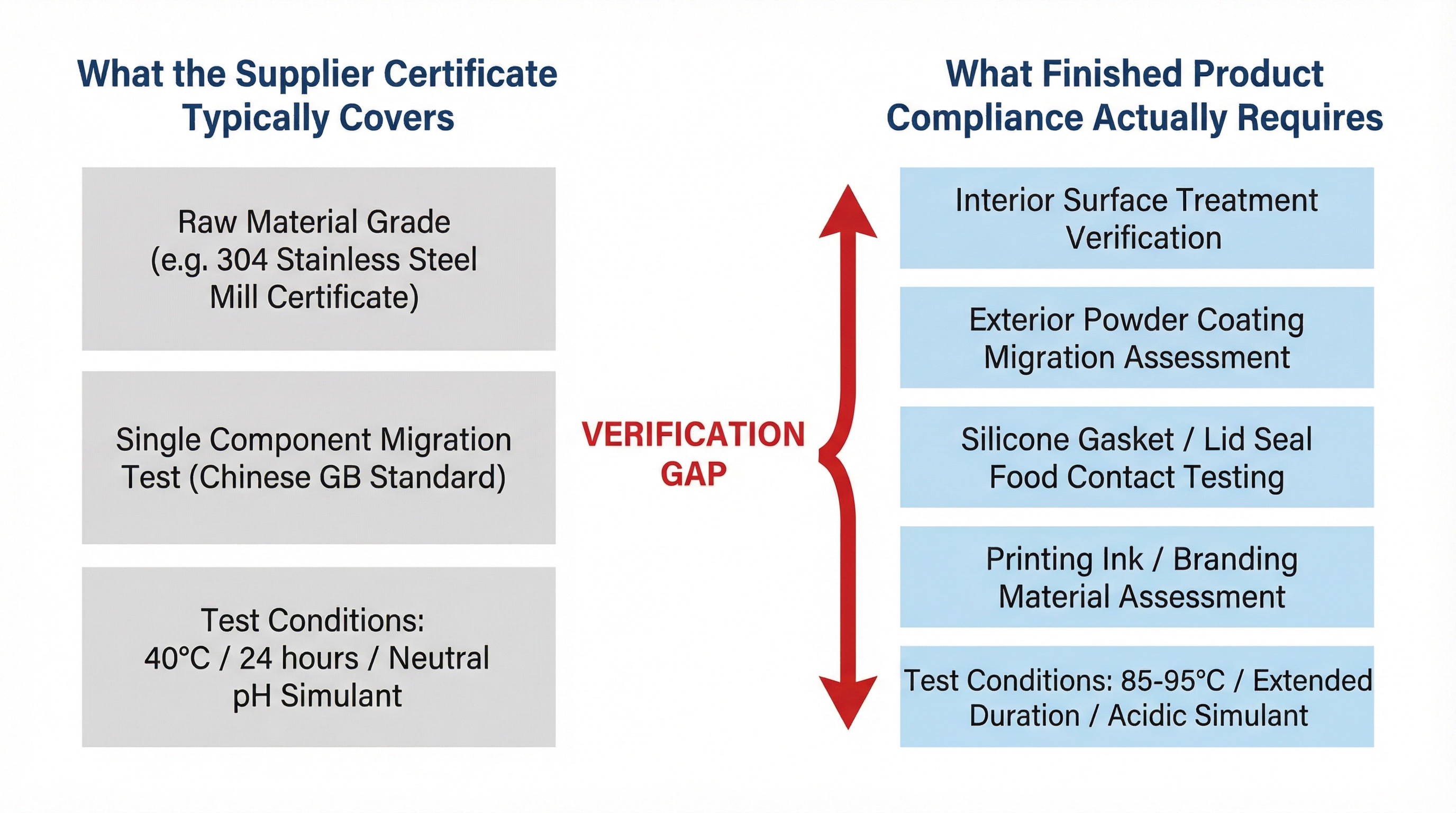
Why 'Food Grade' Claims on Corporate Drinkware Gifts Are Often Misunderstood in the New Zealand Market
A compliance-focused analysis of why procurement teams routinely accept supplier food-safety claims on corporate drinkware gifts without understanding what those claims actually cover—and what verification gaps remain under New Zealand's regulatory framework.
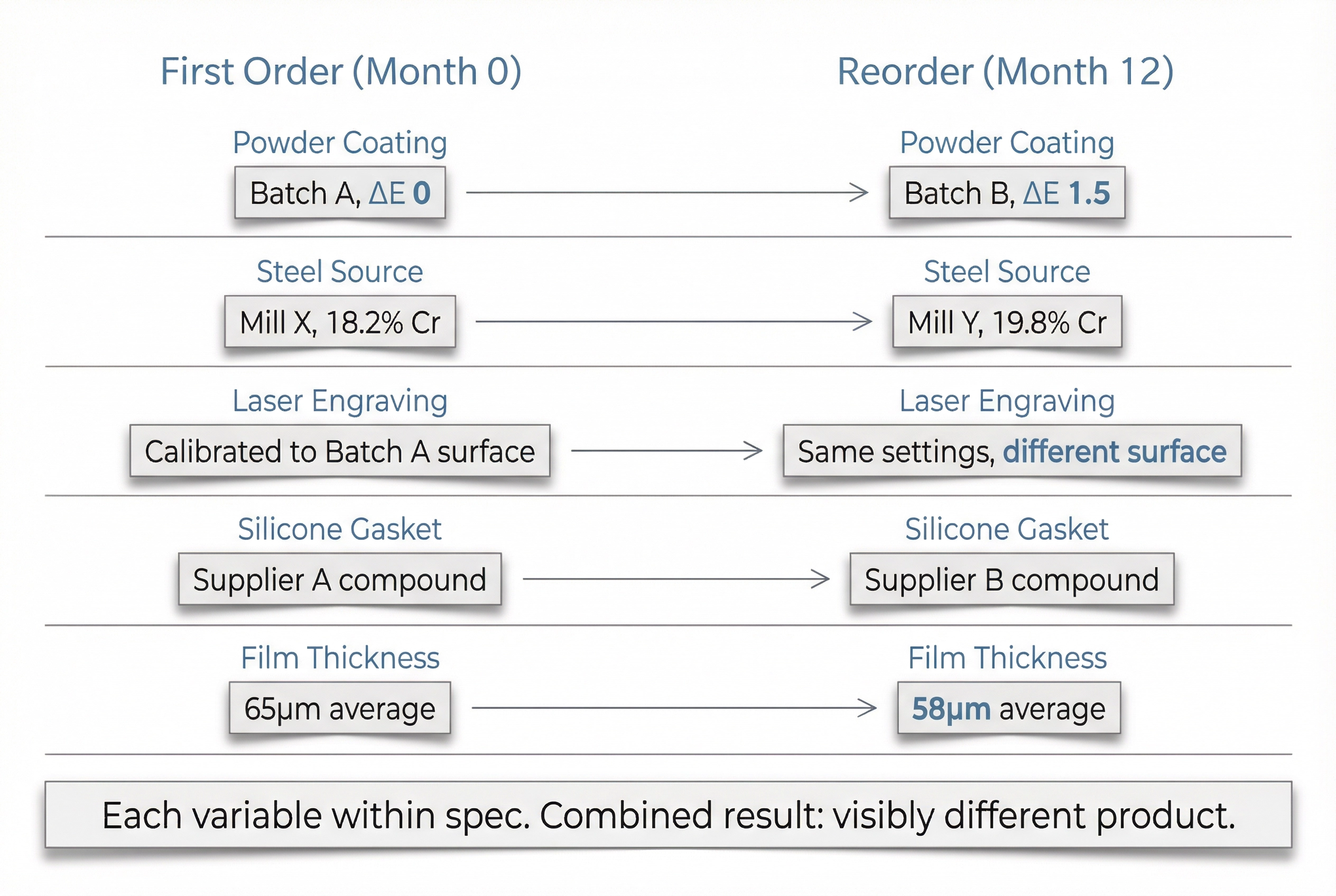
Why Reordering the Same Corporate Drinkware Gift Rarely Produces the Same Result
A production-side analysis of why repeat orders for branded corporate drinkware gifts introduce visible inconsistencies that procurement teams do not anticipate—and why the assumption that a successful first order guarantees an identical second batch is one of the most persistent misjudgments in corporate gift procurement.
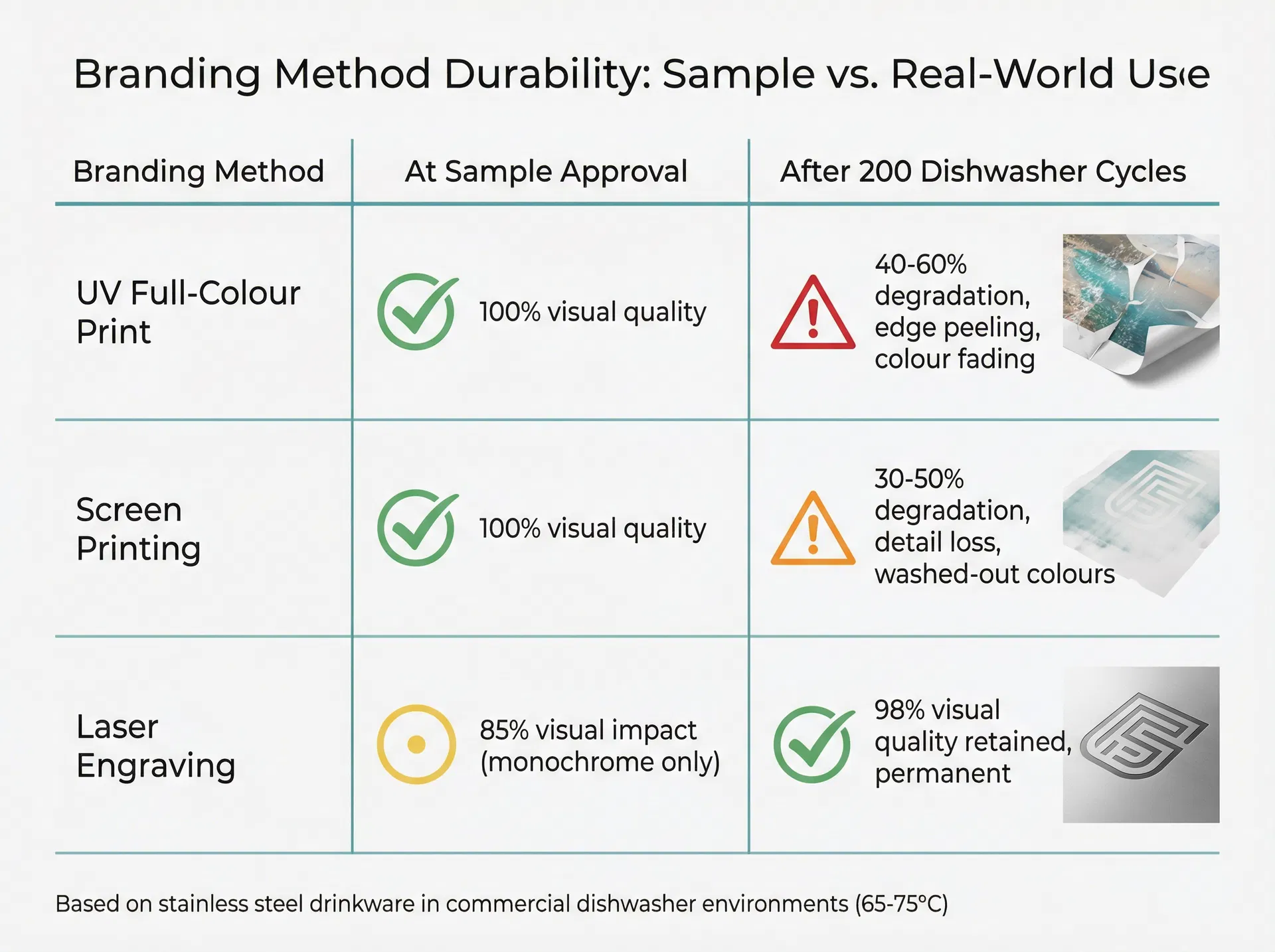
Why the Branding Method You Approved on a Sample May Fail in Real-World Use: Corporate Drinkware Gifts
The gap between how a branded drinkware sample looks in a conference room and how it performs after six months of daily use is one of the most overlooked misjudgments in corporate gift procurement.
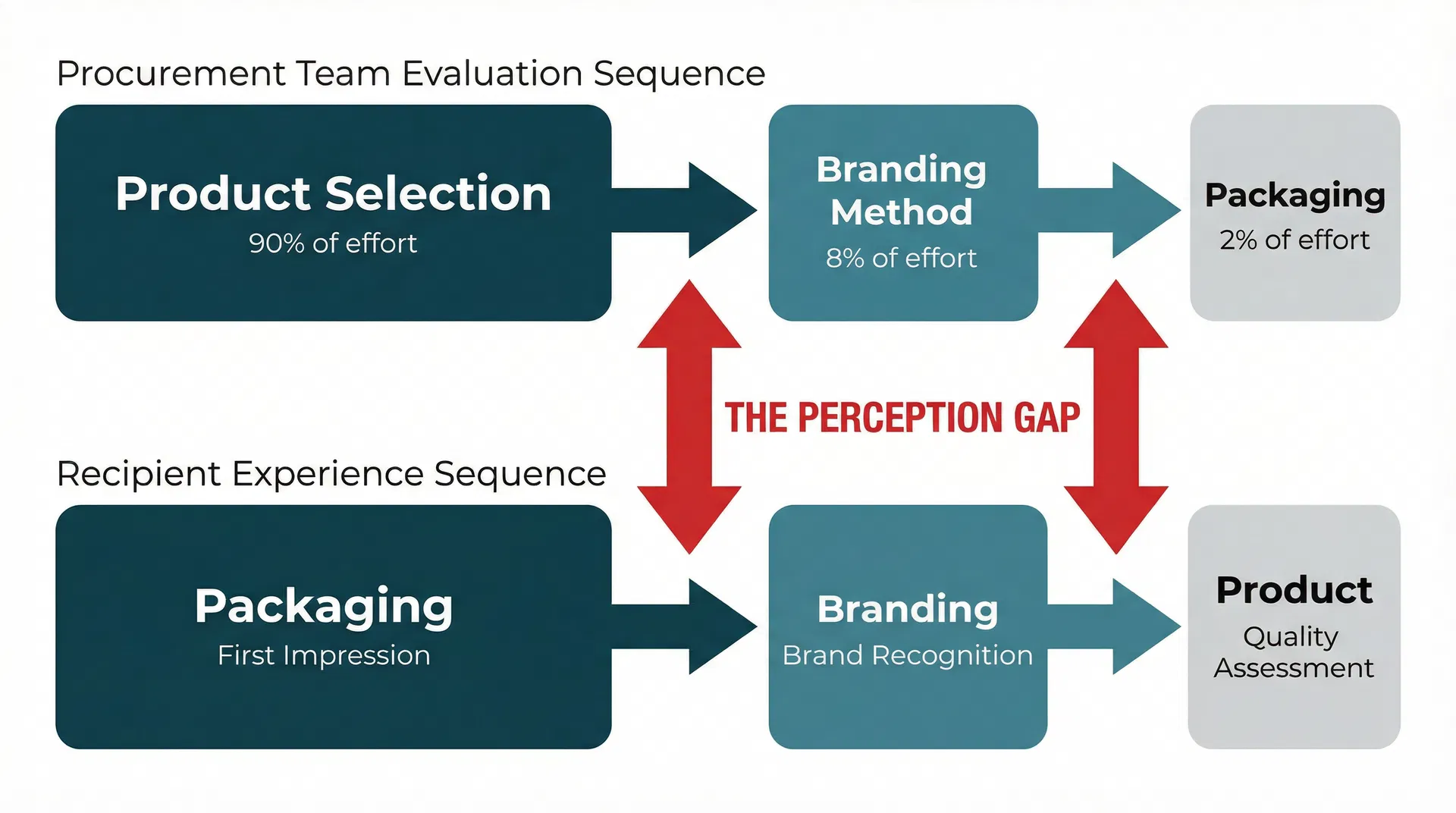
When the Packaging Is an Afterthought: How Presentation Gaps Undermine Corporate Drinkware Gift Investments
Packaging in corporate drinkware procurement is typically classified under logistics, not brand communication. This misclassification means the element that shapes the recipient’s first impression receives less than one percent of the total evaluation effort.
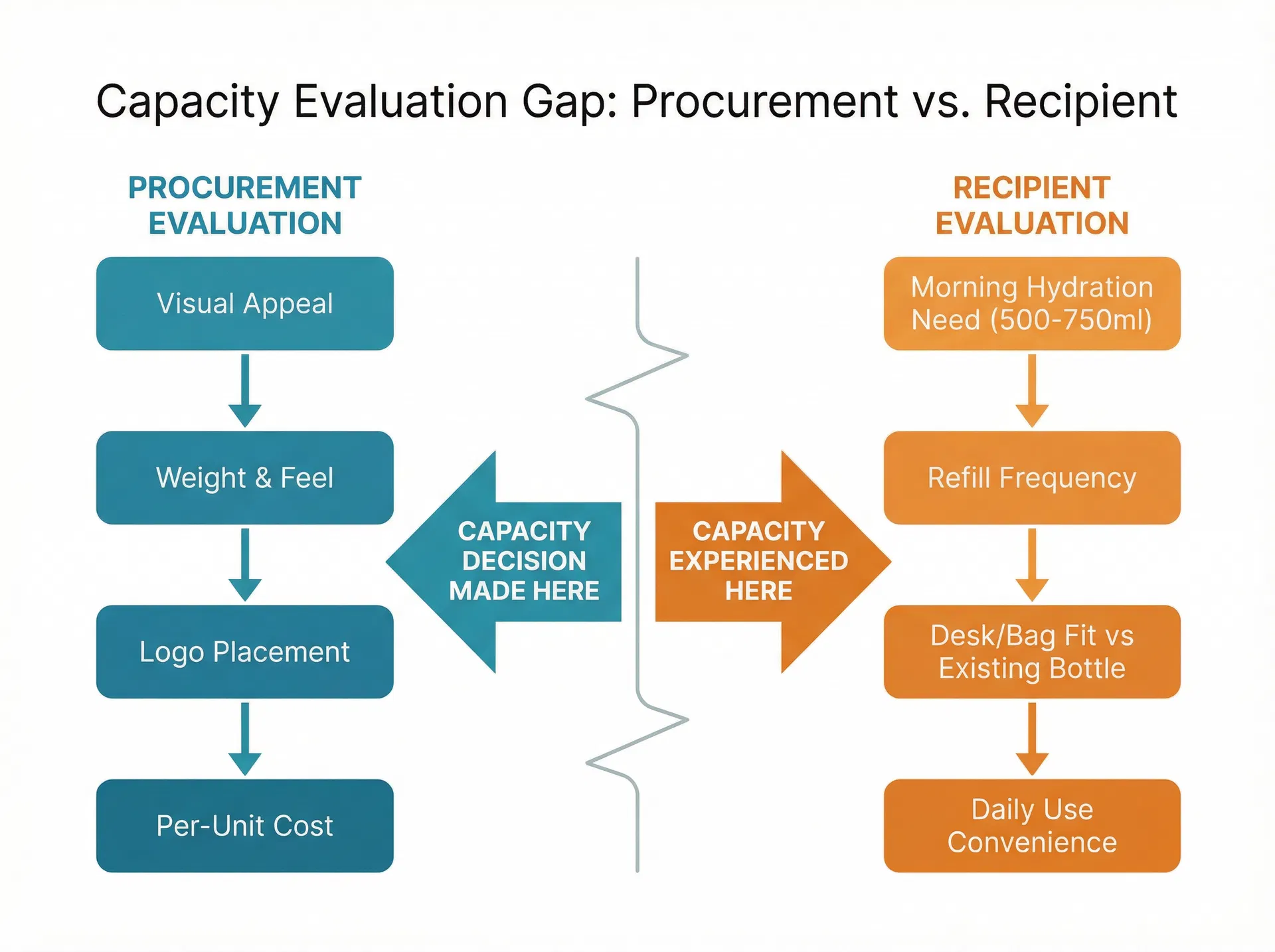
When Capacity Becomes the Reason Corporate Drinkware Gifts Go Unused
Why the most common capacity choice in corporate drinkware procurement — 350ml — leads to gifts that are politely received but rarely used, and how reframing the evaluation sequence around daily use scenarios changes the outcome.
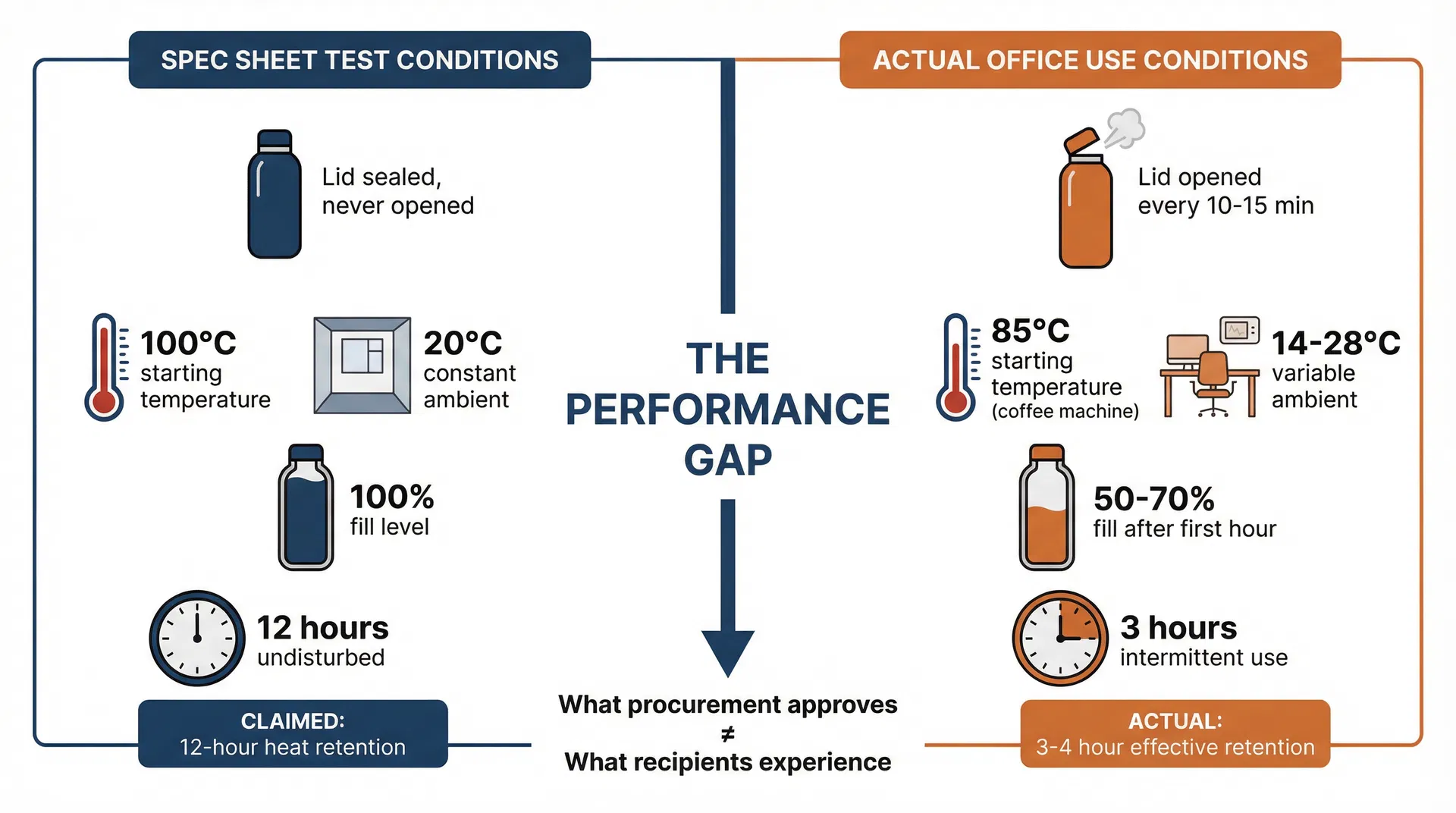
Why Insulation Performance Claims on Corporate Drinkware Gifts Rarely Match Daily Use Reality
The insulation duration printed on a supplier spec sheet is measured under sealed, undisturbed laboratory conditions that no office worker will ever replicate. Understanding the gap between tested performance and actual daily-use thermal retention is critical for corporate gift programmes where brand exposure depends on the recipient using the bottle every day.
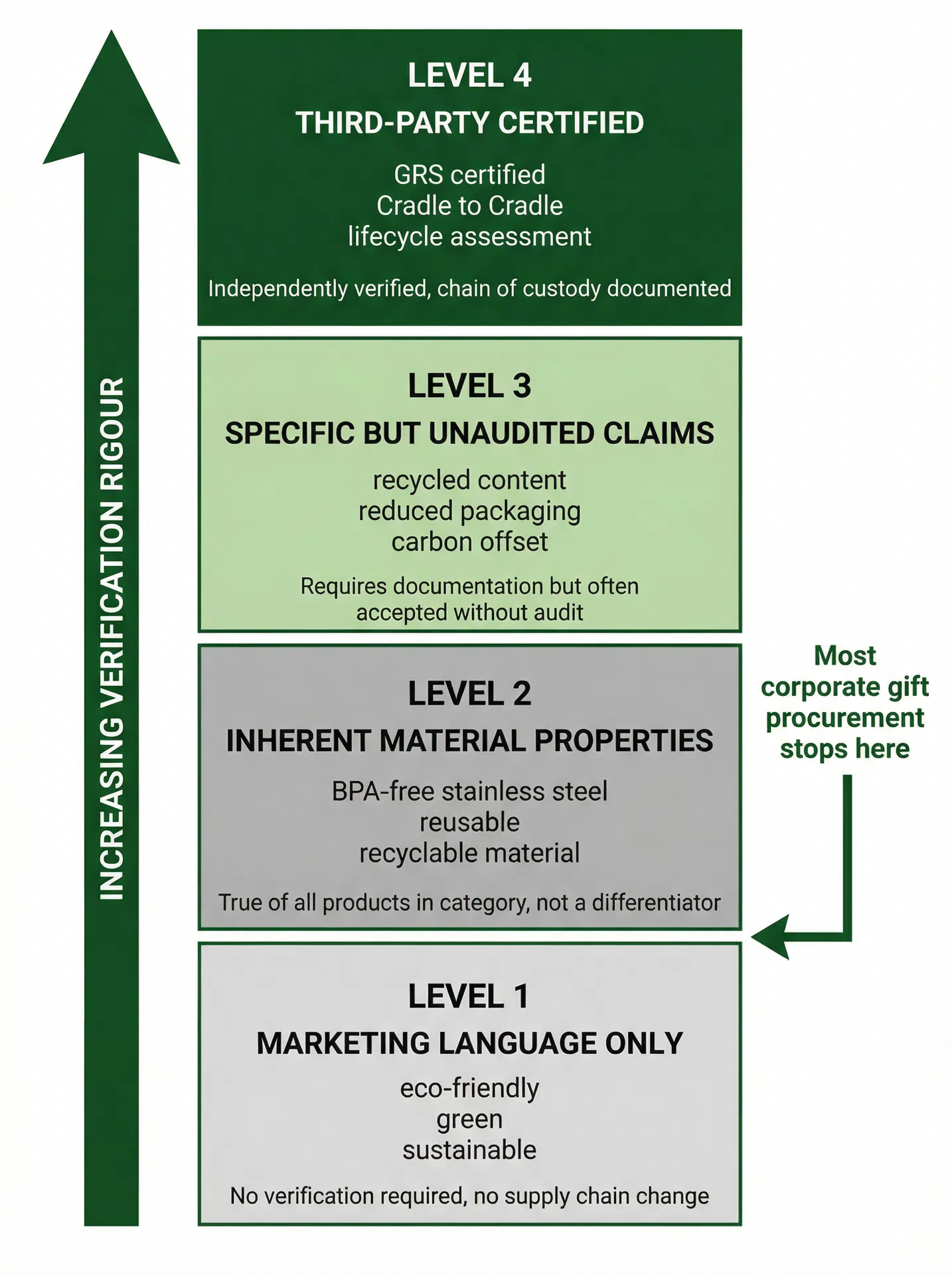
Why 'Eco-Friendly' Labels on Corporate Drinkware Gifts Often Survive Procurement but Not Scrutiny
Sustainability claims on corporate gift drinkware pass procurement filters because they capture language rather than evidence. Understanding the gap between marketing labels and verifiable environmental credentials prevents ESG reporting risk.
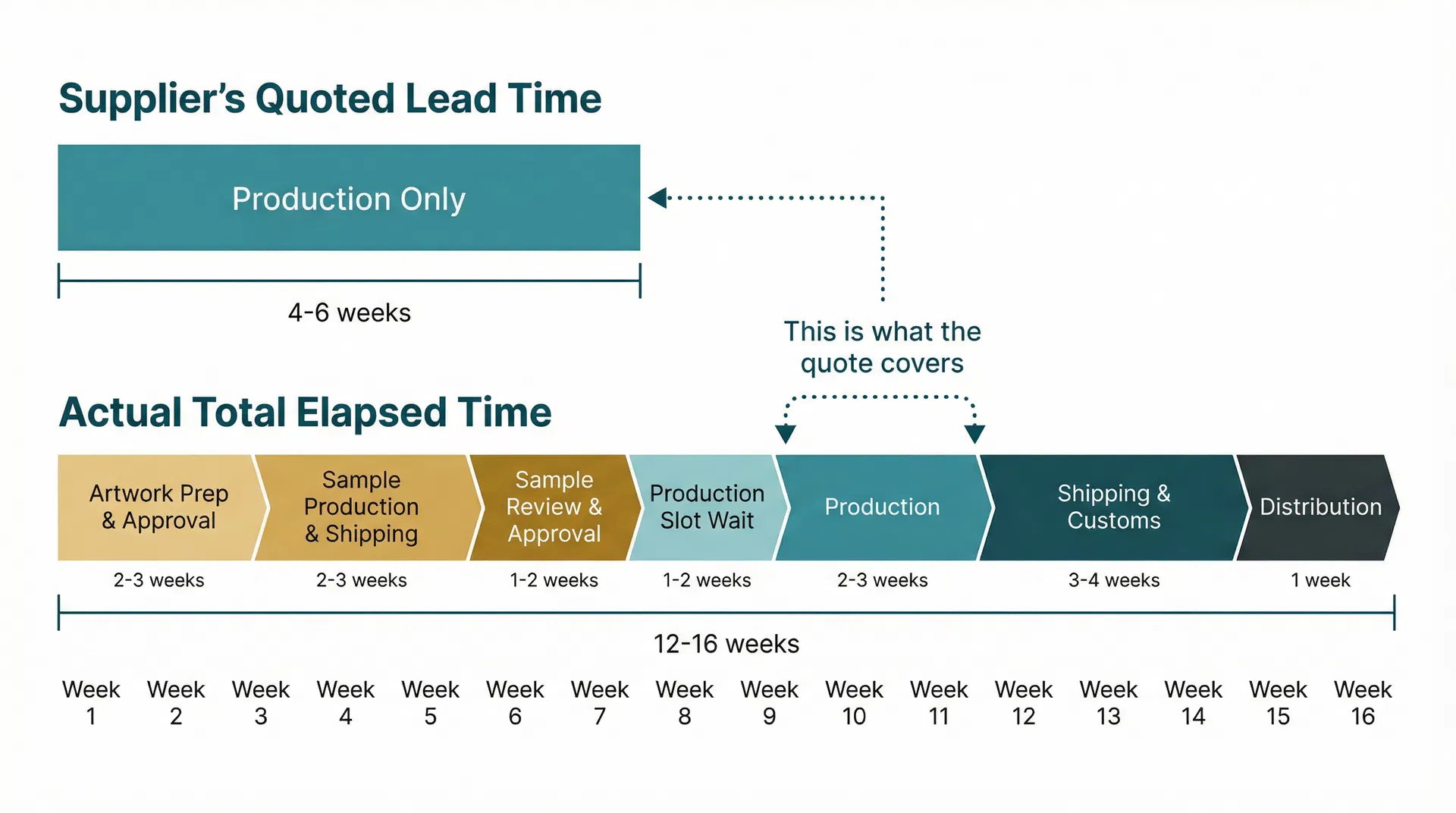
Why the Quoted Lead Time on Custom Drinkware Corporate Gifts Is Almost Never the Number That Matters
The four-to-six-week lead time quoted by suppliers covers production only. The actual elapsed time from enquiry to delivered corporate drinkware gifts is routinely ten to sixteen weeks, and the gap between these numbers is where gift programmes encounter their most avoidable failures.
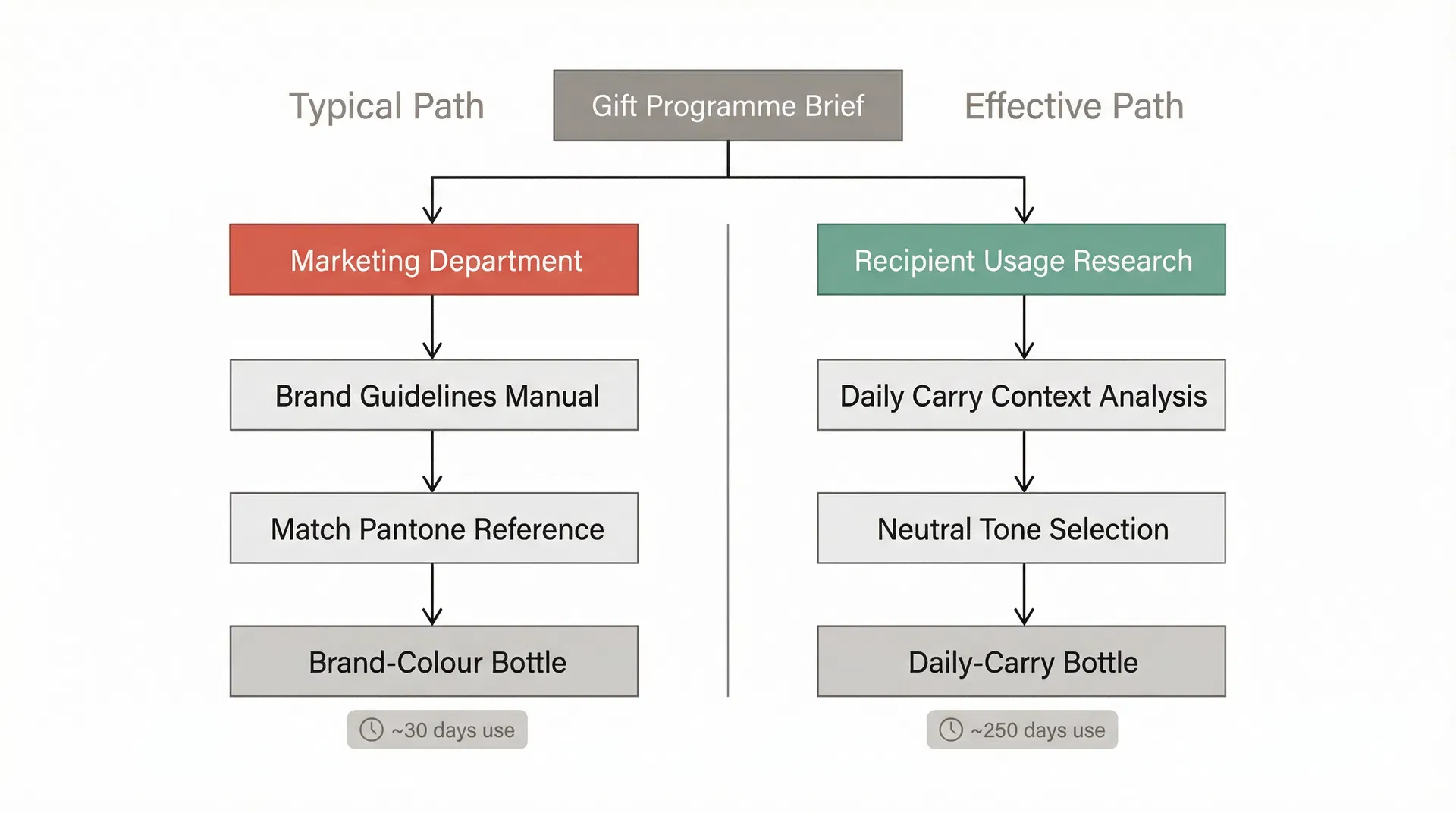
Why Brand-Colour Corporate Drinkware Gifts Cost More and Get Used Less
The colour decision for corporate drinkware gifts is typically driven by brand guidelines designed for signage and packaging. When applied to a personal daily-carry item, brand-primary colours signal 'promotional item' rather than 'personal choice,' suppressing the sustained daily use that determines whether the gift programme succeeds.
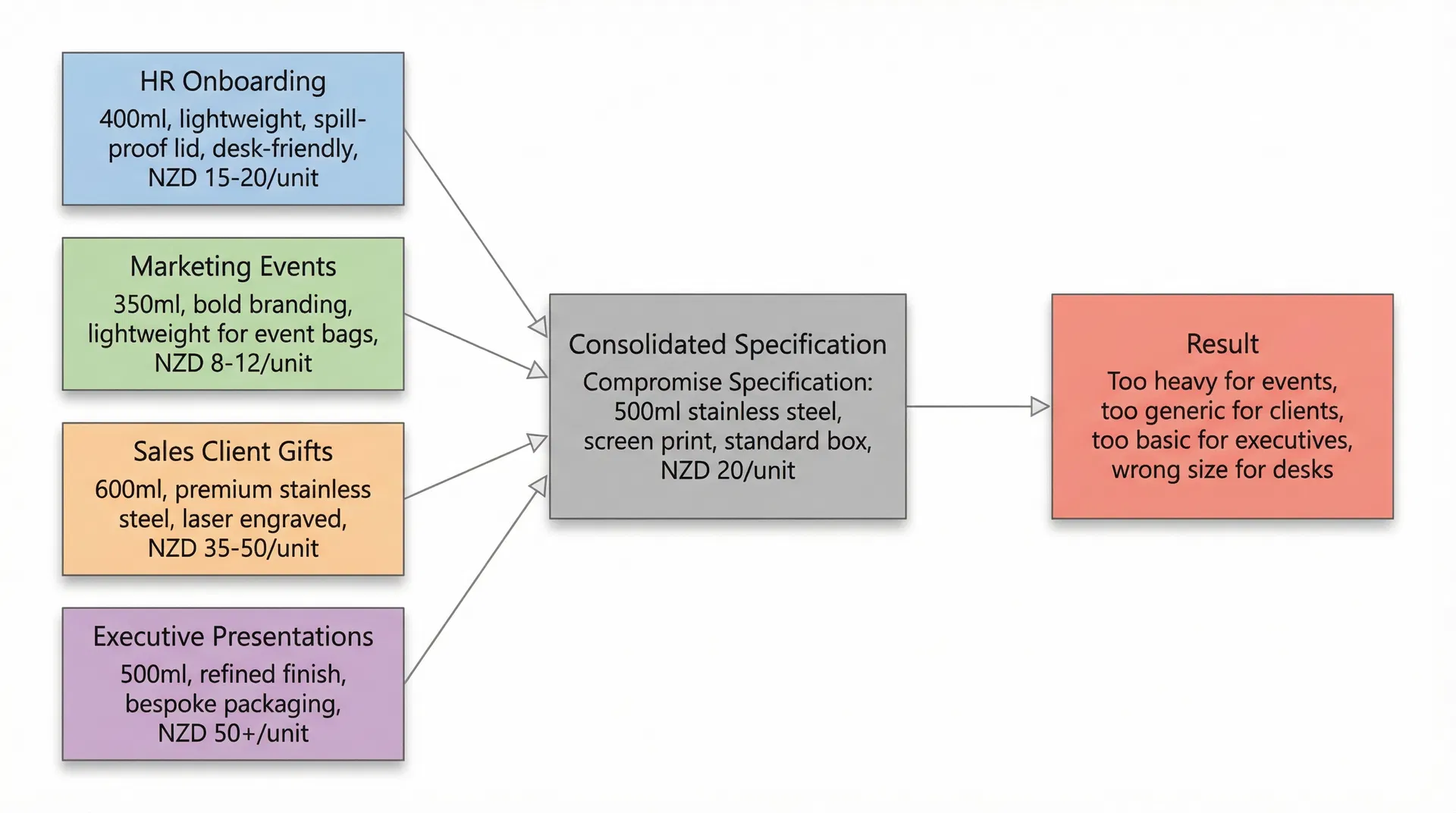
Why Consolidating Corporate Drinkware Gift Orders Across Departments Creates Specification Conflicts That Cost More Than Separate Orders
When multiple departments consolidate their corporate drinkware gift requirements into a single procurement order, the resulting compromise specification satisfies no department's actual needs. The material, branding, packaging, and budget-per-unit conflicts between HR onboarding, Marketing events, Sales client gifts, and executive presentations produce a generic product that triggers supplementary purchases exceeding the original consolidation savings.
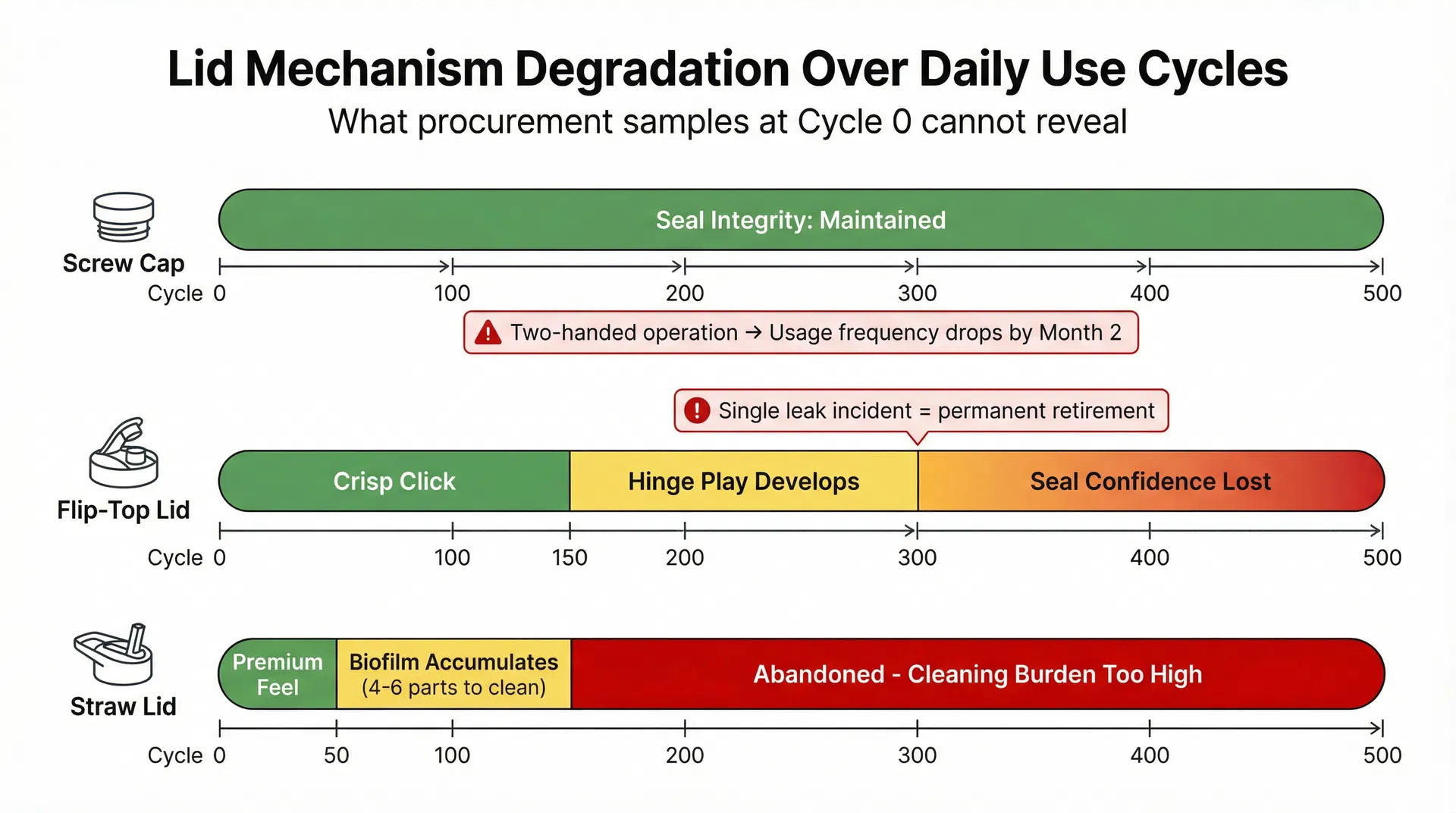
Why the Lid Mechanism Is the Most Overlooked Failure Point in Corporate Drinkware Gift Programmes
Procurement teams evaluate corporate drinkware gifts at cycle zero—when the lid is new, the gasket is fresh, and the mechanism snaps with precision. By cycle 300, the same lid exhibits gasket compression set, hinge fatigue, or cleaning complexity that drives recipients to abandon the bottle entirely. The lid is the primary user interface of any drinkware gift, yet it receives less specification attention than the body material or branding placement.
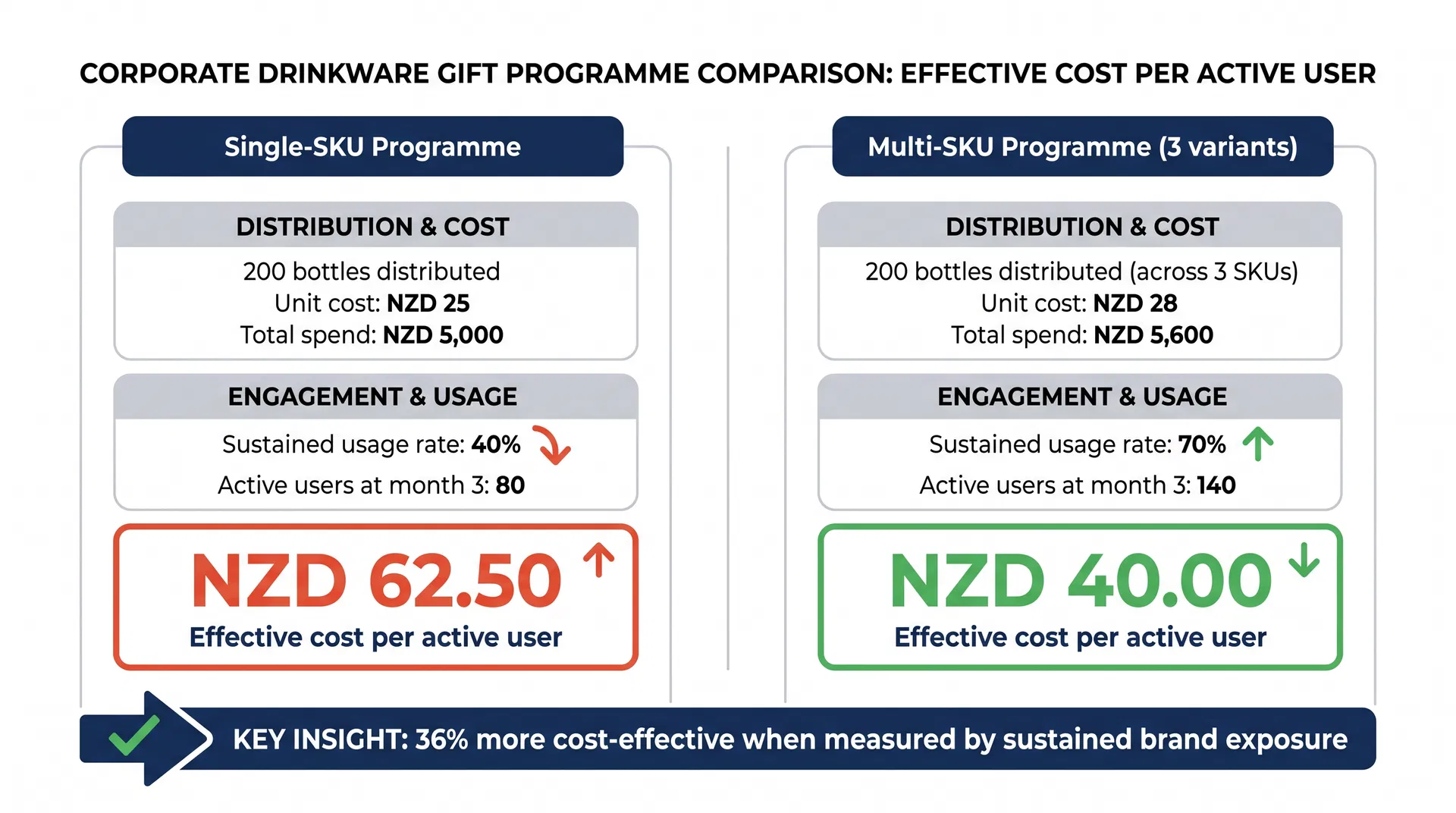
Why Recipient Demographic Assumptions Undermine Corporate Drinkware Gift Programme Effectiveness
Corporate gift procurement briefs describe recipient pools in aggregate terms that conceal the demographic variation determining whether a specific bottle specification will be used daily or stored in a drawer. The single-SKU approach that maximises volume discounts often produces sustained usage rates below 40 percent because it treats fundamentally different usage profiles as interchangeable.
Why Budget Cycle Timing Locks Corporate Drinkware Gift Specifications at the Moment of Least Information
The corporate gift type decision is typically made at the point of budget approval rather than at the point of actual need. This timing mismatch forces specifications to be locked six to eight months before distribution, during a period when recipient context, seasonal conditions, and business objectives are still abstract—producing gifts that satisfy budget compliance without generating sustained daily usage.
Why Gift Programme ROI Measurement Failures Create Invisible Cost Multipliers in Corporate Drinkware Initiatives
Corporate gift programmes are commonly treated as one-time procurement events rather than measurable business initiatives. Without effective ROI measurement frameworks, procurement teams lack the data needed to identify which gift types generate sustained recipient engagement, leading to repeated specification errors, budget waste accumulation, and hidden costs from failed programmes that compound across years.
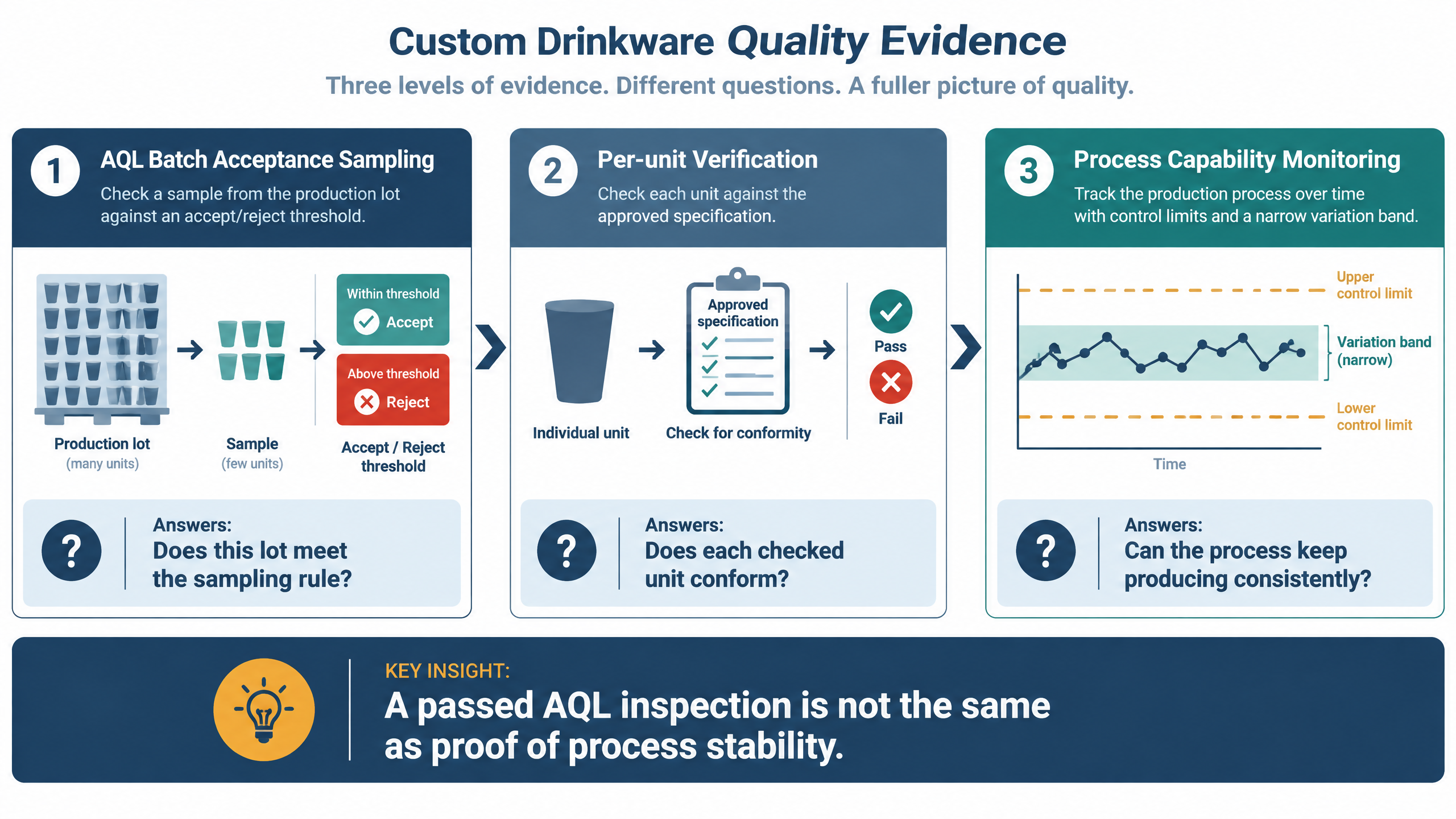
Why Passing an AQL Inspection Does Not Prove Custom Drinkware Quality Is Consistent
A passed pre-shipment AQL inspection confirms a sample-based lot decision, not uniformity across every custom drinkware unit. This procurement guide explains what AQL can prove, what it cannot, and which process evidence buyers should request.
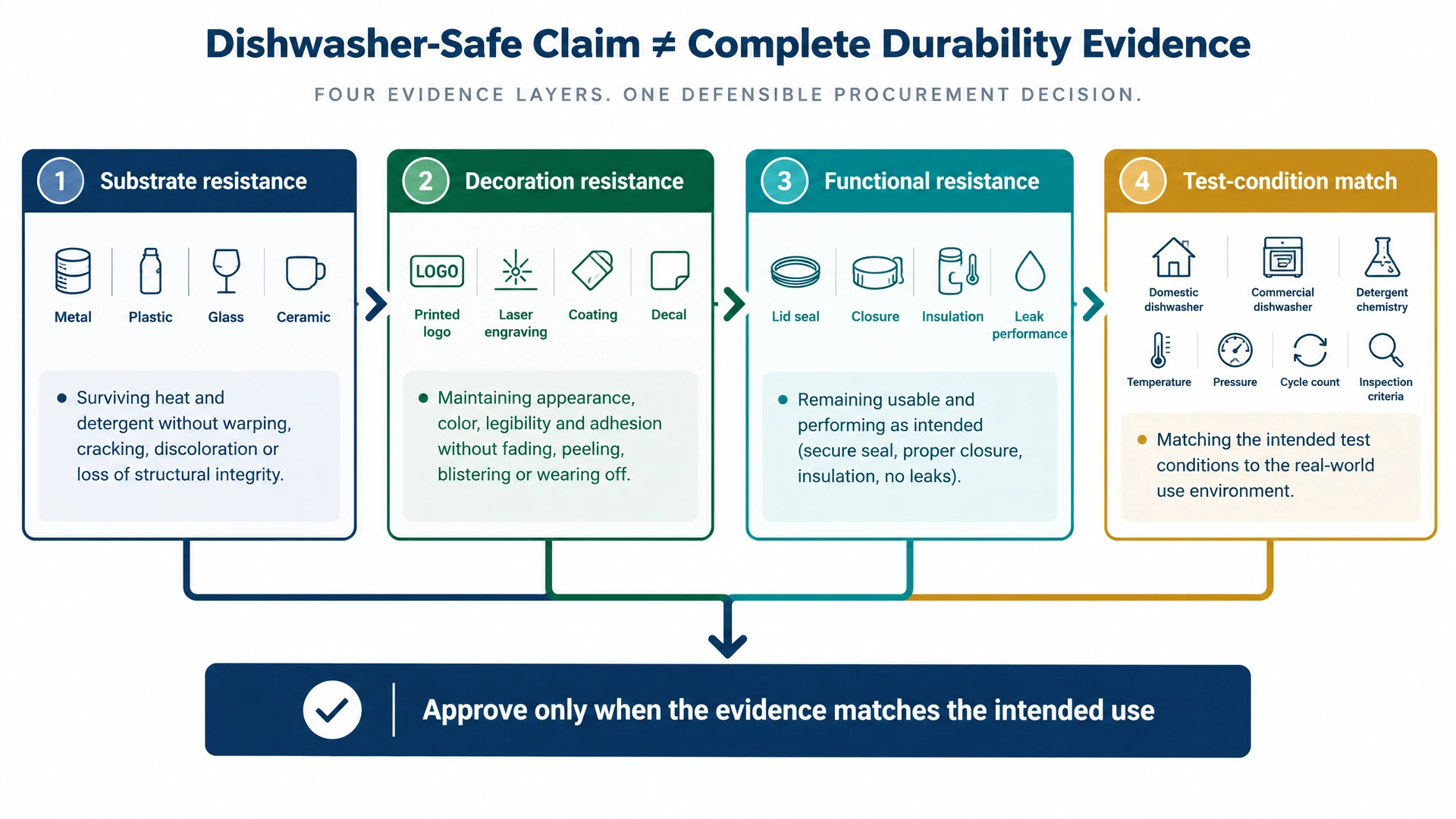
Why Dishwasher-Safe Claims Do Not Prove Custom Drinkware Branding Will Survive Daily Use
A dishwasher-safe claim can describe resistance of a defined product under defined conditions, but it does not automatically prove that logos, coatings, closures, and functions will survive a business's real cleaning environment. This procurement guide separates substrate, decoration, function, and test-condition evidence so buyers can assess custom drinkware durability without overextending a catalogue claim.
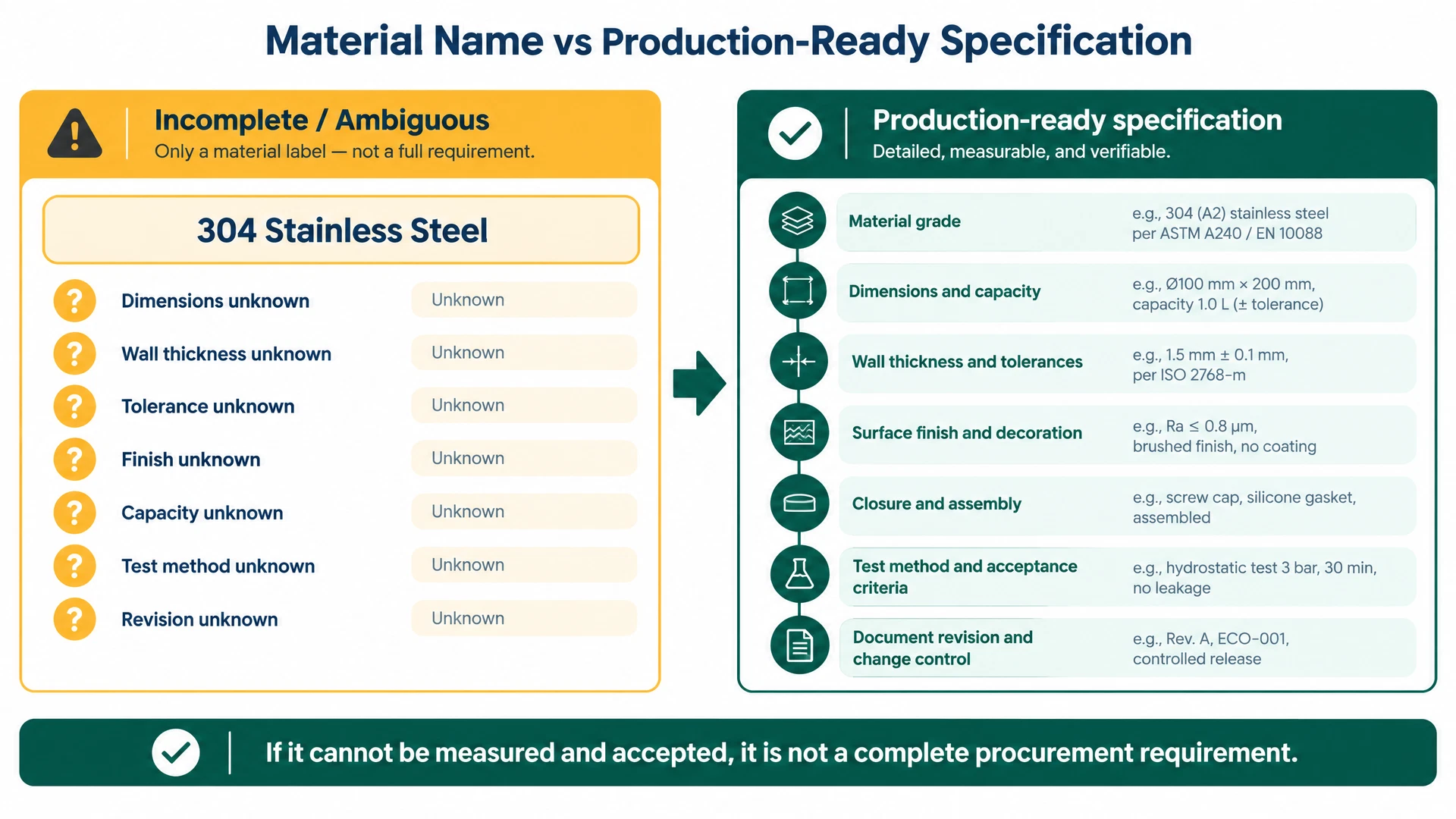
Why a Material Name Alone Cannot Protect Custom Drinkware Quality
A material grade identifies composition, but it does not define the dimensions, tolerances, finish, assembly, testing, or revision controls required to manufacture consistent custom drinkware. This procurement guide explains how to turn a material label into a measurable production specification.
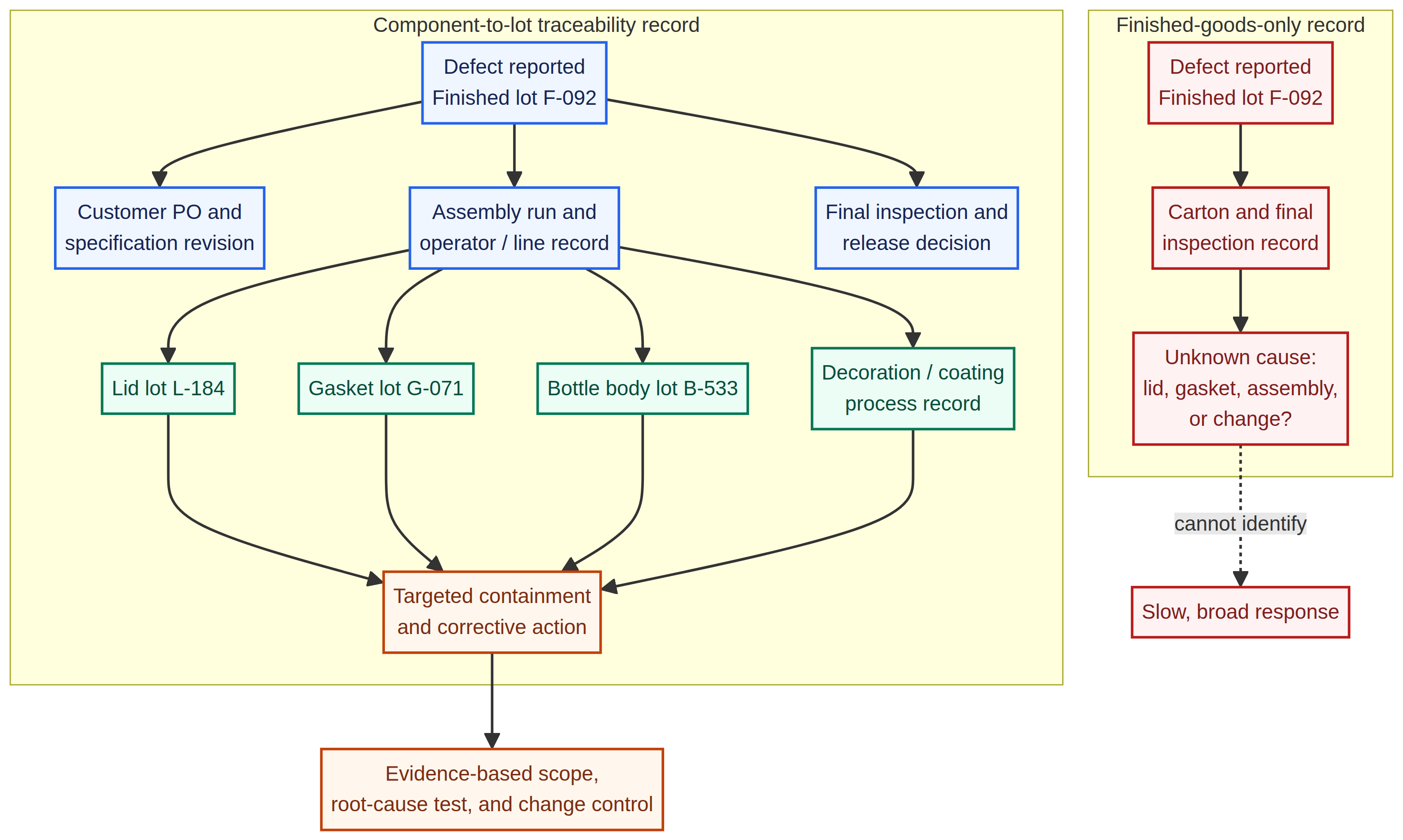
Why Finished-Goods Inspection Cannot Replace Component Traceability in Custom Drinkware
Finished-goods inspection can identify a defect, but it cannot reveal which lid, gasket, assembly run, or process change caused it. Learn how proportionate component traceability supports faster containment and defensible corrective action.
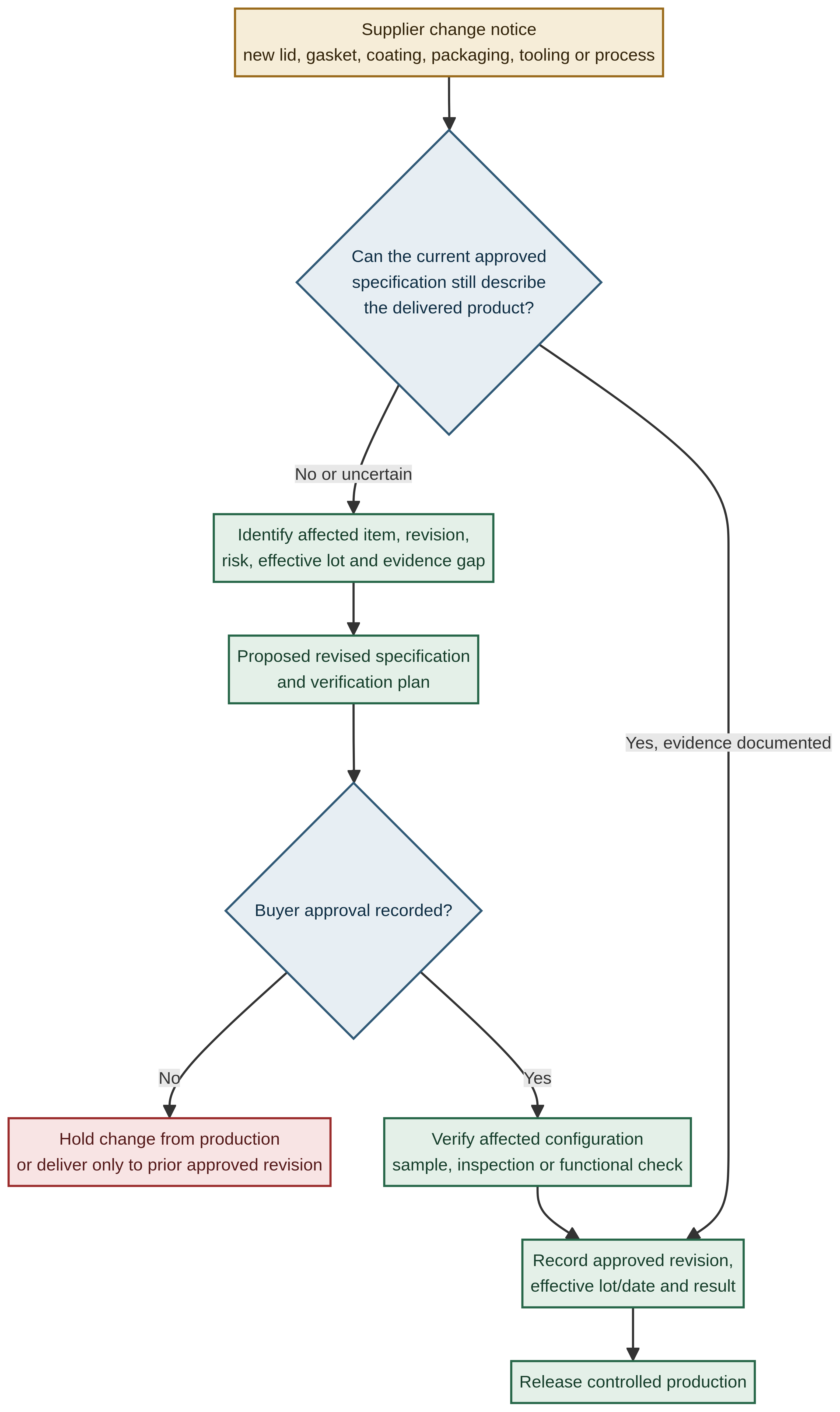
Why a Supplier Change Notice Is Not Buyer-Approved Change Control in Custom Drinkware
A supplier notice can explain that a lid, gasket, coating, packaging, tooling, or process will change. It does not prove that the buyer assessed the impact, approved a revised requirement, verified the affected configuration, or knows which production lot received it. This guide explains the controls that turn notice into an accountable procurement decision.

Why an Approved Sample Does Not Prove Bulk Custom Drinkware Will Match It
An approved sample is valuable visual and functional evidence, but it does not prove that normal bulk production will use the same configuration, materials, components, tooling, process conditions, or acceptance controls. This guide explains the evidence bridge that turns sample approval into a defensible production decision.

Why a Food-Contact Test Report Does Not Automatically Cover Every Custom Drinkware Configuration
A food-contact test report is evidence for the article, materials, conditions, method, and acceptance basis it identifies. It does not automatically extend to a different lid, gasket, coating, decoration, assembly, intended use, or supplier substitution. This guide explains how buyers can test the relevance of the evidence before release.

Why a Digital Artwork Proof Does Not Prove Custom Drinkware Colour Will Match Production
A digital artwork proof confirms a version, placement, and intended appearance on a specified screen or proofing context. It does not by itself prove that the final bottle, tumbler, cup, or mug will reproduce the same perceived colour. This guide explains how to connect digital approval with a physical production reference.

Why “Centre the Logo” Is Not a Production-Ready Placement Specification for Custom Drinkware
“Centre the logo” communicates design intent, but it does not tell a factory or inspector which surface, origin, orientation, logo feature, zone, or variation is acceptable. This guide shows how to turn a visual instruction into a repeatable placement decision for custom drinkware.

Why “Gift Box Included” Is Not a Delivery-Ready Packaging Specification for Corporate Drinkware
A gift box describes one presentation component, not the finished shipping configuration. This guide explains the product, insert, closure, case-pack, handling, distribution, and acceptance details that make corporate drinkware packaging repeatable.

Why a Recipient Address List Is Not a Delivery Specification for Corporate Drinkware Gifts
A spreadsheet with names, phones, and addresses is an input—not a complete multi-address delivery plan. This guide shows the allocation, validation, dispatch, exception, return, and data-minimisation controls that make corporate drinkware gifting traceable.

Why a Carrier “Delivered” Scan Does Not Prove a Corporate Drinkware Gift Programme Is Complete
A carrier delivery event is valuable evidence, but it does not automatically prove the intended gift outcome or close programme exceptions. This guide explains how to connect a released allocation, delivery-service evidence, exceptions, and a proportionate completion decision.

Why a Returned Corporate Drinkware Gift Is Not Automatically Ready to Resend
A returned corporate gift is evidence of a return event—not automatic approval to send the same unit to someone else. This guide shows how to decide redirection, resend, re-pack, reallocation, or withdrawal without losing control of the original campaign record.