How Long Does It Take to Produce Custom Drinkware for New Zealand Businesses?
Key procurement answer
Custom drinkware production timelines in New Zealand range from 10 working days for stock items with logo printing to 60-90 working days for fully custom designs requiring new tooling. The timeline depends on three critical factors: order complexity, order size, and shipping method...
# How Long Does It Take to Produce Custom Drinkware for New Zealand Businesses?
> **Expert Quick Answer**: Custom drinkware production timelines in New Zealand range from **10 working days** for stock items with logo printing to **60-90 working days** for fully custom designs requiring new tooling. The timeline depends on three critical factors: **order complexity** (stock vs semi-custom vs fully custom), **order size** (500 units vs 10,000+ units), and **shipping method** (air vs sea freight from Asia). For most corporate orders using semi-custom designs, expect **35-45 working days** from order confirmation to delivery in Auckland or Wellington.
When a marketing manager asks "How long until we have these branded water bottles for our conference?", the answer is rarely simple. In our fifteen years advising New Zealand enterprises on promotional drinkware procurement, we have observed that **timeline miscalculation accounts for approximately 65% of missed event deadlines**—not supplier failures, not shipping delays, but buyers underestimating the true production window.
The challenge is that "production time" is not a single number. It is a sequence of interdependent phases, each with its own duration, risk factors, and decision points. A stock stainless steel tumbler with laser engraving might reach your Auckland warehouse in twelve working days. A fully custom vacuum bottle with proprietary lid design, custom Pantone color, and compliance testing could require ninety days. Both are "custom drinkware," but their timelines differ by a factor of seven.
This guide provides the decision framework New Zealand procurement teams need to accurately forecast lead times, identify hidden delays, and choose the right production pathway for their budget and deadline constraints.
---
## Why Custom Drinkware Lead Time Is a Critical Decision Variable for NZ Enterprises
Lead time is not merely a logistical detail—it is a strategic constraint that shapes three core business outcomes: **budget allocation**, **brand execution**, and **operational risk**.
From a budget perspective, shorter lead times typically command premium pricing. Rush production services from Asian manufacturers often carry surcharges of 30-50% above standard rates, and air freight from Guangzhou to Auckland costs approximately NZ$8-12 per kilogram compared to NZ$1.50-2.50 per kilogram for sea freight. A 5,000-unit order of stainless steel bottles weighing 350 grams each translates to 1,750 kilograms—the freight cost difference alone exceeds NZ$10,000. Enterprises that plan lead times accurately can avoid these premiums entirely.
Brand execution depends on synchronizing product delivery with marketing campaigns, trade show schedules, or new hire onboarding cycles. We have seen Wellington-based technology firms order custom drink bottles for a product launch, only to receive them three weeks after the event because they calculated "four weeks production" without accounting for Chinese New Year factory shutdowns or Auckland port congestion during December. The bottles arrived in perfect condition, but the marketing moment had passed.
Operational risk manifests when procurement teams fail to build buffer time into their schedules. A single quality failure during trial production—such as a powder coating batch that does not meet the specified Pantone color—can add 10-14 days to the timeline while the factory reruns the coating process. Material shortages, particularly for 304-grade stainless steel during global supply disruptions, can extend raw material procurement by an additional two weeks. Buyers who understand these risk scenarios plan for 20% buffer time on first-time orders and 10% buffer on repeat orders with proven suppliers.
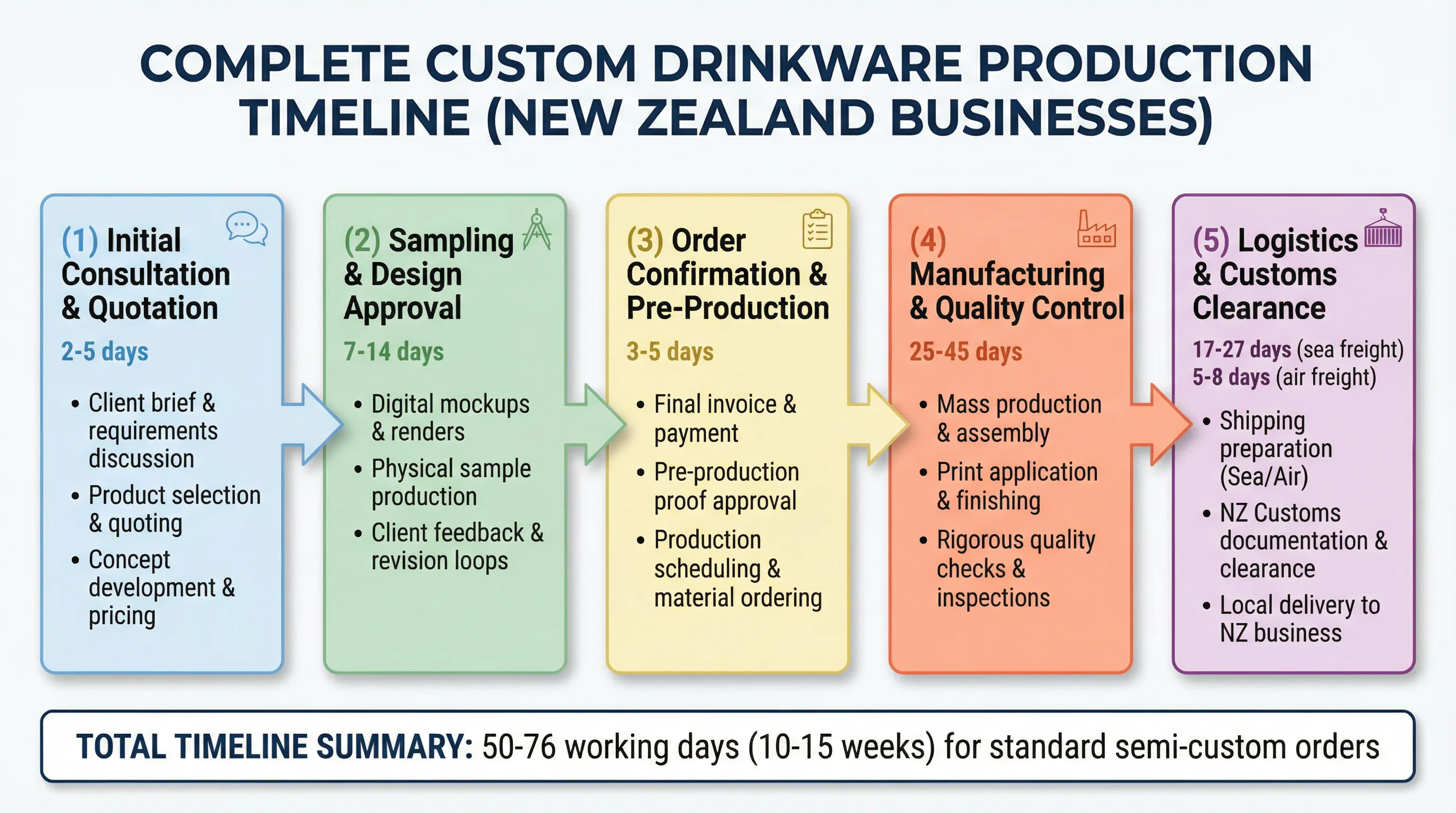
The distinction between "production time" and "total lead time" is where many New Zealand buyers encounter their first miscalculation. Production time refers strictly to the manufacturing window—from raw material cutting to final packaging—and typically ranges from 25 to 45 working days for semi-custom drinkware. Total lead time includes pre-production phases (sampling, artwork approval, compliance testing) and post-production logistics (sea freight, customs clearance, domestic delivery). For a standard corporate order shipped from Guangzhou to Auckland, the complete timeline breaks down as follows:
- **Pre-production**: 7-14 days (sampling and approval)
- **Production**: 25-35 days (manufacturing and quality control)
- **Shipping**: 15-20 days (sea freight to Port of Auckland)
- **Customs clearance**: 2-4 days (longer if biosecurity inspection required)
- **Domestic delivery**: 1-3 days (Auckland to final destination)
**Total lead time**: 50-76 working days, or approximately 10-15 calendar weeks.
This calculation assumes no delays. In practice, we recommend adding 10-15 days of buffer time to account for artwork revision cycles, public holidays in China (Chinese New Year, Golden Week), and New Zealand's summer business slowdown from mid-December through late January.
For enterprises planning large drinkware orders, understanding [minimum order quantities](/blog/minimum-order-quantity-custom-drinkware) is equally critical, as MOQ requirements directly affect production scheduling and timeline feasibility.
---
## How New Zealand Enterprises Actually Procure Custom Drinkware: The Real-World Process
The textbook procurement process—request quote, approve sample, place order, receive goods—rarely matches the reality of custom drinkware sourcing. In our experience working with Auckland corporates, Wellington government agencies, and Christchurch event organizers, the actual workflow involves five distinct phases, each with execution challenges that extend timelines if not managed proactively.
**Phase 1: Initial Consultation and Quotation (2-5 working days)**. The buyer submits an inquiry specifying approximate quantity, preferred product type (e.g., 500ml vacuum bottles), decoration method (laser engraving vs screen printing), and target in-hands date. The supplier responds with a quotation, but this is where the first timeline trap appears. Many New Zealand buyers provide incomplete artwork files—JPEG logos instead of vector AI or EPS files—or fail to specify Pantone color codes for custom powder coating. Suppliers then request revised files, adding 3-5 days to the quotation phase. Best practice: prepare vector artwork and Pantone specifications before initiating the RFQ process.
**Phase 2: Sampling and Design Approval (7-14 working days)**. For semi-custom or fully custom orders, the factory produces a physical sample and couriers it to New Zealand. Express courier from Guangzhou to Auckland typically requires 3-4 working days. The buyer reviews the sample for color accuracy, logo placement, and build quality, then either approves or requests modifications. Modification cycles—such as adjusting logo size or changing powder coating color—add another 7-10 days per iteration. We have observed Auckland-based buyers cycle through three sample revisions, extending this phase to six weeks. The hidden cost here is not just time but also the opportunity cost of delayed market entry.
**Phase 3: Order Confirmation and Pre-Production (3-5 working days)**. Once the sample is approved, the buyer issues a purchase order and pays the deposit (typically 30-50% of total order value). The supplier schedules the order into the production queue and procures raw materials. For standard 304 stainless steel and common Pantone colors, material procurement is straightforward. However, if the buyer specifies 18/8 food-grade stainless steel with a custom metallic finish, the factory may need to order specialty materials, adding 10-15 days. This is a decision point where buyers can trade uniqueness for speed: choosing from the factory's existing color palette eliminates custom material lead time.
**Phase 4: Manufacturing and Quality Control (25-45 working days)**. This is the core production window, and its duration depends on order complexity and size. A 1,000-unit order of stock-design bottles with laser engraving requires approximately 25 working days. A 10,000-unit order of fully custom bottles with new mold tooling, custom powder coating, and proprietary lid mechanisms requires 60-75 working days. The manufacturing process for stainless steel vacuum bottles follows a fixed sequence: steel tube cutting and hydroforming (5-7 days), vacuum welding and sealing (3-5 days), electrolysis polishing (2-3 days), powder coating and curing (5-7 days), logo application (3-5 days), lid assembly and packaging (3-5 days). Factories cannot compress these timelines significantly because each phase involves chemical or thermal processes with mandatory curing periods.
**Phase 5: Logistics and Customs Clearance (17-27 working days for sea freight, 5-8 working days for air freight)**. Once production is complete, the goods are palletized and shipped. Sea freight from Guangzhou or Ningbo to Port of Auckland requires 15-20 working days, depending on vessel schedules and whether the shipment is full container load (FCL) or less than container load (LCL). Air freight reduces transit to 3-5 working days but costs 4-6 times more. Upon arrival in New Zealand, goods clear customs in 2-4 working days unless flagged for biosecurity inspection, which can add another 3-7 days. Domestic delivery from Auckland port to Wellington or Christchurch adds 1-3 working days.
The execution difficulty that New Zealand buyers consistently underestimate is the **artwork approval bottleneck**. In approximately 40% of the corporate orders we have reviewed, the buyer's internal approval process—routing the sample through marketing, legal, and executive stakeholders—consumed 10-20 working days. This delay sits entirely on the buyer's side, yet it extends the total lead time just as effectively as a factory delay. Enterprises that establish clear internal approval workflows and designate a single decision-maker for sample sign-off can eliminate this bottleneck entirely.
Another New Zealand-specific consideration is the **summer business slowdown**. Many Auckland and Wellington corporates operate on skeleton staff from mid-December through late January, which means sample approvals and purchase order processing stall during this period. If your target in-hands date is early February (for example, for a March conference), you must initiate the procurement process no later than early November to account for both the Christmas shutdown and the standard 10-12 week lead time.
---
Complete production timeline breakdown: from initial consultation (2-5 days) through manufacturing (25-45 days) to NZ customs clearance, totaling 50-76 working days for standard semi-custom orders
## The Three Decision Factors That Determine Your Custom Drinkware Lead Time
Lead time is not a fixed attribute of a product—it is an outcome of three interdependent variables: **order complexity**, **order size**, and **shipping method**. Understanding how these factors interact allows procurement teams to make informed trade-offs between speed, cost, and customization depth.
**Order Complexity: Stock vs Semi-Custom vs Fully Custom**
The single largest determinant of lead time is whether you are ordering a stock item with logo decoration, a semi-custom product with modifications to an existing design, or a fully custom product requiring new tooling.
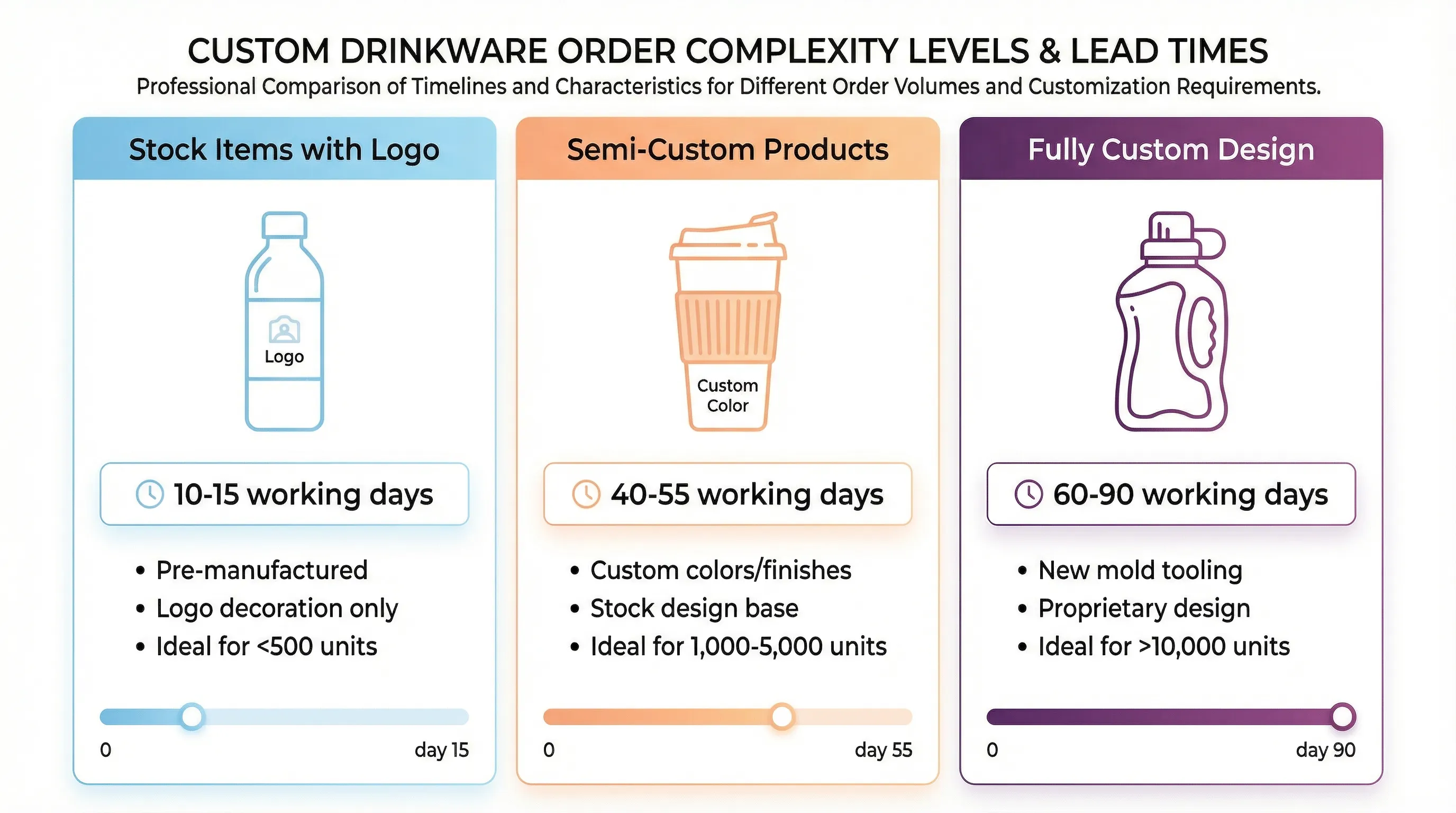
**Stock items with logo** are pre-manufactured bottles held in New Zealand-based inventory by local distributors. The supplier applies your logo via laser engraving, screen printing, or UV printing, then ships within 10-15 working days. This pathway is ideal for orders under 500 units with tight deadlines (e.g., a corporate event in six weeks). The trade-off is limited design flexibility—you choose from existing shapes, colors, and capacities. For Auckland-based enterprises needing 300 branded bottles for a trade show, this is often the optimal pathway.
**Semi-custom products** involve selecting a stock bottle design but customizing the color, finish, or lid type. For example, you might choose a 750ml vacuum bottle from the factory's catalog but request a custom Pantone 2728C blue powder coating and a bamboo lid instead of the standard plastic lid. This requires the factory to run a custom coating batch and source specialty lids, extending the timeline to 25-35 working days for production, plus 15-20 days for sea freight from China. Total lead time: 40-55 working days, or approximately 8-11 calendar weeks. This pathway suits orders of 1,000-5,000 units where brand color consistency is critical but a proprietary bottle shape is not required.
**Fully custom products** involve designing a unique bottle shape, which requires new mold tooling. The factory's engineering team creates 3D CAD drawings, builds the mold (15-25 working days), produces trial samples, and conducts lab testing for insulation performance, sealing integrity, and material compliance (10-15 working days). Mass production then proceeds as normal (25-35 working days). Total lead time for fully custom orders: 60-90 working days, or approximately 12-18 calendar weeks. This pathway is justified for orders exceeding 10,000 units or for brands seeking a proprietary product that competitors cannot replicate. The upfront tooling cost—typically NZ$4,000-$10,000—must be amortized across the order volume, which is why fully custom designs are economically viable only at scale.
Order complexity directly determines lead time: stock items (10-15 days), semi-custom (40-55 days), and fully custom (60-90 days) each serve different volume and customization requirements
The decision framework here is straightforward: if your deadline is less than eight weeks away, stock items are your only option. If you have 10-12 weeks and require brand color matching, semi-custom is appropriate. If you have 16+ weeks and order volume exceeds 10,000 units, fully custom becomes cost-effective.
**Order Size: 500 Units vs 5,000 Units vs 15,000 Units**
Order size affects lead time in two ways: production scheduling and quality control intensity.
For orders under 1,000 units, most factories can slot production into existing schedules without disrupting other orders. A 500-unit run of semi-custom bottles might complete in 25-28 working days. However, orders exceeding 5,000 units require dedicated production runs, which means the factory must clear its schedule and potentially delay other orders. This scheduling coordination adds 5-10 working days to the timeline. For orders exceeding 15,000 units, factories often split production across multiple batches to maintain quality control, which can extend the window to 45-55 working days.
Quality control also scales with order size. A 500-unit order might undergo batch sampling (inspecting 10% of units). A 10,000-unit order requires more rigorous inspection protocols, including drop tests, insulation performance testing, and sealing integrity checks on larger sample sizes. This QC process adds 3-5 working days for large orders.
The practical implication for New Zealand buyers is that large orders (>5,000 units) should be initiated at least 12-14 weeks before the in-hands date, even for semi-custom products, to account for scheduling and QC extensions.
**Shipping Method: Sea Freight vs Air Freight vs Split Shipment**
Shipping method is the most direct lever for compressing lead time, but it comes with significant cost trade-offs.
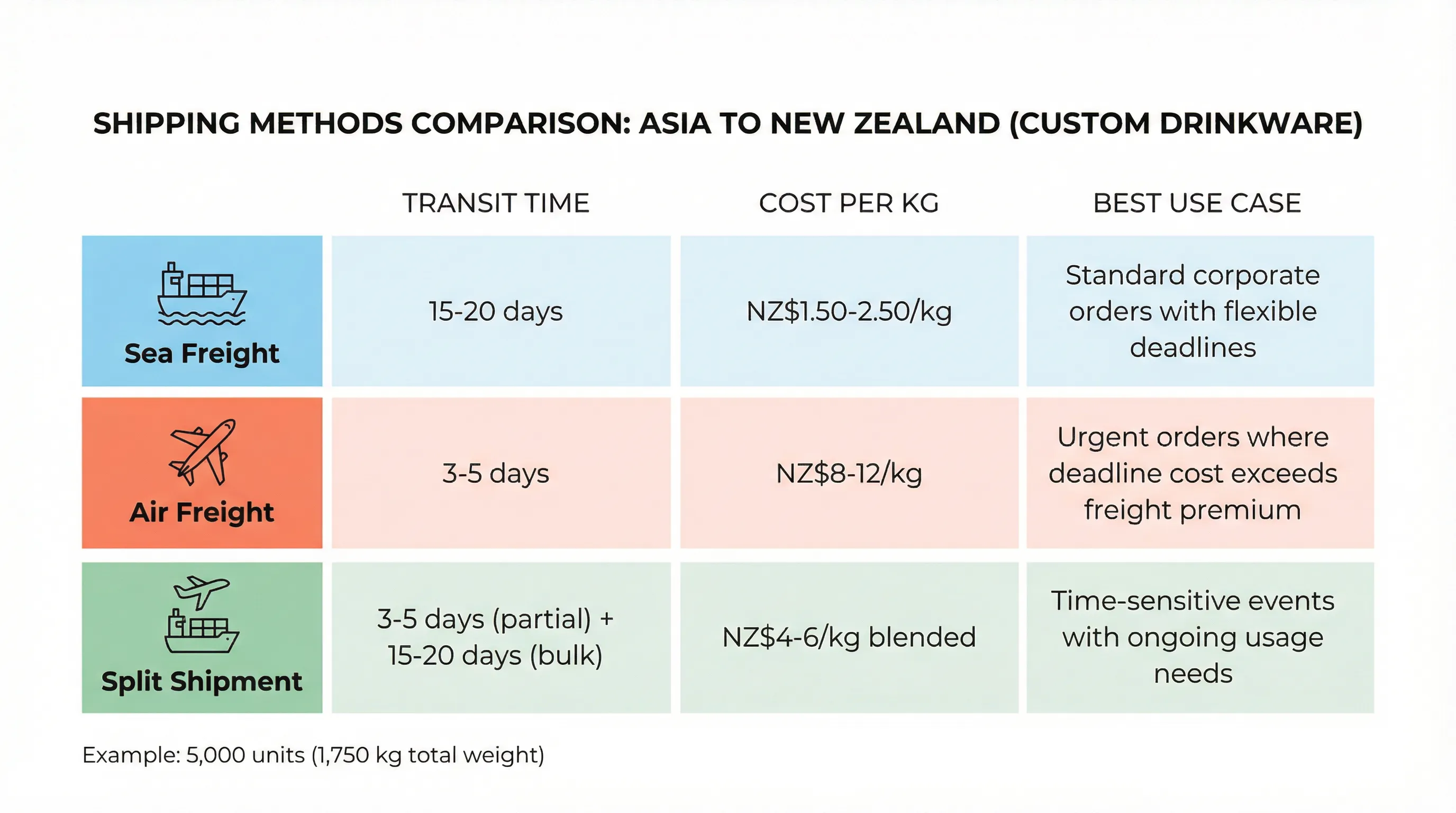
**Sea freight** from Guangzhou or Ningbo to Auckland requires 15-20 working days and costs approximately NZ$1.50-2.50 per kilogram. For a 5,000-unit order of 350-gram bottles (total weight 1,750 kg), sea freight costs NZ$2,625-$4,375. This is the standard method for corporate orders where the deadline allows for the longer transit.
**Air freight** reduces transit to 3-5 working days but costs NZ$8-12 per kilogram. The same 5,000-unit order would cost NZ$14,000-$21,000 for air freight—an increase of NZ$10,000-$17,000. Air freight is justified only when the cost of missing the deadline (e.g., a product launch, a major conference) exceeds the freight premium.
**Split shipment** is a hybrid strategy we recommend for time-sensitive events. The factory air-freights 500-1,000 units to meet the immediate deadline, while the remaining 4,000-4,500 units ship via sea freight for ongoing use (e.g., new hire onboarding kits). This approach costs approximately NZ$4,000-$6,000 more than pure sea freight but is far cheaper than air-freighting the entire order.
Shipping method comparison for 5,000-unit orders: sea freight offers lowest cost (NZ$2,625-4,375), air freight fastest delivery (3-5 days), and split shipment balances both for time-sensitive events
The decision framework: if your deadline is less than six weeks away and production is already complete, air freight is unavoidable. If you have 8-10 weeks, sea freight is appropriate. If you have a hard deadline for 1,000 units but can receive the remaining 4,000 units later, split shipment optimizes cost and risk.
For enterprises seeking reliable suppliers who can meet these timelines consistently, our [custom drinkware supplier selection guide](/custom-drinkware-supplier) provides detailed criteria for evaluating manufacturing partners.
---
## Tailored Lead Time Strategies for Different Enterprise Scales
The optimal lead time strategy varies significantly based on enterprise size, procurement sophistication, and order frequency. A Wellington startup ordering 300 bottles for a launch event faces entirely different constraints than an Auckland-based multinational ordering 20,000 bottles annually across four regional offices.
**For Startups and SMEs (Orders Under 1,000 Units)**
Small and medium enterprises typically prioritize **low minimum order quantities** and **budget flexibility** over customization depth. For these buyers, stock items with logo decoration are often the most practical pathway. A Christchurch-based tech startup needing 400 branded water bottles for a conference in eight weeks should source from a New Zealand-based distributor holding local stock. The lead time compresses to 10-15 working days, and the per-unit cost—while higher than direct import—eliminates the risk of customs delays or quality issues discovered only after a 5,000-unit shipment arrives.
The execution trap for SMEs is **underestimating artwork preparation time**. A startup's in-house designer may provide a PNG logo file, which the supplier cannot use for laser engraving or screen printing. Converting the logo to vector format (AI or EPS) and specifying Pantone colors adds 3-5 days. SMEs should budget one week for artwork preparation before initiating the RFQ process.
Another consideration for small orders is **split shipping**. If the startup needs 200 bottles for the conference and 200 bottles for ongoing office use, they can request the supplier to air-freight 200 units and sea-freight the remainder. This reduces total cost while ensuring the critical 200 units arrive on time.
**For Mid-Market Enterprises (Orders 1,000-5,000 Units)**
Mid-market enterprises—such as Auckland-based professional services firms or Wellington government agencies—typically require **brand color consistency** and **moderate customization**. These buyers should pursue semi-custom orders: selecting a stock bottle design but specifying custom Pantone powder coating and logo placement.
The lead time for semi-custom orders is 40-55 working days (25-35 days production + 15-20 days sea freight). Mid-market buyers should initiate procurement 12-14 weeks before the in-hands date to account for sampling cycles and potential delays. For example, if a Wellington law firm is ordering 2,000 branded bottles for a client appreciation event in mid-May, they should begin the RFQ process no later than early February.
The hidden risk for mid-market orders is **multi-SKU coordination**. If the firm orders 1,000 bottles in corporate blue and 1,000 bottles in corporate gray, the factory must run two separate powder coating batches, which adds 5-7 days to the production timeline. Buyers can eliminate this delay by consolidating to a single color or accepting a slightly longer lead time.
**For Large Enterprises and Multinationals (Orders 5,000+ Units)**
Large enterprises prioritize **compliance**, **global brand consistency**, and **supply chain resilience**. These buyers often establish annual supply agreements with manufacturers, which reduces lead time for repeat orders to 20-25 working days because the factory holds pre-approved molds, Pantone formulations, and quality control protocols on file.
For first-time orders exceeding 10,000 units, large enterprises should consider fully custom designs with proprietary tooling. The upfront tooling cost (NZ$4,000-$10,000) amortizes to NZ$0.40-$1.00 per unit across a 10,000-unit order, and the resulting product is unique to the brand. The lead time for fully custom orders is 60-90 working days, which means procurement must begin 16-20 weeks before the in-hands date.
Large enterprises also benefit from **phased delivery**. For example, an Auckland-based multinational might order 15,000 bottles but request delivery in three shipments of 5,000 units each, spaced six weeks apart. This approach reduces warehouse storage costs and allows the enterprise to adjust quantities based on actual consumption rates. The factory schedules production across three batches, and each batch ships upon completion. Total timeline: 12-16 weeks from initial order to final delivery.
The compliance consideration for large enterprises is **material testing**. If the bottles will be used in food service or healthcare settings, the buyer may require FDA or LFGB certification for food contact materials. Testing adds 10-15 working days to the timeline and should be factored into the initial schedule.
---
## New Zealand-Specific Considerations: Customs, Holidays, and Logistics
New Zealand's geographic isolation and unique business calendar create lead time dynamics that differ significantly from Australia, the United States, or Europe. Procurement teams that fail to account for these local factors consistently underestimate total lead time by 10-20 working days.
**Customs and Biosecurity Clearance**
Goods arriving at Port of Auckland or Port of Tauranga must clear New Zealand Customs, which typically requires 2-4 working days for commercial shipments. However, stainless steel drinkware occasionally triggers biosecurity inspection if the packaging materials (e.g., wooden pallets, cardboard cartons) are flagged for potential pest contamination. Biosecurity inspection adds 3-7 working days and, in rare cases, requires fumigation or repacking, which can extend the delay to two weeks.
To minimize biosecurity risk, specify that the supplier use heat-treated wooden pallets (marked with ISPM 15 certification) and avoid straw or hay packing materials. Most reputable Chinese manufacturers are familiar with New Zealand's biosecurity requirements, but it is worth confirming this during the RFQ phase.
Another customs consideration is **tariff classification**. Stainless steel vacuum bottles typically fall under HS code 9617.00 (vacuum flasks and vessels), which carries a 5% import duty. However, if the bottles include electronic components (e.g., temperature displays, UV sterilization), they may be reclassified under HS code 8516 (electric heating apparatus), which carries a 10% duty. Clarifying the tariff classification before shipment avoids unexpected duty charges and customs delays.
**New Zealand Business Calendar and Holiday Impact**
New Zealand's summer business slowdown from mid-December through late January creates a six-week window where procurement activity stalls. Many Auckland and Wellington corporates operate on skeleton staff during this period, which means sample approvals, purchase order processing, and payment authorizations are delayed. If your target in-hands date is early February (e.g., for a March event), you must initiate procurement no later than early November to complete sampling and order confirmation before the Christmas shutdown.
Public holidays also compress the effective working calendar. Waitangi Day (February 6), ANZAC Day (April 25), Queen's Birthday (early June), and Labour Day (late October) each remove one working day from the schedule. Over a 12-week procurement cycle, these holidays can reduce the effective working days by 3-5 days, which is why we recommend adding 10% buffer time to all lead time calculations.
**Shipping to Regional Locations**
While Auckland and Wellington benefit from direct port access, deliveries to Christchurch, Dunedin, or regional centers add 2-5 working days for domestic freight. For example, a shipment arriving at Port of Auckland on a Monday might not reach a Dunedin warehouse until the following Monday due to interisland ferry schedules and trucking coordination. Enterprises with regional offices should factor this domestic leg into their lead time calculations.
Another regional consideration is **split delivery**. If an enterprise needs 2,000 bottles delivered to Auckland, 1,500 to Wellington, and 500 to Christchurch, the supplier can arrange for the shipment to be broken down at the Auckland port and forwarded to each location. This adds 3-5 working days compared to a single-location delivery but ensures all offices receive stock simultaneously.
---
## Common Lead Time Pitfalls and How to Avoid Them
Even experienced procurement teams make predictable errors when calculating custom drinkware lead times. These mistakes are not random—they follow patterns we have observed across hundreds of New Zealand corporate orders. Understanding these failure modes allows buyers to design their procurement process to avoid them.
**Pitfall 1: Confusing "Production Time" with "Total Lead Time"**
Many suppliers quote "25-30 days production time," and buyers interpret this as the total timeline from order to delivery. In reality, production time excludes sampling (7-14 days), shipping (15-20 days for sea freight), and customs clearance (2-4 days). The actual lead time is 49-68 working days, not 25-30 days. Always clarify whether a supplier's quote refers to production time or total lead time, and request a detailed timeline breakdown.
**Pitfall 2: Ignoring Chinese Public Holidays**
Chinese New Year (late January or early February) shuts down factories for 2-3 weeks, and Golden Week (October 1-7) adds another week of downtime. If you place an order in mid-January expecting 30 days production, but Chinese New Year begins on January 25, your order will not even start production until mid-February. The actual delivery date slips by three weeks. Always check the Chinese holiday calendar before committing to a deadline, and avoid placing orders within four weeks of Chinese New Year or Golden Week.
**Pitfall 3: Underestimating Artwork Approval Cycles**
Buyers often assume they can approve a sample within 24-48 hours, but in practice, internal stakeholder review—routing the sample through marketing, legal, and executive teams—consumes 7-14 days. If the sample requires modifications (e.g., adjusting logo size, changing color), another 7-10 days are added for the revised sample. Enterprises should establish a single decision-maker for sample approval and set internal deadlines for stakeholder feedback to prevent this bottleneck.
**Pitfall 4: Ordering Too Close to the Event Date**
A common pattern: a Wellington-based enterprise plans a conference for mid-September and initiates drinkware procurement in late July, assuming "eight weeks is plenty of time." Eight weeks equals 56 calendar days, or approximately 40 working days. Subtracting sampling (10 days), production (30 days), and shipping (20 days for sea freight) leaves negative 20 days. The order is mathematically impossible to fulfill on time via sea freight. The enterprise must either pay for air freight (adding NZ$10,000+ to the budget) or delay the conference. The correct approach: work backward from the event date, add all lead time components plus 20% buffer, and initiate procurement on that calculated start date.
**Pitfall 5: Failing to Communicate the Hard Deadline**
Buyers sometimes provide a "preferred delivery date" without clarifying whether it is flexible or non-negotiable. Suppliers prioritize orders with hard deadlines (e.g., "must arrive by September 10 for a conference") over orders with soft deadlines (e.g., "we'd like them by mid-September"). If your deadline is non-negotiable, state this explicitly in the RFQ and confirm that the supplier has scheduled your order accordingly. Request a production timeline with specific milestone dates (sampling complete by X, production complete by Y, shipment departure by Z) so you can monitor progress.
**Pitfall 6: Choosing the Cheapest Quote Without Verifying Lead Time**
A supplier quoting NZ$8.50 per unit with a 50-day lead time may appear more attractive than a supplier quoting NZ$9.20 per unit with a 40-day lead time. However, if the cheaper supplier's lead time estimate is optimistic and the order actually requires 65 days, the buyer misses their deadline and incurs rush air freight costs of NZ$10,000+. The total cost (NZ$8.50 per unit + NZ$10,000 air freight) exceeds the higher-priced supplier's quote. Always verify lead time assumptions and prioritize suppliers with proven on-time delivery records over those offering the lowest per-unit price.
---
## Frequently Asked Questions About Custom Drinkware Lead Times
**How can I reduce lead time if my event is only six weeks away?**
If production has not yet started, your options are limited to stock items with logo decoration from New Zealand-based distributors (10-15 working days) or paying for rush production and air freight from Asia (25-30 working days total, with 30-50% cost premium). If production is already underway, you can request the factory prioritize your order and air-freight the finished goods, but this requires factory authorization and adds significant cost. The most reliable approach is to initiate procurement 12-16 weeks before your event to avoid rush scenarios entirely.
**What is the difference between "working days" and "calendar days" in lead time calculations?**
Working days exclude weekends and public holidays. A "30 working days" timeline translates to approximately 42 calendar days (6 weeks) because it excludes Saturdays and Sundays. However, some Chinese factories operate six days per week (Monday-Saturday), which means their "30 working days" equals 35 calendar days (5 weeks). Always clarify whether the supplier's timeline refers to 5-day or 6-day working weeks, and convert to calendar days to avoid confusion.
**Do I need to add extra time for quality control and testing?**
Quality control is typically included in the production timeline quoted by the supplier. However, if you require third-party lab testing (e.g., FDA certification for food contact materials, LFGB testing for European compliance), this adds 10-15 working days and must be specified during the RFQ phase. Some buyers also request pre-shipment inspection (PSI) by an independent agency, which adds 2-3 working days before the goods are released for shipment.
**What happens if the factory misses the agreed delivery date?**
Reputable suppliers include on-time delivery clauses in their contracts, often with penalties for delays (e.g., 1-2% discount per week of delay). However, enforcing these penalties across international borders is difficult. The more practical approach is to choose suppliers with proven track records (ask for references from other New Zealand clients) and build 10-20% buffer time into your schedule so that minor delays do not jeopardize your event.
**Can I split my order across multiple shipments to reduce risk?**
Yes, and this is a common strategy for large orders. For example, you might request 30% of the order air-freighted to meet an immediate deadline, with the remaining 70% shipped via sea freight for ongoing use. The factory will charge for two separate shipments, but the cost is far lower than air-freighting the entire order. Discuss split shipment options during the RFQ phase so the supplier can plan production and logistics accordingly.
**How do I account for New Zealand's summer business slowdown in my lead time planning?**
If your target in-hands date is between late January and early March, you must initiate procurement no later than early November. This ensures that sampling, artwork approval, and order confirmation are complete before mid-December, when many New Zealand corporates begin their Christmas shutdown. Alternatively, you can work with suppliers who maintain skeleton staff during the holiday period, but expect slower response times for approvals and queries.
---
## Deeper Insights: Lead Time Decision Variables
While this guide covers the strategic framework for lead time planning, several specific decision variables warrant deeper exploration. Understanding how [artwork approval windows expand beyond supplier timelines](/blog/artwork-approval-timeline-expansion-custom-drinkware) helps procurement teams identify where delays originate. Similarly, recognizing how [shipping method indecision extends production schedules](/blog/shipping-method-indecision-extends-custom-drinkware-lead-time) allows buyers to make earlier commitments that reduce overall timelines. Understanding [how multi-location delivery requests extend lead times](/blog/multi-location-delivery-extends-custom-drinkware-lead-times) helps procurement teams plan for the additional quality control and logistics coordination that multiple destinations require. Additionally, many procurement teams underestimate [how their own internal decision delays extend lead times](/blog/buyer-procurement-decision-delays-extend-custom-drinkware-lead-times) by 2-4 weeks before the factory even begins production. Finally, recognising [how supplier parameter changes compound during reorders](/blog/supplier-switching-extends-custom-drinkware-lead-times-3-5-weeks) helps enterprises plan for the hidden delays that emerge when switching between suppliers mid-project.
---
## Next Steps: Planning Your Custom Drinkware Order
Accurate lead time forecasting is not about memorizing a single number—it is about understanding the decision variables (order complexity, order size, shipping method), recognizing the hidden delays (artwork approval cycles, public holidays, customs inspections), and building appropriate buffer time into your schedule.
For most New Zealand enterprises ordering semi-custom drinkware in quantities of 1,000-5,000 units, the realistic total lead time is **10-14 weeks** from initial RFQ to delivery. This assumes no major delays, but prudent procurement teams add 10-20% buffer to account for unforeseen issues.
The strategic advantage of understanding lead times is that it allows you to make informed trade-offs. If your deadline is non-negotiable, you can choose stock items or pay for rush production and air freight. If your budget is constrained, you can extend the timeline to use sea freight and standard production schedules. If your brand requires a proprietary design, you can plan 16-20 weeks ahead to accommodate fully custom tooling and testing.
The enterprises that consistently meet their deadlines are not those with the largest budgets—they are those that plan earliest and communicate clearest. By working backward from your event date, accounting for all lead time components, and establishing a single decision-maker for sample approvals, you eliminate the majority of timeline risks.
If you are ready to begin sourcing custom drinkware for your New Zealand enterprise, our team can provide detailed production timelines, factory references, and logistics coordination to ensure your order arrives on schedule. We specialize in helping Auckland, Wellington, and Christchurch-based businesses navigate the complexities of international drinkware procurement while meeting tight deadlines and budget constraints.
[Contact our team](/contact-us) to discuss your specific requirements and receive a customized timeline proposal for your next custom drinkware order.