When Consumption Timelines Outlive Brand Lifecycles in Custom Drinkware Orders
Key procurement answer
The calculation shows three years to consume the order. The branding might not last eighteen months. Understanding why procurement teams evaluate consumption duration but not brand stability reveals a structural blind spot in minimum order quantity decisions.
The consumption calculation looks solid on paper. Ten thousand custom stainless steel bottles ordered at minimum quantity, divided by an annual usage rate of three thousand units, equals three point three years of inventory coverage. The arithmetic is straightforward, the forecast is based on historical data, and the unit economics make sense. But three years from now, when half the order sits in storage bearing a logo that no longer exists, the calculation that seemed so rational at the time of purchase reveals itself as incomplete.
This is not a forecasting problem. The demand projection was accurate. The consumption rate held steady. The issue is that the procurement decision treated the product as static when the product itself was always going to change. For custom branded drinkware, the relevant lifespan is not how long the bottles last or how quickly they are consumed. It is how long the branding remains current. And that timeline is almost never part of the minimum order quantity evaluation.
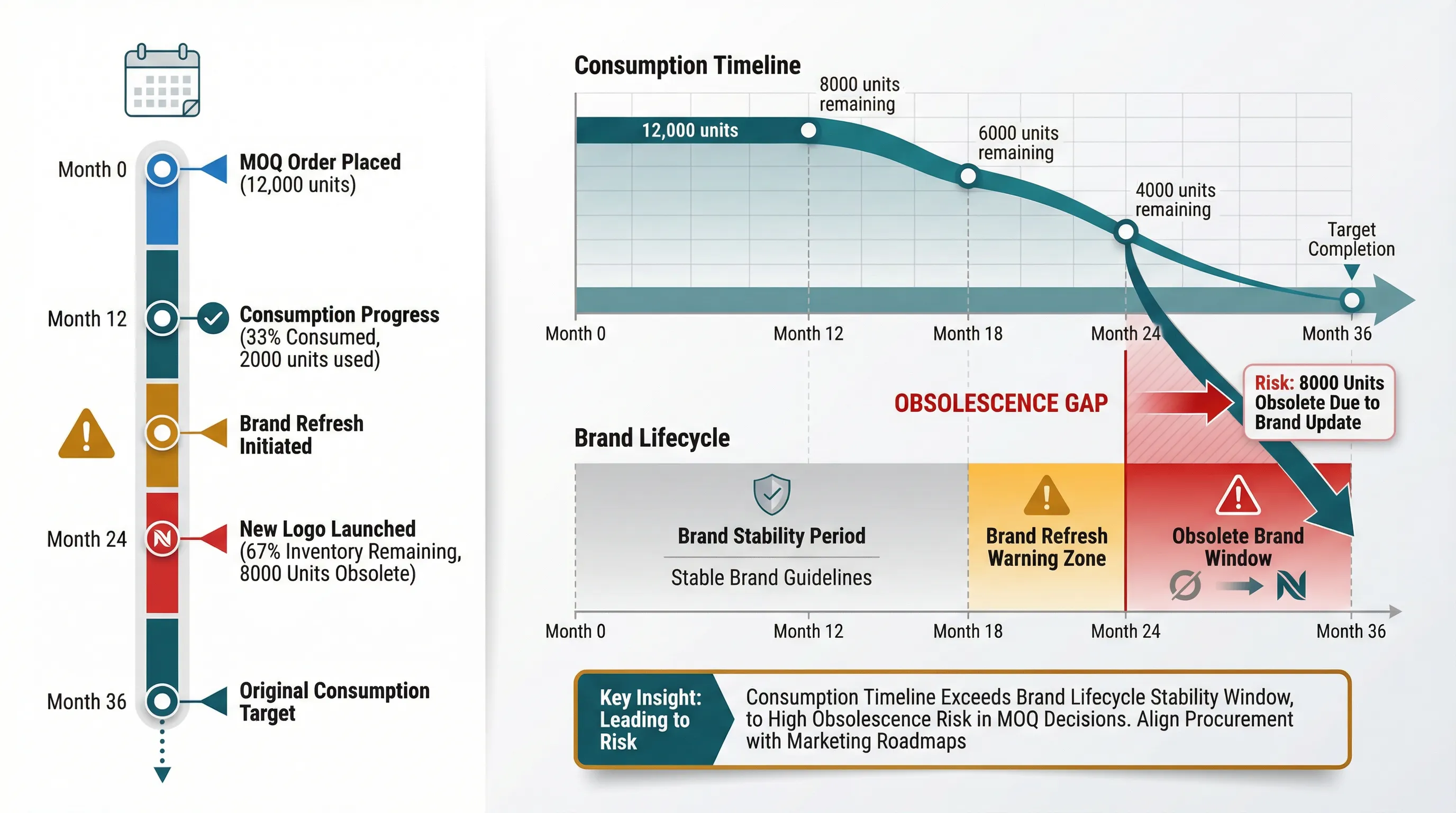
Consumption timeline extends beyond brand stability period, creating obsolescence gap
The standard approach to assessing minimum order commitments focuses on consumption duration. Procurement teams calculate how many months or years it will take to use the ordered quantity based on historical usage patterns. If the supplier's minimum is ten thousand units and the organisation uses three thousand per year, the math suggests a three-year supply. The implicit assumption embedded in this calculation is that the product will remain relevant for the entire consumption period. But for items carrying custom logos, company names, event dates, or campaign-specific messaging, that assumption is rarely examined.
Corporate branding does not operate on a fixed schedule, but it does follow observable patterns. Research tracking major companies shows that seventy-four percent of firms in the S&P 100 index undergo a brand refresh within their first seven years of operation. The typical rebranding cycle for established organisations falls between seven and ten years, with smaller visual updates occurring in the interim. A brand refresh timeline, from initial planning to full rollout, spans twelve to eighteen months. This means that a branding decision made eighteen months after a procurement order was placed can render half of that order obsolete before it is consumed.
The problem is not that rebranding happens. The problem is that procurement systems do not account for it. When a buyer orders custom drinkware at minimum quantity, the decision is evaluated against consumption forecasts, unit pricing, and storage capacity. It is not evaluated against the organisation's brand roadmap, upcoming visual identity changes, or the likelihood of a logo update within the product's consumption window. These two decision streams—procurement and branding—operate independently, and the disconnect creates a structural risk that is only visible in hindsight.
Consider a scenario where an organisation orders ten thousand branded stainless steel bottles in January, meeting the supplier's minimum order quantity. The forecast suggests three years of consumption. In month eighteen, the marketing team initiates a brand refresh that includes a new logo, updated colour palette, and revised typography. The refresh is completed by month twenty-four. At that point, the organisation has consumed two thousand bottles, leaving eight thousand units in inventory. Those eight thousand bottles now carry outdated branding. They cannot be distributed to clients, used at events, or given to employees without signalling that the organisation is using old stock. The bottles are functionally obsolete, not because they are damaged or unsellable in a general sense, but because they are tied to a visual identity that no longer exists.
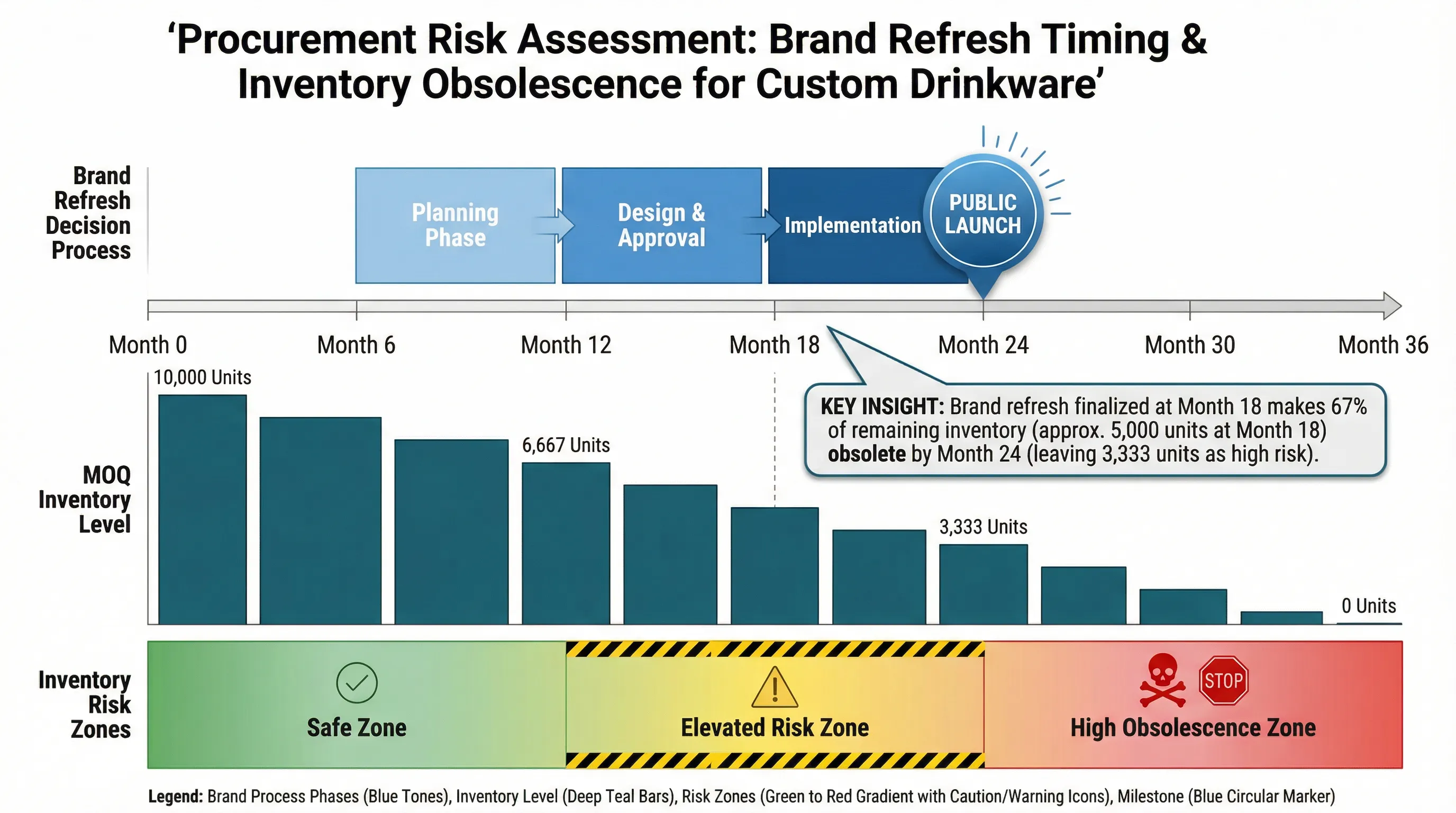
Brand refresh decision process and inventory risk zones over MOQ consumption timeline
The financial impact of this scenario is not limited to the cost of the unused inventory. The organisation has also incurred storage costs for the eighteen months between purchase and obsolescence, and it must now either write off the remaining stock or attempt to liquidate it at a steep discount. For custom branded products, resale to another buyer is not an option. The branding is specific to the original purchaser. The loss is absorbed entirely by the organisation that placed the order.
This outcome was not the result of poor forecasting or unexpected demand fluctuations. It was the result of a decision structure that treated product lifespan and brand lifespan as equivalent when they are not. The bottles themselves have a lifespan measured in years. The branding has a lifespan measured in brand cycles. Minimum order quantity decisions are made using the former timeline, but the risk is determined by the latter.
The frequency of brand updates varies by industry, but the pattern is consistent: branding changes more often than procurement teams assume. In sectors where visual identity is closely tied to market positioning—technology, fashion, consumer goods—brand refreshes occur every three to five years. In more conservative industries, the cycle may extend to seven to ten years, but even in these cases, smaller updates to logos, taglines, or colour schemes happen between major rebrands. Any of these changes can render custom branded merchandise obsolete if the inventory was ordered with a consumption timeline that extends beyond the brand's expected stability window.
The challenge is compounded by the fact that brand refresh decisions are often made without direct input from procurement teams. Marketing departments initiate rebrands based on competitive positioning, customer perception research, or strategic pivots. These decisions are typically finalised twelve to eighteen months before the new branding is publicly launched, but the procurement team may not be informed until the rollout is imminent. By that time, any custom branded inventory ordered in the preceding two years is at risk of obsolescence.
From a factory perspective, this disconnect is visible in the way orders are structured. A buyer places an order for ten thousand custom bottles with a specific logo file, pantone colour reference, and artwork layout. The factory produces the order, ships it, and moves on. Eighteen months later, the same buyer returns with a new logo file and a request for another ten thousand units. The factory has no visibility into what happened to the previous order, but the pattern is recognisable: the branding changed, and the old stock is now unusable. This cycle repeats across multiple clients, and the common thread is always the same—the consumption timeline was longer than the brand stability window.
The solution is not to avoid minimum order quantities. It is to incorporate brand lifecycle assessment into the procurement decision. Before committing to an order that will take three years to consume, the procurement team should ask: what is the likelihood that our branding will change within that timeframe? If the organisation is in a high-growth phase, has recently undergone a merger, or operates in a visually competitive market, the risk of a brand refresh within three years is significant. If the organisation has a stable brand identity and no planned updates, the risk is lower. But in either case, the risk should be explicitly evaluated, not assumed away.
Some organisations address this by negotiating staged deliveries with suppliers. Instead of taking delivery of ten thousand units at once, the buyer commits to the minimum order quantity but arranges for the stock to be held by the supplier and delivered in smaller batches over time. This approach reduces the amount of branded inventory sitting in the buyer's warehouse at any given moment, which limits exposure to obsolescence risk. However, it does not eliminate the risk entirely. If the branding changes midway through the delivery schedule, the remaining stock held by the supplier is still tied to outdated artwork.
Another approach is to align procurement decisions with known brand planning cycles. If the marketing team is planning a brand refresh within the next two years, procurement should avoid placing orders for custom branded merchandise that will take longer than two years to consume. This requires coordination between departments that do not typically communicate during the procurement process, but the coordination is necessary to prevent the structural mismatch between consumption timelines and brand timelines.
For organisations that regularly order custom drinkware, the most effective strategy is to treat brand stability as a variable in the minimum order quantity calculation. Instead of asking "how long will it take to consume this order," the question should be "how long will the branding remain current, and does that window align with the consumption timeline?" If the answer is no, the order should either be reduced, staged, or deferred until the brand roadmap provides more certainty.
Understanding how minimum quantities interact with organisational change cycles requires recognising that product lifespan and brand lifespan are not the same. A stainless steel bottle can last for years. A logo might not. When procurement decisions are made using only the former timeline, the result is predictable: inventory that is technically functional but commercially obsolete. The calculation was correct. The assumption was not.