Why Forecast Confidence Intervals Disappear When Ordering Custom Drinkware at MOQ
Key procurement answer
The forecast range that informs every other procurement decision disappears the moment a supplier's minimum order quantity forces a commitment. Understanding why confidence intervals collapse to binary choices reveals hidden risks in custom branded drinkware orders.
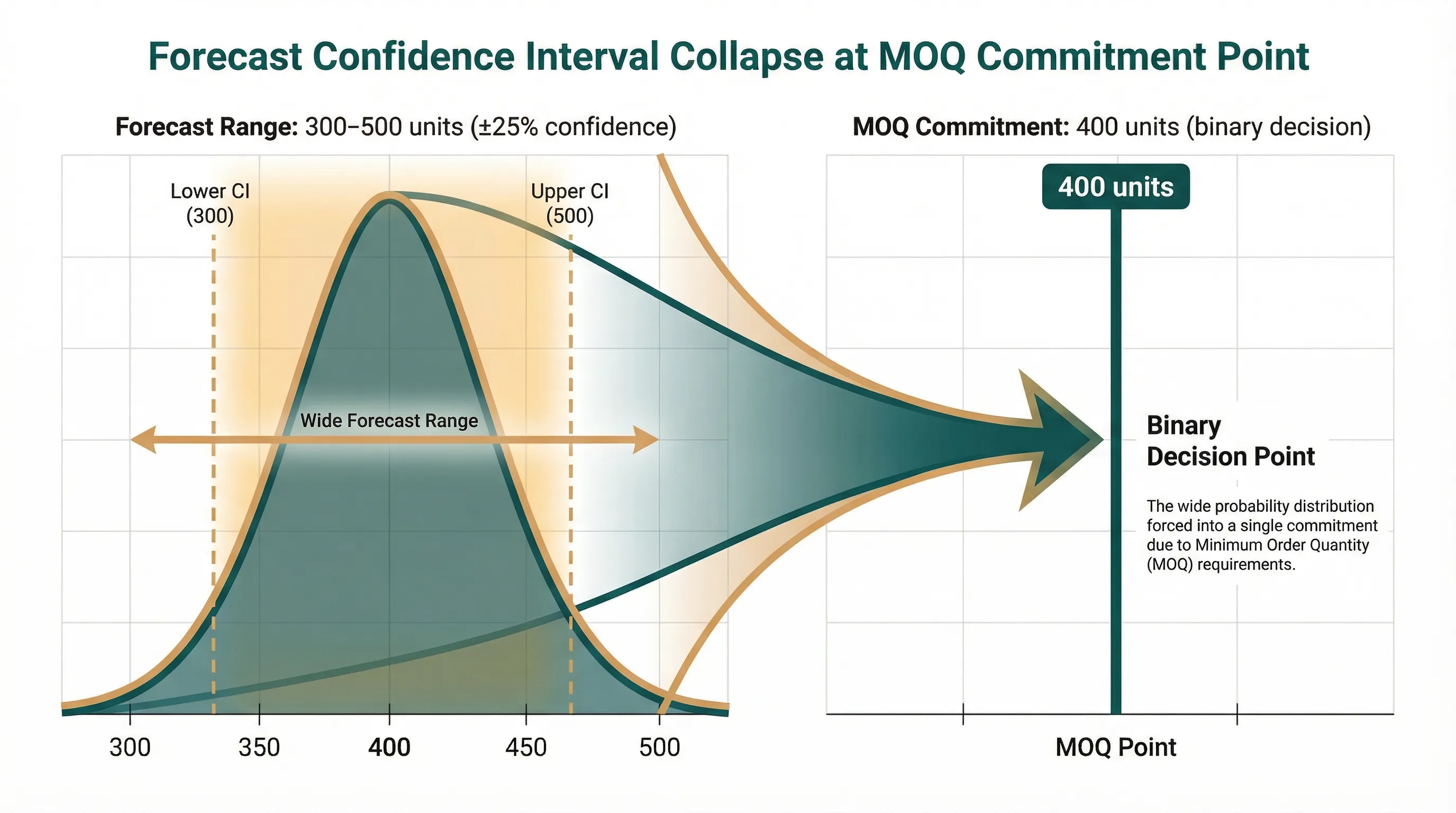
The forecast range that informs every other procurement decision disappears the moment a supplier's minimum order quantity forces a commitment. A demand projection that reads "three hundred to five hundred custom stainless steel bottles needed across the next two quarters" collapses to a binary choice: order four hundred units at the minimum, or place no order at all. The confidence interval that should guide risk assessment—the acknowledgment that actual consumption could land anywhere within that range—becomes irrelevant because the order structure permits only one quantity.
This is not a problem unique to forecasting. It is a problem created by the interaction between forecast uncertainty and the rigidity of minimum order requirements. When the forecast suggests a range and the supplier demands a fixed commitment, the procurement decision shifts from "how much do we need" to "which single point within our uncertainty range are we willing to bet on." For custom branded drinkware, where excess inventory cannot be resold and shortfalls cannot be corrected quickly, that bet carries asymmetric consequences.
How forecast uncertainty ranges are forced into binary decisions by minimum order quantity requirements
The standard approach to demand forecasting produces a point estimate—a single number representing expected consumption—alongside a measure of confidence, often expressed as a percentage or a range. A forecast might indicate that four hundred bottles will be needed, with a confidence interval of plus or minus twenty-five percent. That interval reflects variability in event attendance, employee onboarding rates, client gifting schedules, or seasonal demand fluctuations. It is an honest acknowledgment that the future is not fixed.
But when a supplier's minimum order quantity is four hundred units, the forecast range of three hundred to five hundred units becomes operationally meaningless. The procurement team cannot order three hundred and wait to see how demand develops. They cannot split the order into two batches of two hundred with staggered delivery. They cannot hedge by ordering three fifty and accepting a partial shortfall. The minimum order quantity eliminates every option except one: commit to four hundred units now, or commit to nothing.
This creates a decision structure that treats forecasts with narrow confidence intervals the same as forecasts with wide confidence intervals, as long as both suggest the same point estimate. A forecast of four hundred units with plus or minus fifteen percent confidence—a range of three forty to four sixty—looks identical to a forecast of four hundred units with plus or minus forty percent confidence—a range of two forty to five sixty—when both are filtered through a minimum order quantity of four hundred. The procurement system sees "order four hundred" in both cases, even though the underlying uncertainty is radically different.
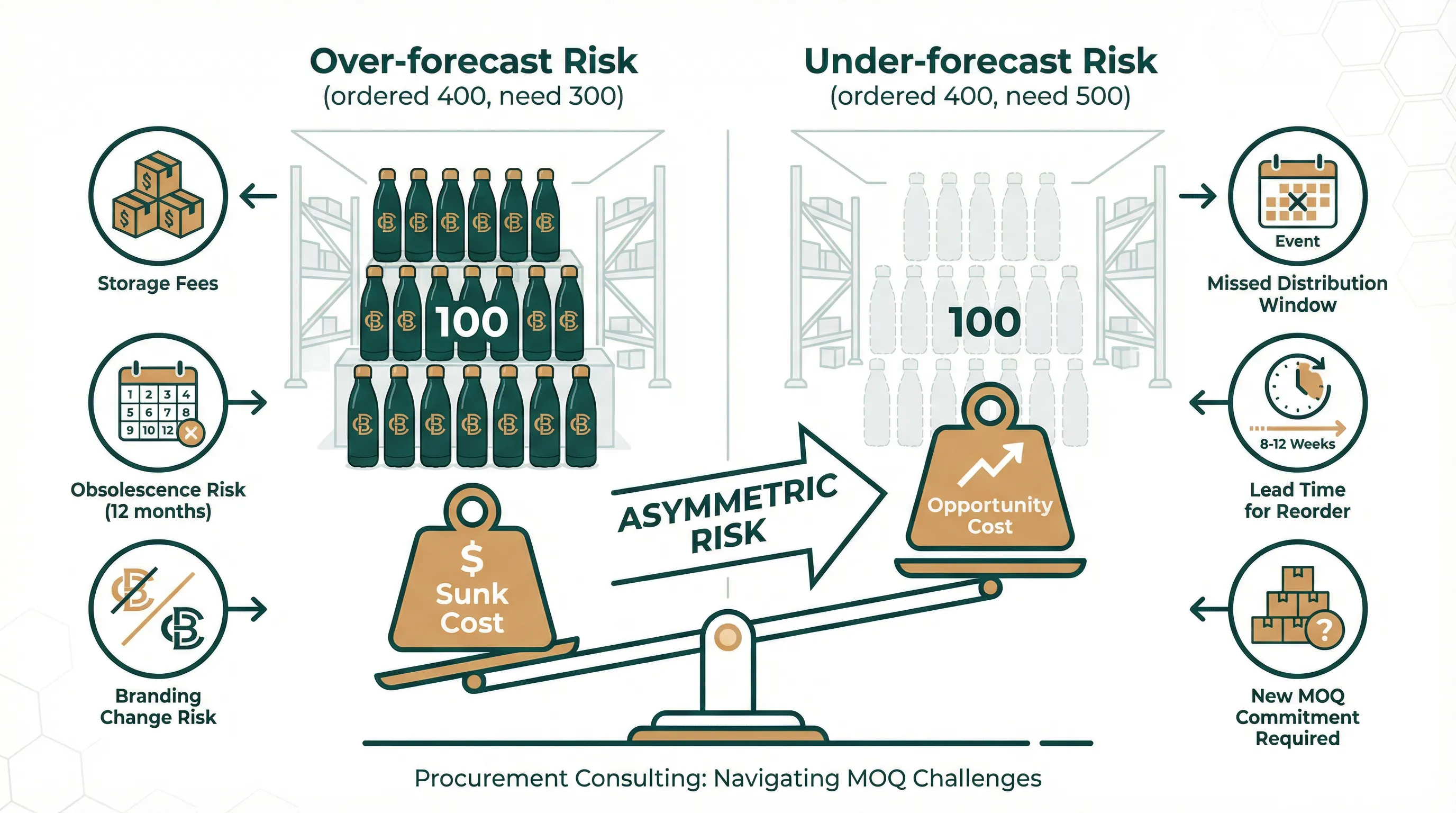
The consequences of this collapse depend on which end of the forecast range actual demand lands. If consumption settles at the low end of the range, the organisation is left holding excess inventory. For custom branded drinkware, this is not a temporary inconvenience. A hundred surplus bottles bearing the company logo cannot be sold to another buyer. They cannot be repurposed for a different campaign if the branding is event-specific or includes dates. They sit in storage, accumulating holding costs, until they are either consumed through unplanned distribution or written off as obsolete.
The asymmetric cost structure of forecast errors in custom branded drinkware procurement
The risk of obsolescence is not hypothetical. Organisations rebrand. Visual identities change. Mergers trigger new logo requirements. A forecast that assumes twelve months of consumption can be invalidated by a branding decision made in month six, leaving half the inventory unusable. The longer the consumption period, the greater the exposure to this risk, and ordering at minimum quantity extends that period by definition.
If consumption settles at the high end of the forecast range, the organisation faces a different problem: shortfall. A forecast that suggested four hundred units would be sufficient turns out to require five hundred. The missing hundred bottles cannot be sourced quickly. Custom drinkware orders carry lead times of eight to twelve weeks, depending on supplier capacity and the complexity of the branding. By the time a reorder arrives, the distribution window—an event, a product launch, a client appreciation campaign—has closed. The shortfall is not just an inconvenience; it is a missed opportunity that cannot be recovered.
Reordering also triggers a new minimum order quantity commitment. If the shortfall is a hundred units but the supplier's minimum is four hundred, the procurement team must decide whether to order four hundred more—accepting three hundred units of excess—or accept the shortfall and move on. Either choice compounds the original forecasting problem. The decision to order at minimum quantity does not resolve uncertainty; it defers it to the next cycle.
The asymmetry between these two outcomes—excess and shortfall—is not balanced. Excess inventory for custom branded products is a sunk cost. It ties up capital, occupies storage space, and carries obsolescence risk. Shortfall, by contrast, is an opportunity cost. It represents distribution that did not happen, relationships that were not reinforced, brand visibility that was not achieved. Both are costly, but they are costly in different ways, and the decision to order at minimum quantity forces the procurement team to choose which risk they are willing to accept without knowing which outcome will occur.
This is where forecast confidence intervals should matter. A forecast with a narrow confidence interval—say, plus or minus fifteen percent—suggests that actual demand is likely to fall close to the point estimate. The risk of significant excess or shortfall is low. A forecast with a wide confidence interval—plus or minus forty percent—suggests that actual demand could vary substantially from the point estimate. The risk of significant deviation is high. In a rational procurement system, these two forecasts would trigger different ordering strategies, even if both suggest the same expected value.
But minimum order quantities eliminate that distinction. The forecast range collapses to a single commitment point, and the procurement decision becomes binary: order at the minimum or do not order. The confidence interval, which should inform the level of risk the organisation is taking, is ignored because the order structure does not accommodate it. The result is that procurement teams end up treating high-confidence forecasts and low-confidence forecasts identically, as long as both point to the same minimum order quantity.
This problem is compounded by the way demand forecasts are typically communicated within organisations. Forecasting systems produce point estimates because that is what procurement systems are designed to consume. A purchase order requires a quantity field, not a range field. The confidence interval, if it is calculated at all, is often relegated to a footnote or a separate report that does not feed directly into the ordering process. By the time the forecast reaches the procurement team, it has been stripped of the uncertainty information that would be most useful for navigating minimum order quantity decisions.
The practical implication is that procurement teams ordering custom drinkware at minimum quantities are making decisions based on incomplete information. They see the point estimate—four hundred bottles—but they do not see the confidence interval that would tell them whether that estimate is reliable or speculative. They do not see the range of possible outcomes, the probability distribution, or the asymmetric costs of over-ordering versus under-ordering. They see a single number and a minimum order requirement, and they make a binary choice.
This is not a failure of forecasting. It is a failure of decision architecture. The forecasting system is producing the right information—a point estimate and a confidence interval—but the procurement system is not structured to use it. Minimum order quantities, by their nature, force single-point commitments, and single-point commitments are incompatible with probabilistic forecasts. The mismatch between the two creates a decision environment where uncertainty is acknowledged in the forecast but ignored in the order.
The solution is not to improve forecast accuracy. A more accurate forecast does not solve the problem if the confidence interval remains wide. A forecast that predicts four hundred units with ninety percent accuracy is still a forecast with a range, and that range still collapses to a binary decision at the minimum order quantity. The solution is to structure procurement decisions in a way that accommodates uncertainty, either by negotiating flexible order quantities, staging deliveries over time, or building contingency plans for both excess and shortfall scenarios.
Some suppliers offer consignment arrangements where the buyer commits to a minimum quantity but takes delivery in smaller batches over time. This shifts the inventory holding risk back to the supplier while allowing the buyer to adjust consumption rates as actual demand becomes clearer. Other suppliers allow split orders, where the minimum quantity is met but the delivery is staged across multiple shipments. Both approaches reduce the risk of ordering at minimum quantity by decoupling the commitment from the delivery, giving the buyer more flexibility to respond to forecast uncertainty.
For organisations that regularly order custom branded merchandise, the most effective approach is to build internal forecasting processes that explicitly account for confidence intervals and communicate them to procurement teams in a usable format. Instead of presenting a single point estimate, the forecast should present a range with associated probabilities: "We expect to need between three hundred and five hundred bottles, with a seventy percent probability that actual demand will fall between three fifty and four fifty." This gives the procurement team the information they need to assess whether ordering at minimum quantity is a reasonable risk or a gamble.
It also allows the organisation to make more informed decisions about which products to order at minimum quantity and which to avoid. Products with narrow forecast confidence intervals are safer candidates for minimum order commitments. Products with wide confidence intervals carry higher risk and may justify paying a premium for smaller order quantities or choosing suppliers with more flexible terms. The decision should be driven by the level of uncertainty, not just the point estimate.
Understanding how minimum quantities interact with demand variability requires recognising that the forecast range is not a nuisance to be ignored—it is the most important piece of information for assessing risk. When that range collapses to a single commitment point, the procurement decision becomes a bet on one outcome within a distribution of possibilities. For custom branded drinkware, where the consequences of that bet are asymmetric and irreversible, the confidence interval matters more than the point estimate. The challenge is building procurement systems that recognise that fact.