The Hidden Cost of Ordering at Minimum Quantities
Key procurement answer
Why ordering exactly at MOQ often results in higher total costs. A procurement perspective on quantity decisions for corporate drinkware.
When a supplier quotes a minimum order quantity of fifty units, most procurement teams instinctively treat that number as both a floor and a target. The logic seems sound: order the minimum, test the product with a limited audience, and scale up later if results warrant. In practice, this approach frequently produces the opposite of its intended effect—higher per-unit costs, compressed timelines on subsequent orders, and occasionally, quality inconsistencies that undermine the entire purpose of the branded merchandise.
The economics of custom drinkware production create a pricing structure that penalises orders placed precisely at the minimum threshold. Understanding why this happens requires looking beyond the quoted unit price to the underlying cost components that suppliers must recover regardless of order size.
The Fixed Cost Reality
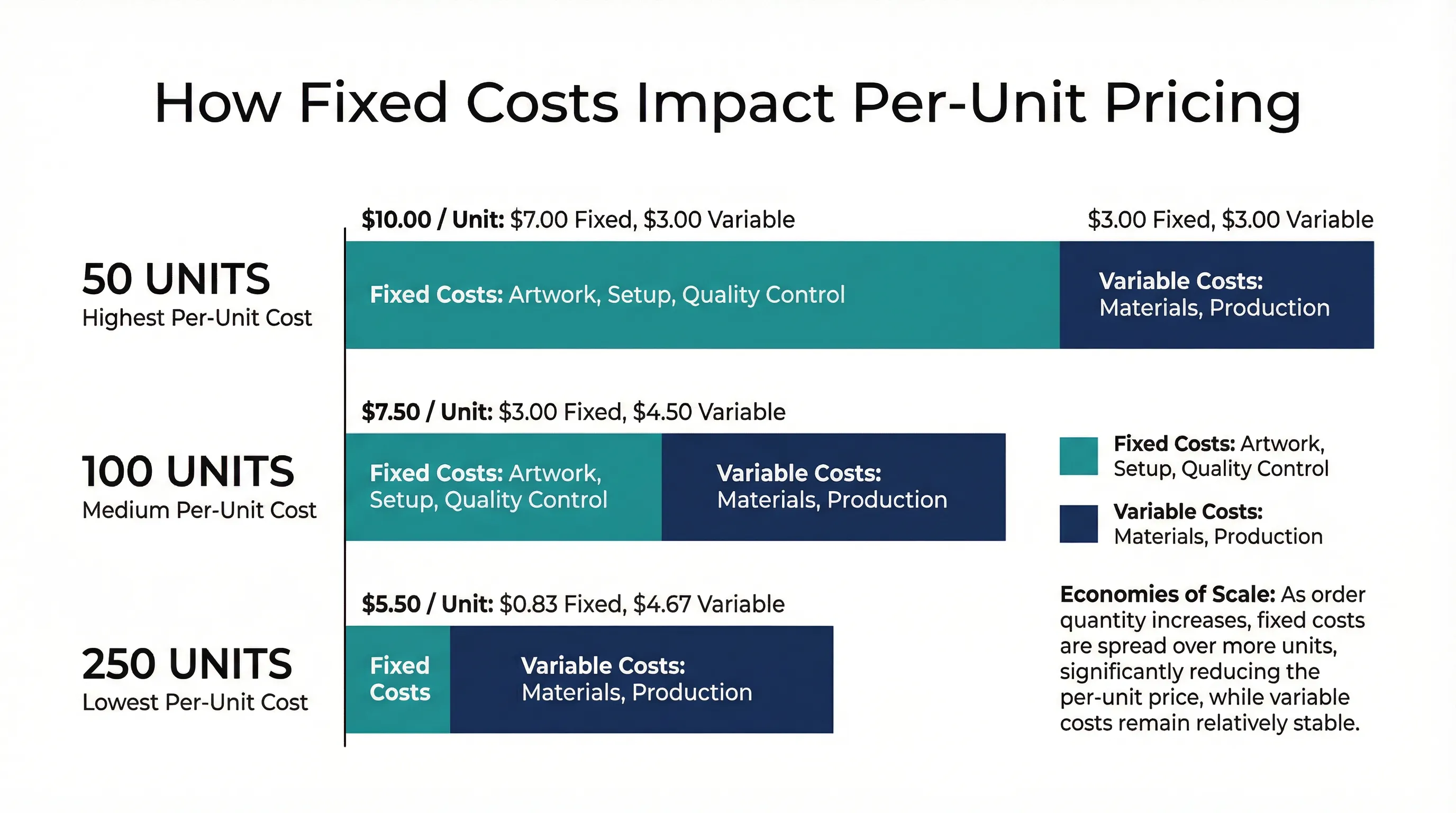
Every custom drinkware order carries fixed costs that remain constant whether you order fifty units or five hundred. Artwork preparation, screen or pad setup, colour matching, and quality control protocols all require the same labour investment at the minimum quantity as they do at higher volumes. When these fixed costs are distributed across only fifty units, each item absorbs a disproportionate share of the overhead. At one hundred units, that same overhead is halved on a per-unit basis. At two hundred and fifty units, it becomes nearly negligible.
This is why suppliers often structure their pricing with significant breaks just above the stated minimum. A procurement manager reviewing a quote might see fifty units at fourteen dollars each, one hundred units at eleven dollars, and two hundred and fifty units at eight dollars fifty. The instinct to order at minimum appears to save money in absolute terms—seven hundred dollars versus eleven hundred—but the per-unit economics tell a different story. The organisation ordering one hundred units pays less per item than the one ordering fifty, despite committing to double the quantity.
The Reorder Penalty
The calculation becomes more complex when factoring in the near-certainty of reordering. Corporate drinkware programmes rarely exist as one-time initiatives. Employee onboarding, client appreciation, trade shows, and sustainability campaigns all generate recurring demand. An organisation that orders fifty units in January and fifty more in April pays setup fees twice. The supplier must retrieve the artwork, recalibrate equipment, and repeat quality checks—all costs that would have been incurred only once had the initial order been placed at one hundred units.
Batch Variation Risk
There is also a less obvious risk embedded in minimum-quantity orders: batch variation. Manufacturing processes, particularly those involving colour application, produce slightly different results from run to run. Ordering at the minimum and reordering later increases the probability that the second batch will not perfectly match the first. For branded merchandise where colour consistency matters—and it almost always does—this creates a situation where the organisation either accepts visible variation or requests costly colour-matching adjustments on subsequent orders.
A More Strategic Approach
None of this suggests that minimum order quantities should be ignored or that every organisation should automatically order at the highest tier. Budget constraints are real, and overcommitting to inventory carries its own risks. The point is that the decision to order at the minimum should be made with full awareness of the cost structure, not as a reflexive response to the word "minimum."
A more productive approach involves requesting a detailed quote across multiple quantity tiers and calculating the true per-unit cost inclusive of setup fees. If the supplier charges a one-hundred-dollar artwork fee regardless of quantity, that fee adds two dollars per unit at fifty pieces but only forty cents per unit at two hundred and fifty. When procurement teams present these calculations to internal stakeholders, the conversation shifts from "how few can we order" to "what quantity optimises our total cost of ownership."
For organisations genuinely uncertain about demand, there are alternatives to ordering at the bare minimum. Some suppliers offer split-shipment arrangements where a larger order is produced in one run but delivered in stages. Others provide warehousing options that allow the buyer to draw down inventory over time without triggering multiple production cycles. These arrangements capture the per-unit savings of a larger order while addressing the cash flow and storage concerns that often drive minimum-quantity decisions.
The relationship between order quantity and total cost is one of the most frequently misunderstood aspects of corporate merchandise procurement. Organisations that approach quantity planning with a clear understanding of how fixed costs distribute across production runs consistently achieve better outcomes than those who default to the minimum as a matter of policy.