Why Sample Approval Doesn't Mean Your Custom Drinkware Production Starts Tomorrow
Key procurement answer
The gap between sample approval and production start is one of the least discussed phases in custom drinkware manufacturing. Understanding this hidden 2-4 week phase prevents timeline misjudgments.
There is a moment in every custom drinkware project when the procurement team receives confirmation that their sample has been approved. The natural assumption—and one that persists across organisations of all sizes—is that production will now begin immediately. The factory has validated the design, the materials are confirmed, and the timeline quoted at the start of the project should now apply. In practice, this is precisely where customization process decisions begin to be significantly misjudged.
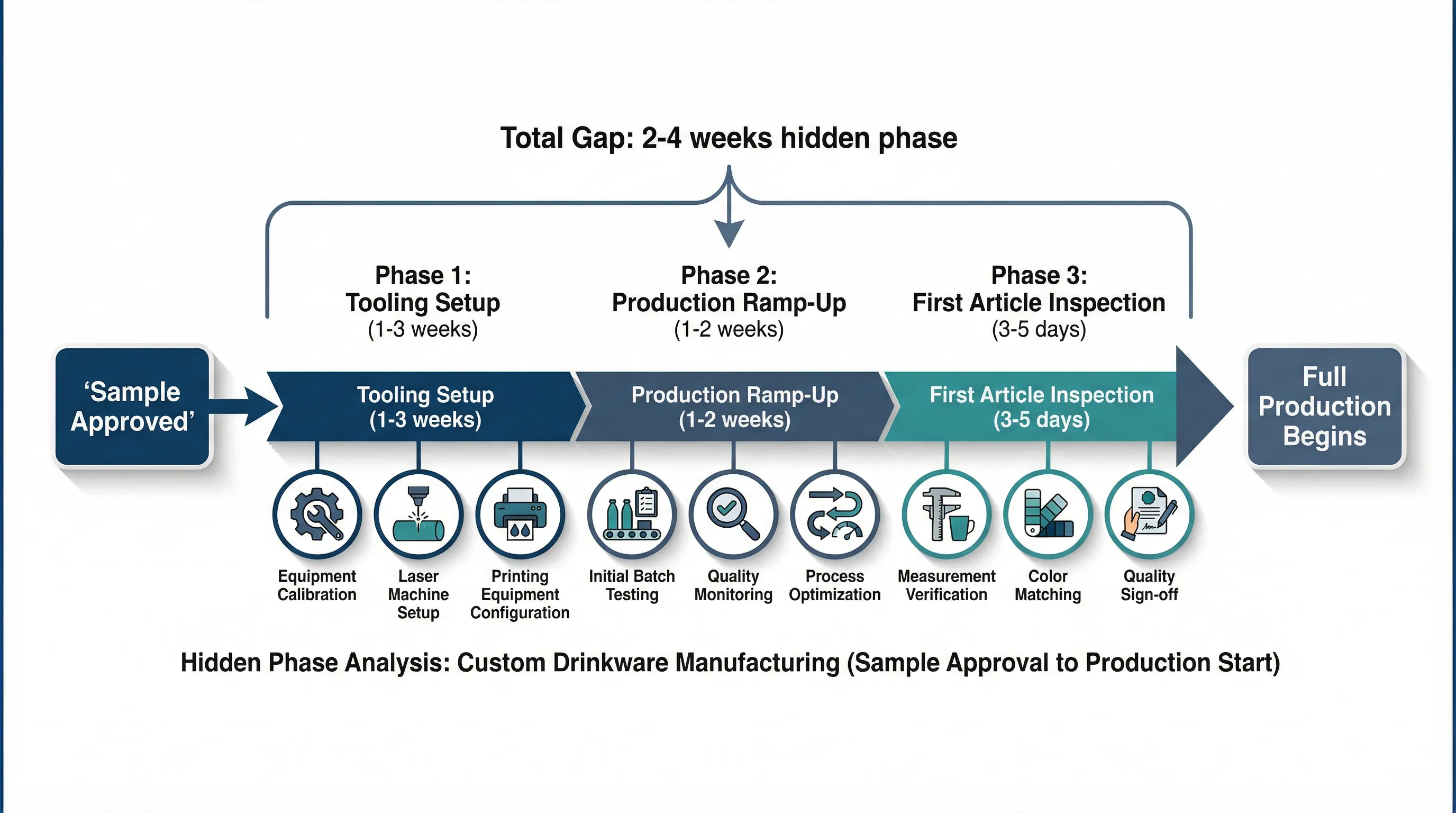
The gap between sample approval and the actual start of production is one of the least discussed phases in custom drinkware manufacturing, yet it represents a critical quality assurance checkpoint that cannot be compressed without introducing significant risk. From a compliance perspective, this phase exists for a reason that has nothing to do with factory inefficiency or scheduling delays. It exists because a sample and a production run are fundamentally different manufacturing contexts, and bridging these two contexts requires deliberate preparation.
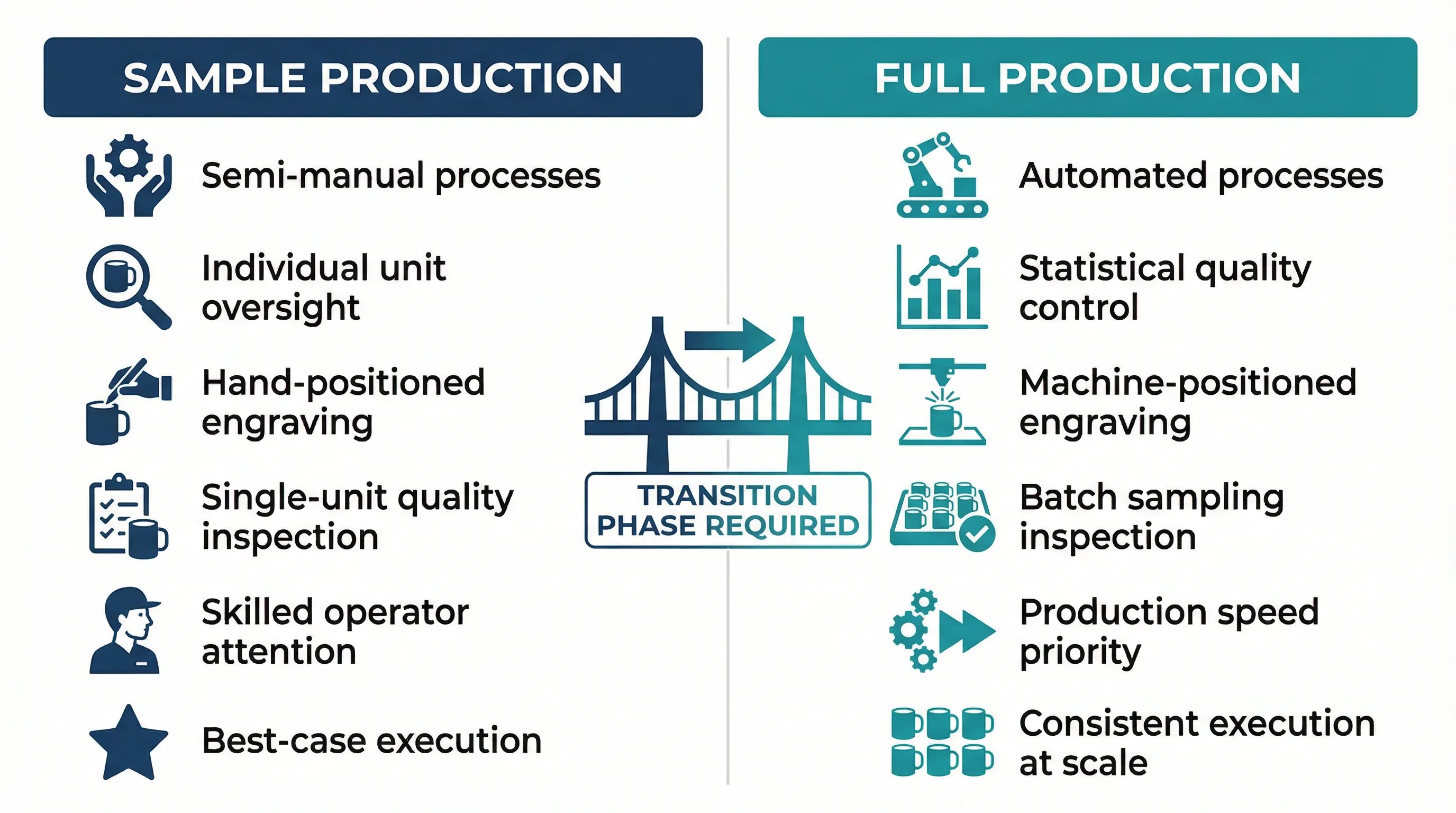
Consider what happens when a factory produces a sample of a custom stainless steel bottle. The sample is typically manufactured using semi-manual processes, with skilled operators overseeing each step. The laser engraving is positioned by hand. The powder coating is applied with close attention to coverage uniformity. The vacuum insulation seal is tested individually. Every aspect of the sample receives focused quality oversight because the factory understands that this single unit will determine whether the entire order proceeds. The result is a sample that represents the best possible execution of the design specification.
Full production, however, operates under entirely different conditions. The same laser engraving that was positioned by hand during sampling must now be executed by automated equipment running at production speed. The powder coating that was carefully inspected on a single unit must now be applied consistently across hundreds or thousands of units per day. The vacuum seal that was tested individually must now be validated through statistical sampling methods. The transition from sample-level quality to production-level consistency is not automatic—it requires a distinct phase of preparation that procurement teams rarely account for in their timeline planning.
This preparation phase typically encompasses three activities that occur sequentially after sample approval. The first is tooling setup, which involves configuring all production equipment to match the approved sample specifications. For custom drinkware, this includes calibrating laser engraving machines for the specific logo dimensions and positioning, setting up screen printing or pad printing equipment with the correct ink formulations and curing parameters, and configuring assembly stations for any custom lid or cap configurations. Depending on the complexity of the customization, tooling setup can require one to three weeks.
The second activity is production ramp-up, during which the factory runs initial production batches at reduced capacity. These early batches serve a critical quality function: they reveal any discrepancies between sample-level execution and production-level execution before the full order is manufactured. It is during ramp-up that minor issues emerge—a slight colour variation under different lighting conditions, a positioning drift that only becomes apparent after several hundred units, or a coating adhesion issue that manifests only under production-speed curing. Identifying and correcting these issues during ramp-up prevents them from affecting the entire order. This phase typically extends one to two weeks.
The third activity is first article inspection, a formal quality validation step where the initial production units are measured against the approved sample and the original specification. This inspection verifies that the production process is capable of consistently reproducing the sample quality at scale. For custom drinkware destined for corporate use, first article inspection often includes dimensional verification, print registration measurement, colour matching under standardised lighting, and functional testing of insulation performance or leak resistance. Only after first article inspection confirms that production quality matches sample quality does full-rate production begin.
The practical consequence of this hidden phase is significant. When a factory quotes "eight weeks for production," that figure typically assumes all preparation work has already been completed. The eight weeks represents steady-state production time—the duration required to manufacture the full order once all equipment is configured and the process is running at full efficiency. However, if the order requires two weeks of tooling setup, one week of production ramp-up, and several days of first article inspection, the actual timeline from sample approval to delivery is eleven to twelve weeks, not eight.
Procurement teams that do not account for this phase frequently discover that their expected delivery date has shifted by two to four weeks. They interpret this shift as a factory delay or a failure to meet commitments, rather than recognizing it as a consequence of their own timeline assumptions. The frustration is understandable but misdirected. The factory is not delaying production—it is ensuring that production quality matches the sample that was approved.
From a compliance standpoint, attempting to compress or eliminate this phase introduces quality risk that most organisations would not accept if they understood the trade-off. Skipping tooling setup means production equipment may not be optimally configured, leading to inconsistent results across the order. Rushing production ramp-up means quality issues may not be identified until they have affected a significant portion of the order. Bypassing first article inspection means there is no formal verification that production quality matches sample quality before the full order is manufactured.
For organisations planning custom drinkware projects, the practical guidance is straightforward. When receiving a production lead time quote from a supplier, explicitly ask whether that figure includes tooling setup and production ramp-up, or whether it assumes these phases have already been completed. A transparent supplier will provide a breakdown that separates these phases, allowing for accurate timeline planning. Those working through the complete customization process will find that understanding this hidden phase transforms their ability to set realistic expectations and manage internal stakeholders effectively.
The gap between sample approval and production start is not a delay to be eliminated. It is a quality assurance checkpoint that protects the integrity of the final order. Organisations that understand this distinction plan their timelines accordingly and avoid the frustration of discovering, weeks into what they thought was the production phase, that their custom drinkware order has not yet begun manufacturing.