How Rush Orders Transform What MOQ Delivers for Custom Drinkware
Key procurement answer
The same order quantity under compressed timelines produces different results. Understanding why time pressure changes production outcomes for branded bottles and mugs.
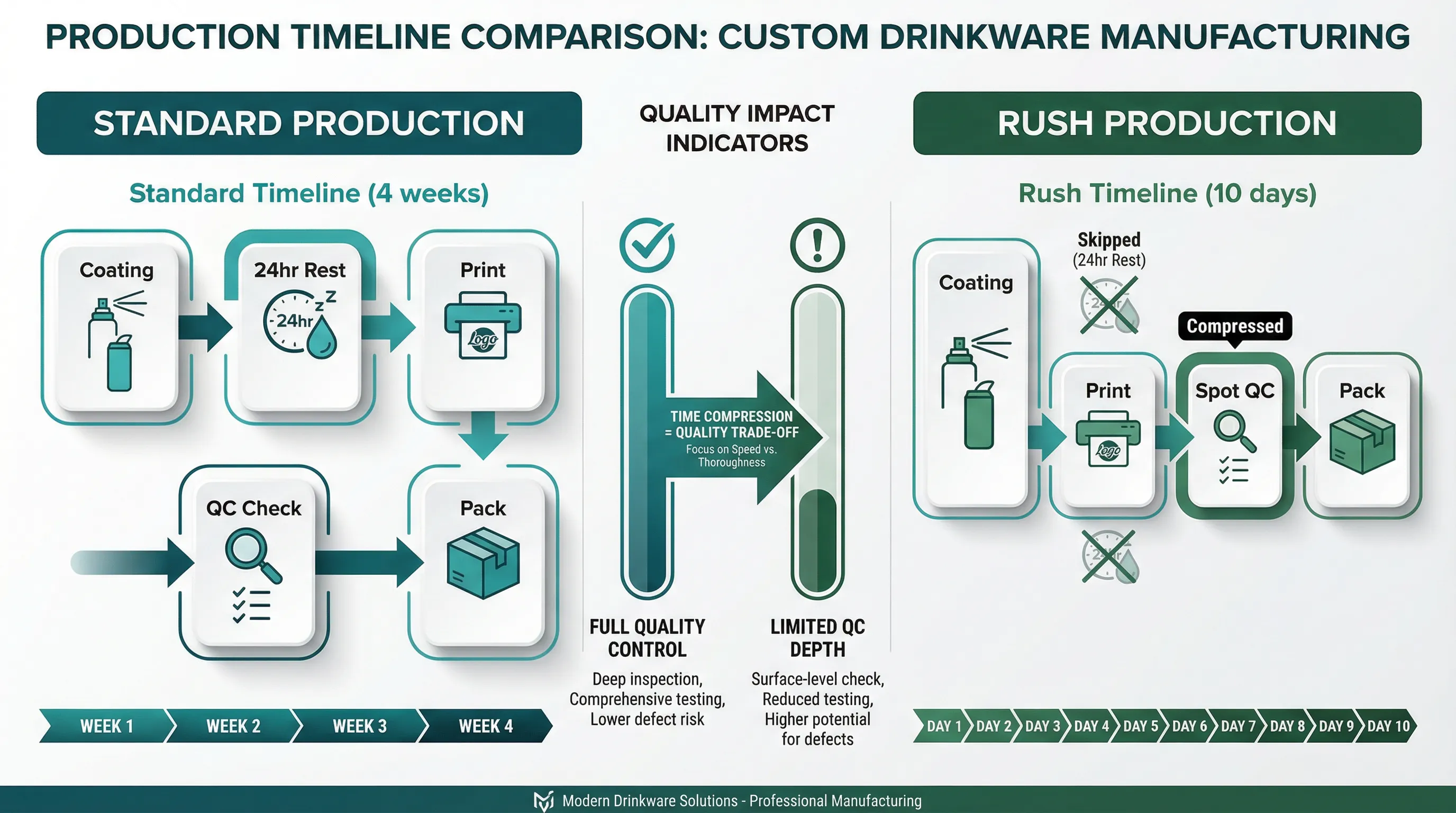
When a procurement request lands with a compressed timeline—an event moved forward, a product launch accelerated, an executive decision made late—the instinct is to ask whether the supplier can expedite. The answer is usually yes. What that answer conceals is that the production run you receive under rush conditions is not the same production run you would have received under standard lead times, even if the order quantity, specifications, and pricing remain identical.
This distinction matters because the minimum order quantity on a quote sheet represents more than just a number of units. It represents a production configuration—a set of assumptions about how the factory will allocate resources, sequence operations, and conduct quality verification. When time pressure enters the equation, those assumptions change. The MOQ number stays the same, but what it delivers shifts in ways that are rarely made explicit.
What Compression Does to Production
Consider what happens when a standard four-week production window for custom stainless steel water bottles compresses to ten days. The powder coating process, which typically includes a full cure cycle followed by a twenty-four-hour rest period before inspection, gets abbreviated. The coating still cures, but the rest period shrinks or disappears entirely. Units move to printing before the coating has fully stabilised, which can affect adhesion and durability in ways that only become apparent weeks or months after delivery. The bottles pass inspection because they meet specification at the moment of shipment. Whether they continue to meet specification through normal use is a different question.
The same compression affects every stage of production. Screen printing on ceramic mugs requires registration checks at intervals throughout the run to ensure logo placement remains consistent. Under standard timelines, these checks happen every few hundred units. Under rush conditions, the interval stretches—not because the operator is cutting corners, but because the schedule does not permit the same frequency of verification. The result is greater variation within the batch, with units at the beginning and end of the run potentially showing different registration accuracy than units in the middle.
Insulated Drinkware and Vacuum Testing
For insulated drinkware—vacuum-sealed travel mugs and tumblers—the implications are more significant. Vacuum integrity testing, which verifies that the insulation layer will perform as specified, is a time-consuming process. Each unit ideally sits for a period after sealing to allow any slow leaks to manifest before testing. Rush production compresses or eliminates this waiting period, meaning units ship with less certainty about long-term vacuum retention. A tumbler that keeps drinks cold for twelve hours on day one may only manage eight hours six months later, and that degradation traces back to a production schedule that did not allow for proper verification.
The Real Question for Procurement
The practical question for procurement teams is not whether rush production is possible—it almost always is—but whether the timeline pressure justifies the quality trade-offs that come with it. This requires understanding that the relationship between order quantities and production outcomes is not fixed. The same MOQ under different timeline conditions produces different results, and those differences compound when the merchandise is intended for high-visibility applications like executive gifts, client appreciation programmes, or branded employee welcome kits.
Managing Expectations
Suppliers rarely volunteer this information because the trade-offs are difficult to quantify and even more difficult to guarantee against. A factory cannot promise that rush production will produce identical results to standard production, but neither can it specify exactly how the results will differ. The variation depends on which steps get compressed, which operators are available, and what other orders are competing for the same resources. What can be said with confidence is that compressed timelines reduce the margin for error at every stage, and that reduction manifests as increased variability in the finished product.
The decision to expedite is sometimes unavoidable. Events have fixed dates, and missing them is not an option. In those cases, the appropriate response is not to avoid rush production but to adjust expectations accordingly—to understand that the batch arriving under time pressure may require more careful inspection on receipt, may show greater unit-to-unit variation, and may not represent the supplier's best work. That understanding allows for more realistic planning and reduces the friction that arises when delivered goods do not quite match what the sample suggested they would be.