Why Approved Samples Don't Guarantee Production Quality
Key procurement answer
Understanding the gap between sample production conditions and bulk manufacturing—and why this distinction matters for procurement decisions.
When a pre-production sample arrives and meets every specification—colour accuracy, logo placement, material weight, finish quality—there is a natural inclination to treat the approval as a guarantee. The sample represents what the bulk order will look like. The procurement team signs off, the purchase order is issued, and the production run begins. What happens next, in a significant number of cases, is that the delivered goods do not quite match the approved sample. The colour is slightly different. The print registration is less precise. The finish has a different texture. None of these variations are necessarily defects in the contractual sense, but they represent a gap between expectation and reality that could have been anticipated.
The assumption that an approved sample guarantees production quality is one of the more persistent misunderstandings in corporate merchandise procurement. It stems from a reasonable but incomplete mental model of how manufacturing works. In that model, the sample is a miniature version of the production run—same materials, same process, same people, just fewer units. In practice, sample production and bulk production often operate under fundamentally different conditions, and understanding those differences is essential to managing quality expectations.
The Sample Line Reality
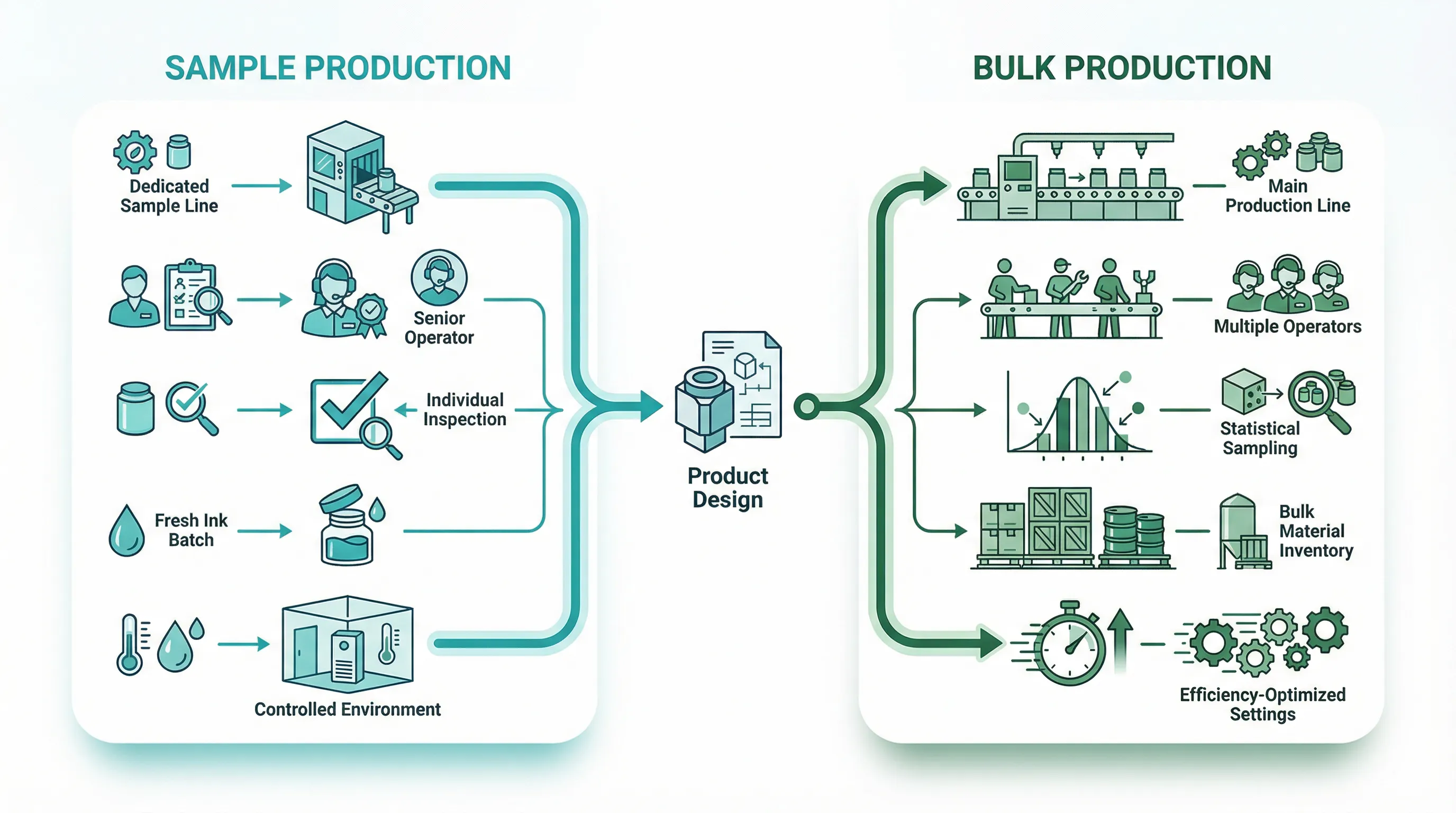
Most suppliers maintain separate workflows for samples and production orders. A sample request typically routes to a dedicated sample line or, in smaller operations, to a senior technician who handles pre-production work exclusively. This person is often the most experienced operator on the floor, someone who understands the nuances of colour matching, can adjust equipment settings on the fly, and takes the time to inspect each unit before it ships. The sample that arrives on your desk is, in effect, the best possible version of the product—made under ideal conditions by someone whose primary concern is approval, not throughput.
When the bulk order enters production, the dynamics shift. The work moves to the main production line, where operators are measured on output volume and cycle time. The equipment may be the same, but the settings are optimised for speed rather than precision. Material is drawn from bulk inventory rather than the small batch reserved for sampling. Quality control shifts from individual inspection to statistical sampling. None of this is negligence; it is simply how manufacturing at scale operates. The economics of producing five hundred units are different from the economics of producing five, and those economics influence every decision on the production floor.
Where Variation Occurs
Colour variation is perhaps the most common manifestation of this gap. A sample produced with a fresh ink batch, mixed specifically for the approval process, will not necessarily match a production run using ink from a larger batch mixed weeks later. Environmental factors—humidity, temperature, even the age of the substrate—can shift colour output in ways that are imperceptible on a single unit but noticeable across a batch. Suppliers who understand this will build in colour tolerance ranges, but procurement teams who expect exact replication of the sample are often surprised by the result.
Print quality follows a similar pattern. A screen print sample produced at low speed with careful squeegee pressure will show crisp edges and full ink coverage. The same design printed at production speed may exhibit slight bleeding, thinner coverage, or minor registration drift. These variations typically fall within acceptable quality standards, but they can be jarring to a buyer who approved a sample expecting identical reproduction.
Managing Expectations
The practical implication is not that samples are unreliable, but that they should be understood for what they are: a representation of capability under controlled conditions, not a contractual specification for bulk output. When evaluating a sample, the relevant question is not whether it looks perfect, but whether the supplier can consistently produce at an acceptable quality level across the full order quantity. That assessment requires looking beyond the sample itself to the supplier's quality control processes, their tolerance specifications, and their track record on similar orders.
For organisations placing orders near the minimum quantity threshold, this distinction becomes particularly relevant. Smaller orders often receive more individual attention during production, which can narrow the gap between sample and bulk quality. Larger orders, by contrast, are more susceptible to the efficiency pressures that create variation. Understanding where your order falls on that spectrum—and what quality controls the supplier applies at different volumes—provides a more realistic foundation for expectations than the sample alone can offer.
The sample approval process is a necessary step in procurement, but treating it as a quality guarantee conflates two different things: the supplier's ability to produce a high-quality unit and their ability to reproduce that quality at scale. The first is demonstrated by the sample. The second requires a different kind of due diligence.