Why Your Supplier's MOQ Reflects Production Line Economics
Key procurement answer
The setup fee on a quote is visible. The two to four hours of line downtime during changeover is not. Understanding why minimum order quantities exist to recover hidden costs.
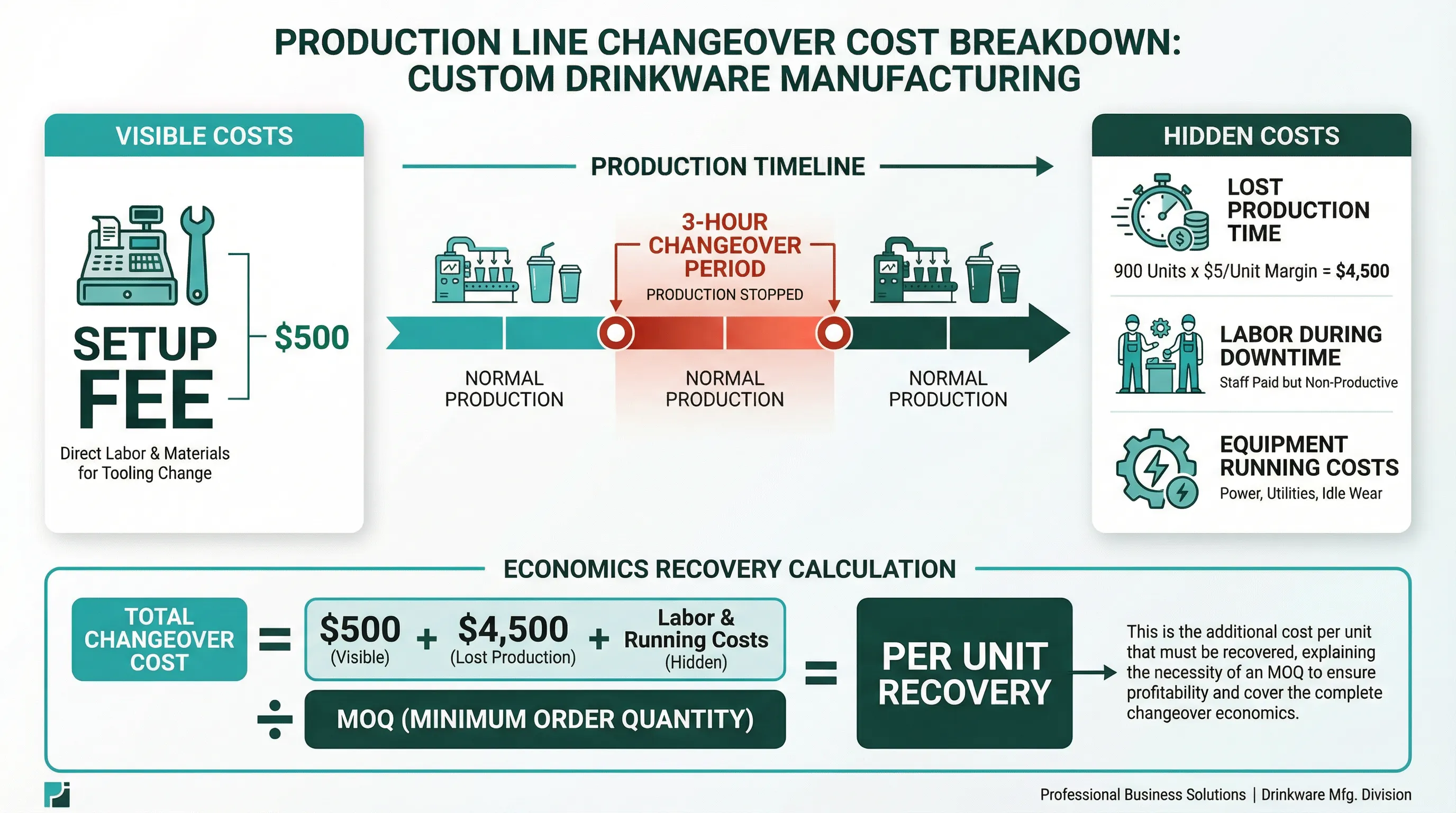
The setup fee line on a quote for custom stainless steel bottles or branded ceramic mugs typically shows a fixed amount—perhaps five hundred dollars, perhaps a thousand. What that number does not show is the two to four hours of production line downtime required to switch from one order to the next, during which the factory earns nothing while operators clean equipment, recalibrate settings, run test pieces, and verify that the new configuration will produce acceptable results. The minimum order quantity that appears below the setup fee exists primarily to recover the cost of that downtime, distributed across enough units to make the changeover economically viable.
This relationship between changeover time and order quantity is fundamental to understanding why suppliers set the minimums they do, yet it remains largely invisible to procurement teams evaluating quotes. The setup fee appears as a discrete, quantifiable cost. The changeover downtime does not appear at all. The result is a tendency to view MOQ as arbitrary or negotiable, when in practice it represents a calculation about how many units must be produced to justify stopping the line, reconfiguring it, and starting again.
The Economics of Line Changeover
Consider what happens when a powder coating line switches from one colour to another for custom insulated tumblers. The line must be flushed to remove residual powder from the previous run. Spray guns are cleaned and recalibrated. The curing oven temperature profile is adjusted if the new powder formulation requires different heat treatment. Test pieces are coated and inspected to confirm colour match and adhesion before production units enter the line. This process consumes two to three hours of time during which the line produces nothing, yet operators are paid, equipment runs, and overhead costs accumulate.
If the line normally produces three hundred units per hour and the changeover takes three hours, the factory foregoes nine hundred units of output to accommodate the new order. If those units would have generated a contribution margin of five dollars each, the changeover represents four thousand five hundred dollars in lost opportunity cost, in addition to the direct labour and material costs of the changeover itself. The setup fee on the quote recovers some of this cost, but rarely all of it. The remainder must be distributed across the production run, which is why the factory sets a minimum order quantity that ensures the per-unit recovery is economically rational.
Why This Matters for Procurement Decisions
When a procurement team negotiates for a lower MOQ or requests a quote at the supplier's stated minimum, they are asking the supplier to absorb more of the changeover cost per unit. This is not inherently problematic if the relationship is ongoing and the supplier expects future orders that will offset the thin margins on the initial run. It becomes problematic when the pattern repeats—when every order arrives at minimum quantity, leaving the supplier with a portfolio of low-margin changeovers that collectively undermine profitability.
Suppliers respond to this pattern in predictable ways. They raise the MOQ. They increase the setup fee. They deprioritize orders from customers who consistently order at minimum, scheduling them during off-peak periods or after higher-volume clients. They reduce the attention given to quality verification, not out of malice but because the economics of the order do not support the same level of process oversight that a larger run would justify. These responses are not punitive; they are adjustments to align the cost structure with the revenue the order generates.
The Hidden Subsidy
What this means in practice is that ordering at minimum quantity often involves an implicit subsidy from the supplier—a willingness to accept lower margins in the expectation that the relationship will develop into something more substantial. Understanding the economics behind order quantities clarifies why this subsidy cannot be assumed to continue indefinitely. A supplier who consistently receives minimum-quantity orders from the same customer will eventually conclude that the relationship is not developing as anticipated, and will adjust terms accordingly.
For organisations sourcing custom drinkware for corporate programmes, employee gifting, or client appreciation, this dynamic has practical implications. Ordering at minimum may be appropriate for a pilot programme or a one-time event, but it is not a sustainable strategy for ongoing merchandise needs. The supplier's willingness to accommodate minimum orders depends on the expectation that future orders will be larger, more frequent, or both. When that expectation is not met, the terms change.
The alternative is to structure orders in a way that acknowledges the changeover economics—consolidating smaller needs into less frequent but larger orders, coordinating timing across departments to combine requirements, or accepting that the per-unit cost will be higher for genuinely one-off needs. These approaches align the procurement strategy with the supplier's cost structure, which tends to produce more stable pricing, more reliable delivery, and better quality outcomes over time.