When Product Specification Upgrades Outpace MOQ Consumption Timelines in Custom Drinkware
Key procurement answer
The calculation shows 3.3 years to consume the order. The specification remains unchanged. Yet eighteen months later, six thousand units remain unsellable. Understanding why technical standards evolve faster than inventory depletion reveals a critical blind spot in minimum order quantity planning.
The procurement manager presents a straightforward calculation. The supplier quotes ten thousand units at a competitive unit price. Annual consumption sits at three thousand units. The timeline shows 3.3 years to deplete inventory. The finance team approves based on acceptable carrying costs over that period. The purchase order moves forward. Eighteen months later, the same manager returns with a problem: six thousand units remain in the warehouse, but the sales team refuses to accept them for customer orders. The specification has not changed. The branding remains identical. The bottles still hold liquid and maintain temperature. Yet the inventory has become unsellable. The issue is not what the product does—it is what the product no longer represents in the market.
This scenario repeats across procurement teams ordering custom drinkware, and the pattern reveals a structural blind spot in [how minimum order quantities interact with product lifecycle planning](https://ethermfg.co.nz/blog/minimum-order-quantity-guide-nz). The calculation assumes the product specification will remain market-acceptable for the duration of the consumption timeline. It treats technical standards as static variables. In practice, product specifications evolve independently of inventory depletion rates, and when specification upgrades become market expectations rather than premium features, existing inventory transitions from "current stock" to "obsolete specification" regardless of remaining quantity or physical condition.
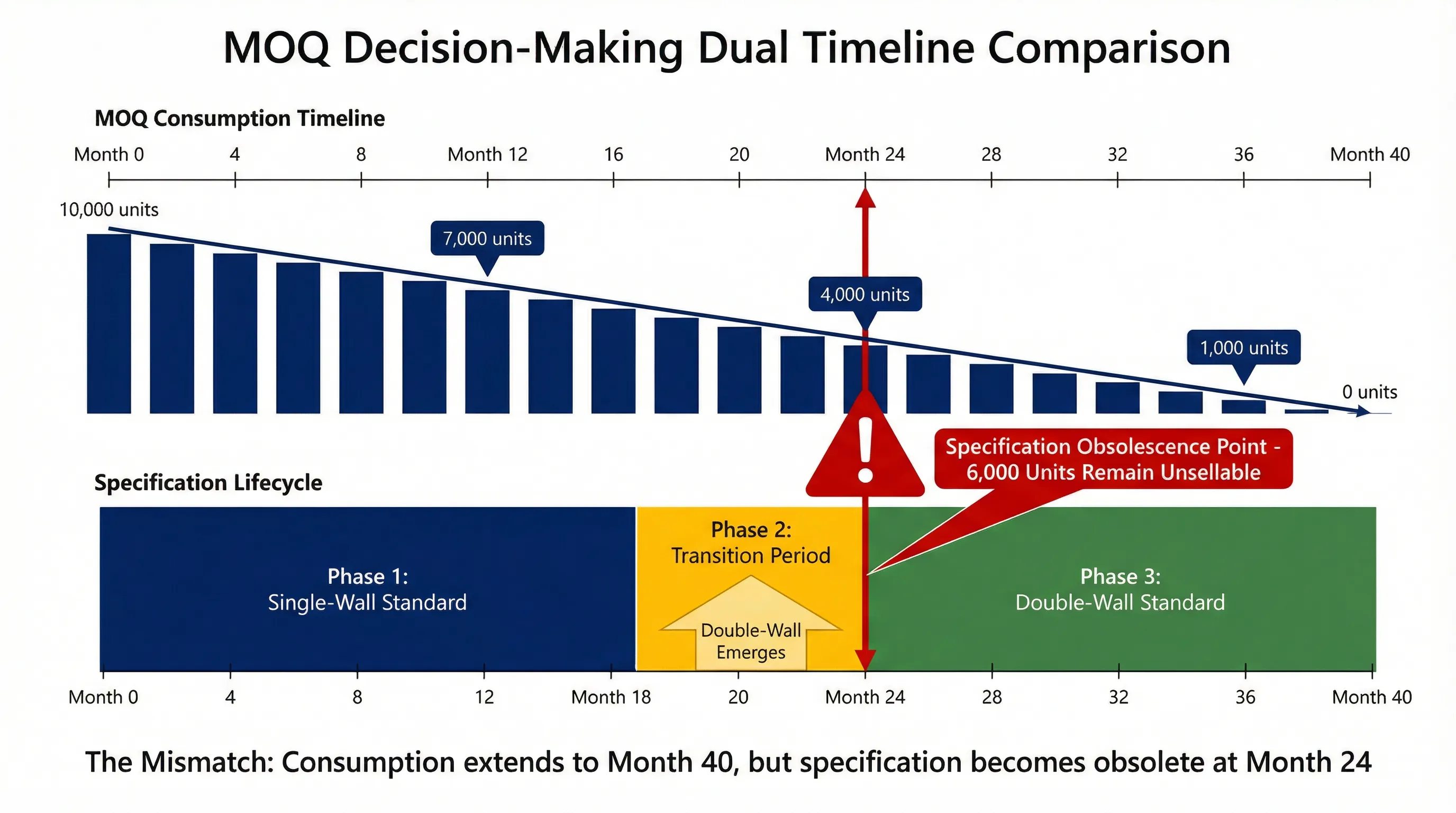
Specification upgrade timeline versus MOQ consumption timeline mismatch
The shift from single-wall to double-wall vacuum insulation technology in stainless steel drinkware illustrates this dynamic. A procurement team orders ten thousand single-wall vacuum bottles in early 2022. The specification represents the market standard. Competitors offer similar products. Customers accept the performance characteristics without question. The unit economics justify the minimum order quantity. The consumption forecast shows 3.3 years to full depletion based on historical demand patterns. The decision appears sound according to conventional minimum order quantity evaluation frameworks.
By mid-2023, double-wall vacuum technology becomes widely available from Asian manufacturers. The performance improvement is measurable—heat retention increases by twenty to forty percent compared to single-wall designs. Initial market response treats double-wall as a premium option. Corporate buyers continue ordering single-wall products for standard programmes. The procurement team monitoring their inventory sees no immediate concern. Consumption continues at projected rates. The specification has not changed. The product still functions as designed.
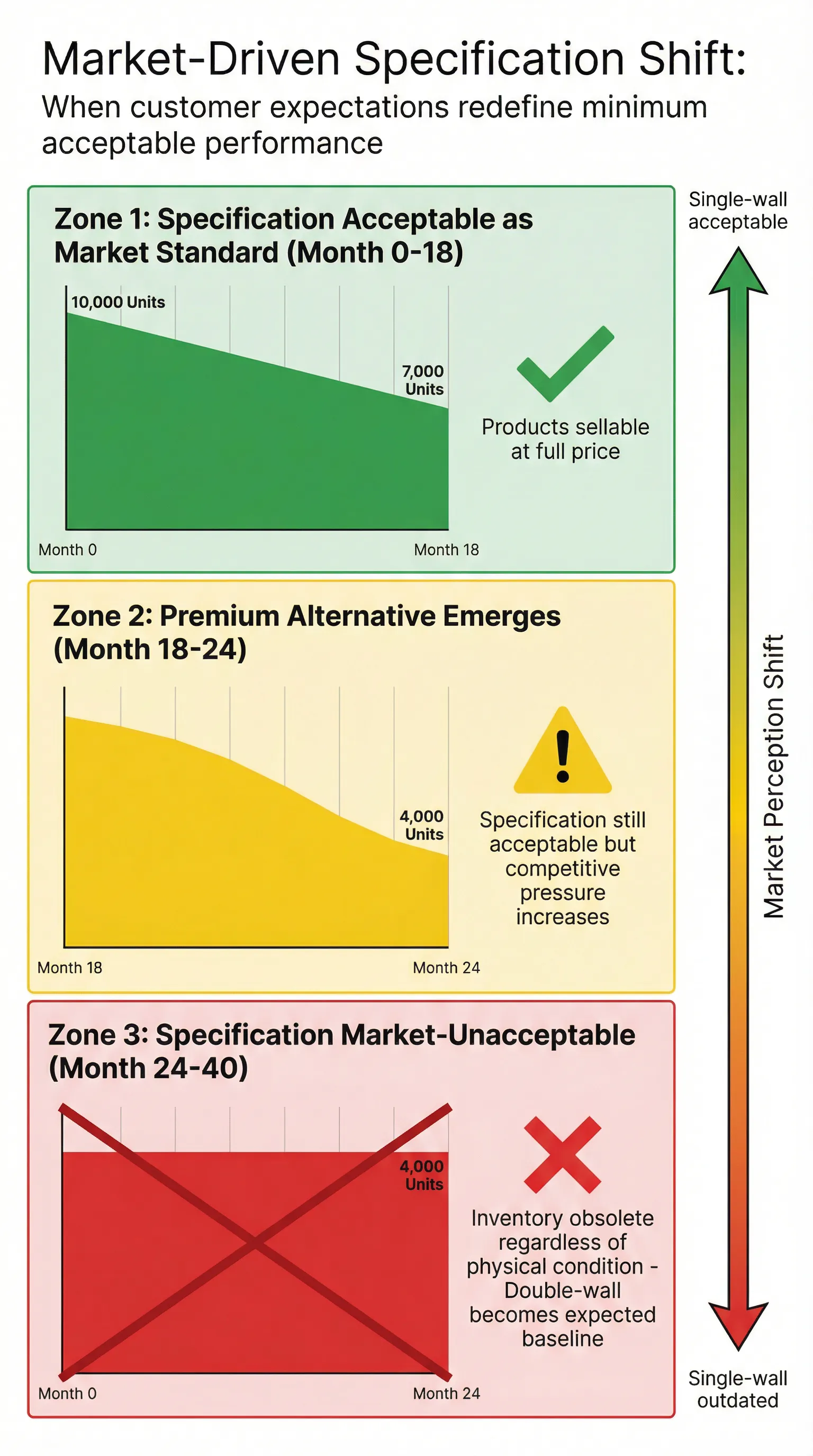
The inflection point arrives between late 2023 and early 2024. What began as a premium feature becomes the expected baseline. Corporate buyers begin specifying double-wall technology in tender documents. Sales teams report customer questions about insulation performance. Competitors promote double-wall as standard rather than premium. The market perception shifts from "single-wall is acceptable, double-wall is better" to "single-wall is outdated, double-wall is standard". This transition does not announce itself through formal industry notifications or regulatory changes. It emerges through accumulated competitive pressure and shifting customer expectations.
The procurement team now faces six thousand units of single-wall inventory. The bottles remain physically sound. The vacuum seal maintains integrity. The branding matches current corporate identity. The specification has not degraded. Yet the inventory has become functionally obsolete because the market baseline has moved. Customers who previously accepted single-wall technology now expect double-wall performance. The sales team cannot position single-wall products without significant discounting that erodes the original unit cost savings from the minimum order quantity. The organisation has not changed its product requirements—the market has changed its definition of acceptable performance.
The financial impact extends beyond the direct inventory write-off. The organisation has incurred storage costs for eighteen months on inventory that will never be consumed at the projected rate. The procurement team must now place a new order for double-wall technology to meet current demand, creating duplicate inventory carrying costs. The sales team loses opportunities because they cannot offer products that meet current market specifications. The original minimum order quantity decision, which appeared economically sound based on consumption timeline analysis, has generated losses that exceed any unit price savings from bulk ordering.
This pattern differs fundamentally from brand obsolescence scenarios where internal decisions about visual identity trigger inventory issues. Specification upgrades are market-driven rather than internally controlled. A company can delay a logo refresh or maintain brand consistency across multi-year periods. A company cannot prevent the market from redefining performance baselines. When competitors adopt superior specifications and customers begin expecting those specifications as standard, existing inventory becomes obsolete regardless of internal planning timelines.
Market-driven specification shift creating three risk zones for MOQ inventory
The challenge compounds in custom drinkware because specification upgrades often involve manufacturing technology rather than cosmetic features. A logo can be applied to any base product. A colour can be matched across different production runs. But vacuum insulation technology is embedded in the product structure. A single-wall bottle cannot be upgraded to double-wall specification. The manufacturing process determines the specification at production. Once the minimum order quantity is produced, the specification is locked for the entire inventory volume.
Procurement teams typically evaluate minimum order quantity decisions using consumption timelines derived from historical demand data. The forecast assumes the product will remain sellable at current rates throughout the depletion period. This assumption holds when product specifications are stable or when specification changes are incremental and backward-compatible. It fails when specification upgrades create a performance gap large enough that customers perceive the previous specification as inadequate rather than merely inferior.
The distinction between "inferior" and "inadequate" determines whether inventory remains sellable. An inferior product can still be sold, often at a discount that reflects the performance gap. An inadequate product cannot be sold at any price point that recovers costs because it fails to meet the minimum threshold of market acceptability. Single-wall vacuum bottles did not become inferior when double-wall technology emerged—they became inadequate once double-wall became the expected baseline. The market redefined the minimum acceptable specification, and products below that threshold lost commercial viability.
The procurement consultant observing these patterns across multiple clients notices that specification obsolescence correlates with three factors: the magnitude of performance improvement in the new specification, the speed of market adoption by competitors, and the visibility of the specification difference to end customers. Double-wall vacuum technology scored high on all three factors. The performance improvement was quantifiable and significant. Competitors adopted the technology rapidly once manufacturing costs decreased. Customers could easily understand the difference through simple performance comparisons.
The solution is not to avoid minimum order quantities or to order only small volumes. The solution is to incorporate specification lifecycle assessment into minimum order quantity timeline calculations. This requires asking different questions during the procurement decision process. Instead of "How long will it take to consume this inventory?", the question becomes "How long will this specification remain market-acceptable?" Instead of "What is our annual consumption rate?", the question becomes "What is the probability of specification upgrade within the consumption timeline?"
These questions do not have precise answers, but they shift the analytical framework from assuming specification stability to evaluating specification risk. A procurement team ordering custom drinkware in 2022 could have observed that vacuum insulation technology was an active area of manufacturing innovation. They could have noted that performance improvements in insulation technology create clear value propositions for customers. They could have assessed that the market was in a transition phase where premium specifications were becoming more accessible. These observations would not have predicted the exact timing of the shift from single-wall to double-wall as market standard, but they would have flagged specification risk as a variable in the minimum order quantity decision.
The practical response to specification risk involves several strategies. First, procurement teams can negotiate staged delivery arrangements where the supplier holds inventory and ships in smaller batches over time. This does not eliminate specification risk, but it reduces the exposure by shortening the period between production and consumption. If a specification upgrade occurs mid-way through the delivery schedule, the organisation can potentially negotiate specification changes for remaining batches rather than being locked into the full minimum order quantity at the original specification.
Second, procurement teams can build specification flexibility into supplier agreements. Some manufacturers can adapt production specifications mid-contract if the change involves technology they have already developed for other clients. A supplier producing both single-wall and double-wall bottles for different customers can potentially switch a client's remaining order volume from single-wall to double-wall specification if the client covers any incremental tooling or setup costs. This flexibility is not always available, but it is worth negotiating as a contractual option when placing large minimum order quantity orders.
Third, procurement teams can adjust their minimum order quantity acceptance thresholds based on specification risk assessment. A product with high specification risk warrants a more conservative approach to minimum order quantities even if the unit economics appear favourable. The potential cost of specification obsolescence should be factored into the total cost analysis alongside traditional variables like unit price, storage costs, and capital tied up in inventory. A higher unit price from a supplier offering lower minimum order quantities may prove more economical than a lower unit price from a supplier requiring high minimum order quantities if specification risk is material.
The broader implication is that minimum order quantity decisions in custom drinkware—and in any product category where technical specifications evolve—cannot be evaluated purely through consumption timeline mathematics. The timeline must account for specification lifecycle as well as inventory depletion. When specification upgrade cycles are shorter than consumption timelines, the organisation faces structural risk of specification obsolescence regardless of how accurately it forecasts demand. The bottles will still be in the warehouse when the market no longer wants that specification.
This is not a failure of demand forecasting. The demand for insulated drinkware remained stable. The failure was in specification lifecycle forecasting—in not recognising that the product specification itself had a shorter market life than the inventory consumption timeline. The organisation correctly predicted how many bottles it would need. It incorrectly assumed those bottles would remain sellable in their original specification throughout the consumption period. The distinction matters because it points to a different analytical requirement in minimum order quantity decisions.
Procurement teams cannot prevent specification upgrades from occurring in the market. They cannot control the pace of manufacturing innovation or the speed at which competitors adopt new specifications. What they can control is how they factor specification lifecycle into minimum order quantity commitments. The calculation needs to include not just "how long to consume" but "how long until this specification becomes market-unacceptable". When the second timeline is shorter than the first, the minimum order quantity decision carries specification obsolescence risk that may outweigh any unit cost advantages from bulk ordering.
The six thousand single-wall bottles sitting in the warehouse represent more than excess inventory. They represent a decision framework that treated product specifications as constants when they were actually variables. The bottles have not failed. The specification has expired. And the expiration was predictable not in its exact timing but in its inevitability once the performance gap between old and new specifications became large enough to shift market expectations. The procurement team did not make a bad decision based on the information framework they used. They used an incomplete information framework that did not account for specification lifecycle as a constraint on minimum order quantity timelines.