Why the Branding Method You Approved on a Sample May Fail in Real-World Use: Corporate Drinkware Gifts
Key procurement answer
The gap between how a branded drinkware sample looks in a conference room and how it performs after six months of daily use is one of the most overlooked misjudgments in corporate gift procurement.
When a procurement team evaluates branding options for corporate drinkware gifts, the decision almost always happens in a conference room. Samples arrive from the supplier — a stainless steel bottle with a laser-engraved logo, another with a full-colour UV print, perhaps a third with screen-printed branding in the company’s Pantone colours. The team passes them around, holds them under the office lights, compares the visual impact, and makes a selection. The chosen method is the one that looks best at that moment, in that room, under those conditions. What almost never enters the evaluation is what the branding will look like after six months of actual use — after repeated dishwasher cycles, daily handling, exposure to cleaning chemicals, and the accumulated micro-abrasion of being carried in bags, placed on desks, and knocked against other objects. This gap between sample-condition evaluation and end-use reality is one of the most consequential and least examined misjudgments in corporate gift procurement.
The problem is structural, not negligent. Branding method selection sits at the intersection of marketing preference and manufacturing capability, and procurement teams are typically guided by visual appeal rather than material science. A UV-printed full-colour logo on a powder-coated stainless steel bottle looks striking in a sample — vivid colours, sharp edges, photographic detail. It is also, in many production configurations, an ink layer sitting on top of a coating layer sitting on top of metal. The adhesion between these layers depends on surface preparation, ink formulation, curing parameters, and the chemical compatibility between the UV ink and the specific powder coating beneath it. When the bottle enters a commercial dishwasher operating at 65–75 degrees Celsius with alkaline detergent, the thermal cycling and chemical exposure begin testing every one of those adhesion interfaces. A domestic dishwasher at home might run at 50–55 degrees with milder detergent, which is why the supplier’s claim that the product is “dishwasher safe” can be technically accurate while being practically misleading for corporate environments where the drinkware ends up in office kitchen dishwashers running institutional cycles.
Screen printing on drinkware introduces a different failure pattern. The ink is pressed through a mesh onto the product surface, and its durability depends heavily on the ink system used and the post-print curing process. Solvent-based inks cured at the correct temperature on properly prepared surfaces can deliver reasonable longevity. But the economics of corporate gift production create pressure to use faster-curing ink systems, shorter dwell times, and less rigorous surface preparation — all of which reduce cost per unit while incrementally reducing adhesion quality. The degradation is not immediate. A screen-printed logo typically looks acceptable for the first two to three months of regular use. Then the edges begin to soften. Fine details blur. Colours that were originally saturated start to appear washed out. By the six-month mark, the logo that was approved based on a pristine sample now communicates something the procurement team never intended: that the company’s brand is disposable.
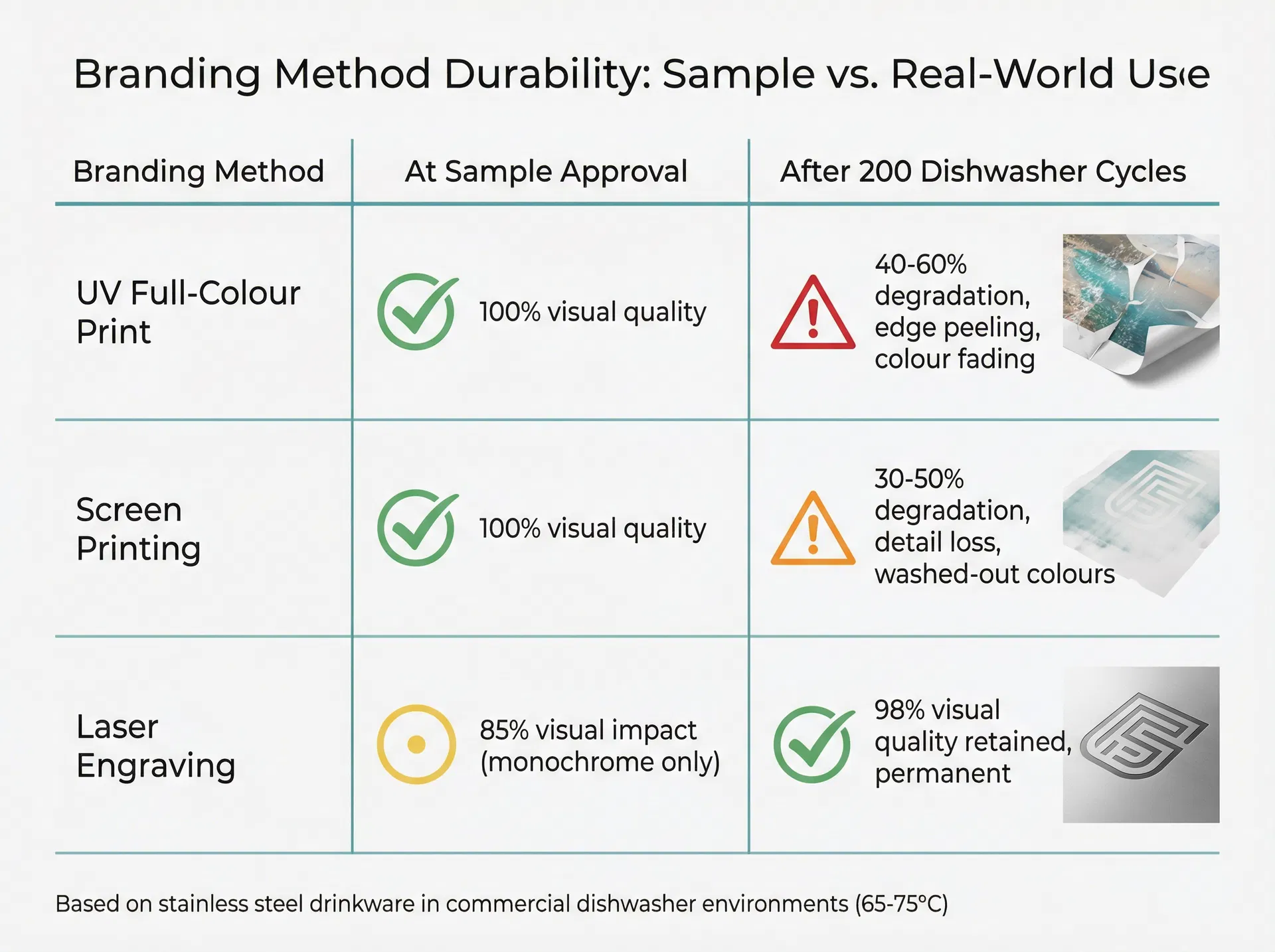
Laser engraving operates on a fundamentally different principle, and understanding this difference is essential to evaluating corporate drinkware gifts accurately. Rather than applying material to the surface, laser engraving removes material from it. The logo is etched into the metal itself, which means there is no adhesion interface to fail, no ink layer to degrade, and no coating-to-substrate bond to weaken over time. The trade-off is that laser engraving is inherently monochromatic — the engraved area reveals the base metal colour against the surrounding finish, which limits the visual complexity of the branding. For procurement teams accustomed to evaluating gifts based on immediate visual impact, this limitation often disqualifies laser engraving during sample review. The irony is that the method rejected for looking too subtle at the point of approval is frequently the only method that would still look professional at the point of use.
This is where the misjudgment compounds. The procurement team’s evaluation criteria are weighted toward first impression — how the gift looks when it is unboxed, handed over, or displayed at an event. These are legitimate considerations, but they represent perhaps the first forty-eight hours of a product’s functional life. A well-made reusable bottle or tumbler might be used daily for twelve to twenty-four months. The branding method that wins the forty-eight-hour evaluation is not necessarily the method that wins the twelve-month evaluation, and the corporate gift programme’s actual objective — sustained brand visibility and positive brand association — is measured across the longer timeframe.
The situation becomes more complex when the product material and the branding method are evaluated independently, which happens more often than it should. A procurement team might select a double-wall vacuum-insulated stainless steel bottle for its premium feel and functional performance, then specify full-colour UV printing because the marketing department wants the brand’s gradient logo reproduced exactly. The bottle selection and the branding specification are both individually reasonable. But the combination creates a product where the highest-value component — the insulated vessel that will perform reliably for years — is paired with a branding method that may visibly degrade within months. The recipient’s experience shifts from “this is a quality gift from a company that values our relationship” to “this company gave me something that’s already falling apart.” The bottle still works. The branding does not. And the branding is the entire reason the gift exists as a corporate investment rather than a personal purchase.
In practice, this is often where corporate gift type decisions start to diverge from their intended outcomes. The procurement specification focuses on product attributes — material, capacity, insulation performance, colour — and treats branding as a secondary decoration step rather than an integral design decision. Suppliers reinforce this by presenting branding options as add-on services with different price points, which frames the decision as a cost question rather than a durability question. The cheapest branding option gets selected because the product itself has already consumed most of the per-unit budget, and the assumption is that all branding methods produce equivalent results. They do not. The cost difference between a screen print that lasts three months and a laser engraving that lasts five years is typically two to four dollars per unit on a product that costs fifteen to twenty-five dollars. As a percentage of the total gift investment, the branding upgrade is marginal. As a percentage of the gift’s functional brand-building lifespan, it is decisive.
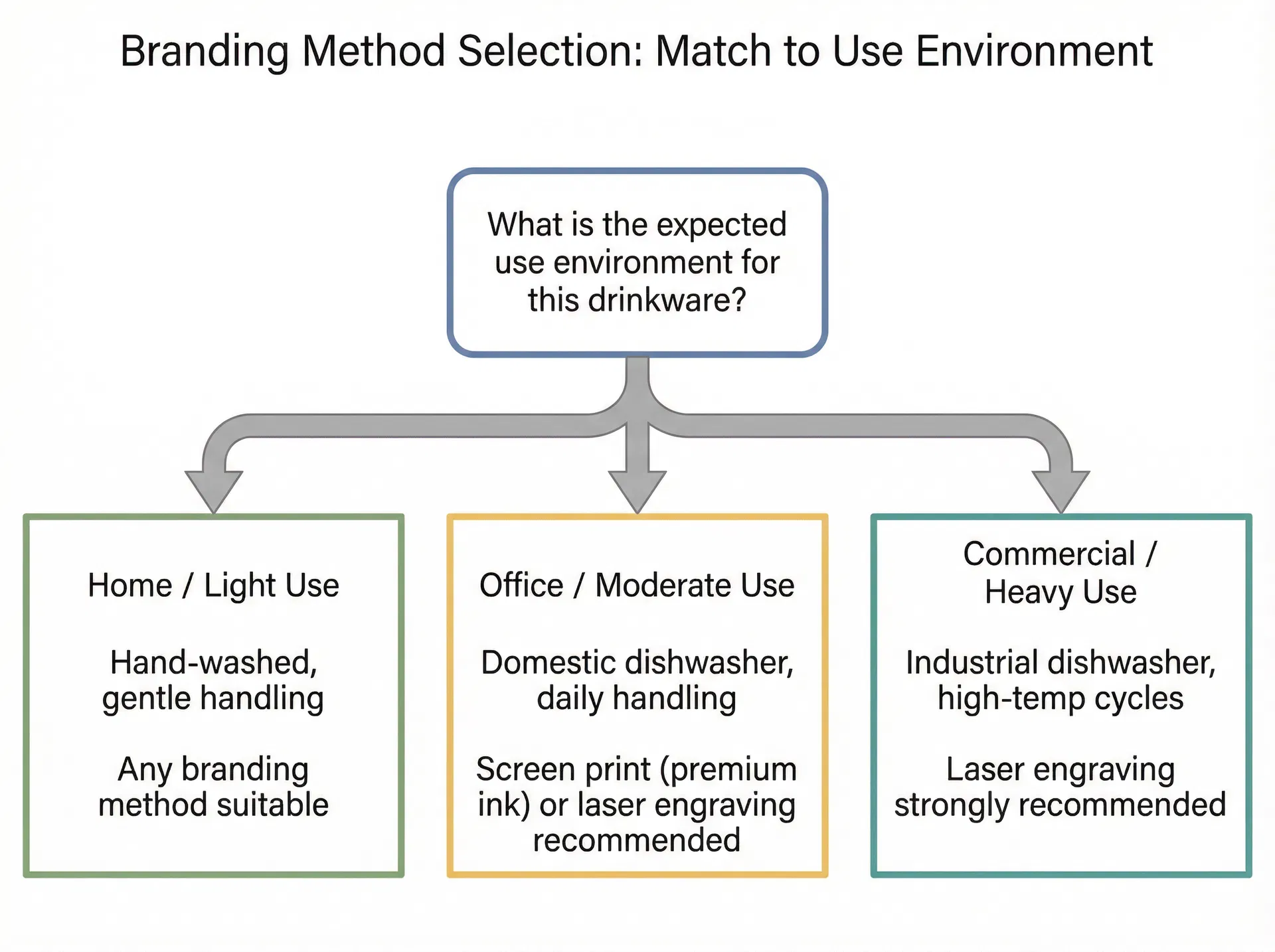
There is a practical checkpoint that rarely appears in corporate gift procurement workflows but probably should. Before finalising the branding method, the specification should explicitly state the expected use environment — will the drinkware be used in an office with a commercial dishwasher, carried outdoors with UV exposure, or used primarily at home? Each environment creates different stress conditions, and the branding method that survives one environment may fail in another. A ceramic coffee mug used exclusively in a home office and hand-washed has very different branding requirements than a stainless steel bottle used in a construction site lunch room and cleaned in an industrial dishwasher. The product might be the same. The branding method should not be.
When evaluating which corporate drinkware products suit different business gifting needs, the branding dimension is almost always subordinated to product selection. Teams invest significant effort in choosing the right vessel — the right material, the right size, the right aesthetic — and then default to whatever branding method the supplier recommends or whatever method reproduces the logo most faithfully on the sample. The supplier’s recommendation is not necessarily wrong, but it is typically optimised for production efficiency and visual appeal at the point of delivery, not for durability at the point of use. The supplier has no visibility into whether the bottle will be hand-washed gently or run through a commercial dishwasher five times a week. That context lives entirely with the buyer, and if the buyer does not introduce it into the specification, the branding method will be selected without it.
The consequence is a category of corporate gift failure that is invisible at the point of purchase and only becomes apparent months later, when the procurement team has moved on to other projects and the recipients are left with products whose branding has quietly deteriorated. No one files a complaint about a logo that fades gradually. The bottle still functions. The recipient simply stops associating it with the gifting company, or worse, begins associating the faded branding with a lack of quality. The gift that was supposed to build a relationship has become a silent detractor, and because the degradation is gradual rather than sudden, there is no single moment that triggers a review of the branding method decision. The procurement team reorders the same product with the same branding method the following year, and the cycle repeats. The only way to interrupt this pattern is to evaluate branding methods under conditions that approximate actual use rather than conditions that approximate a boardroom presentation.