When Capacity Becomes the Reason Corporate Drinkware Gifts Go Unused
Key procurement answer
Why the most common capacity choice in corporate drinkware procurement — 350ml — leads to gifts that are politely received but rarely used, and how reframing the evaluation sequence around daily use scenarios changes the outcome.
There is a pattern in corporate drinkware procurement that repeats itself with remarkable consistency. A procurement team evaluates samples, selects a stainless steel bottle or insulated tumbler that looks sharp and fits the budget, approves the branding, and ships several hundred units to employees or clients. Within three weeks, a significant portion of those bottles are sitting in desk drawers or kitchen cupboards, replaced by whatever vessel the recipient was already using. The product itself was not defective. The branding was intact. The packaging may even have been thoughtful. What went wrong was a specification decision made so early in the process that nobody thought to question it: the capacity.
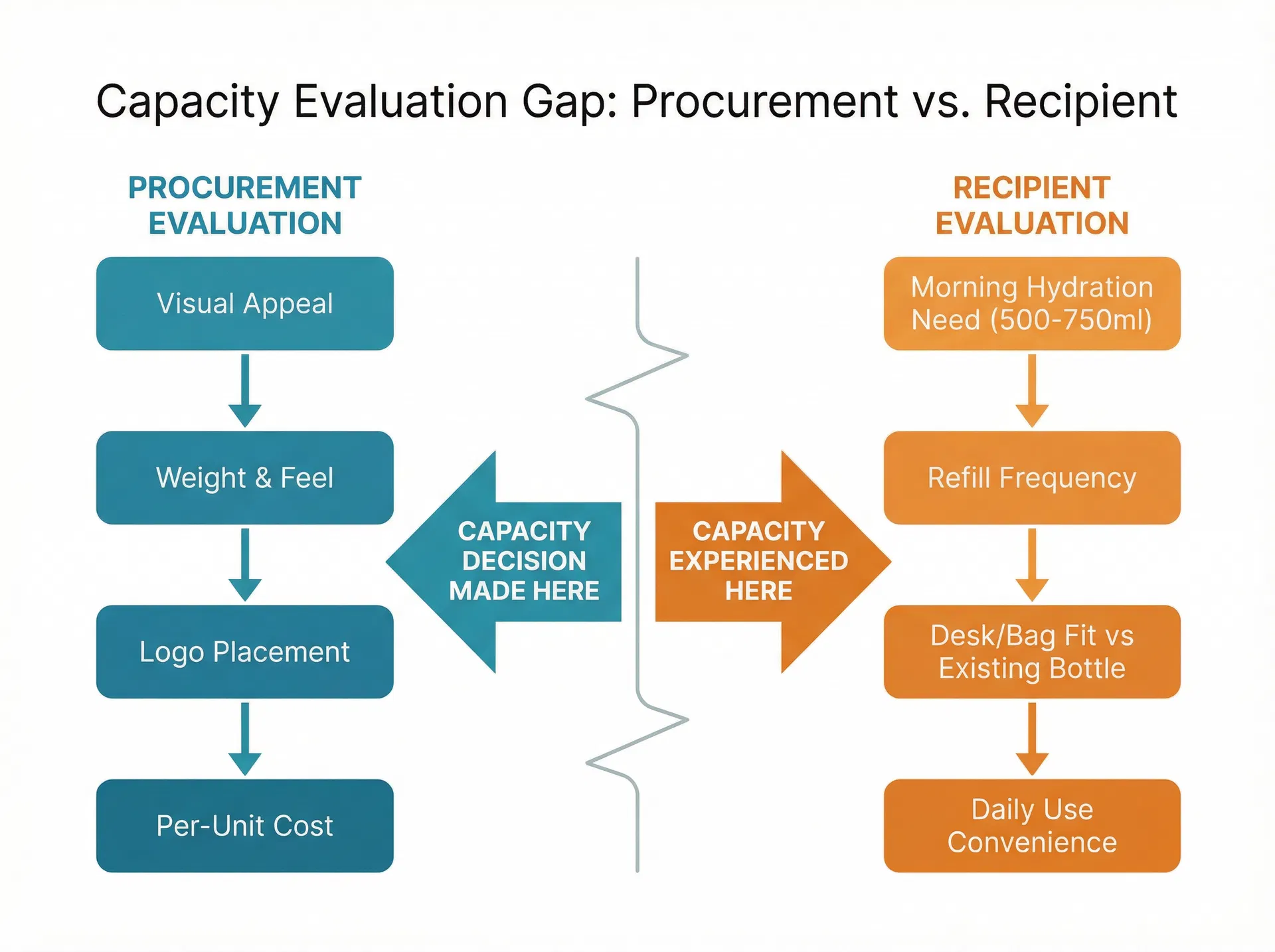
In practice, this is often where corporate gift drinkware decisions start to be misjudged — not at the branding stage, not at the material selection stage, but at the point where someone on the procurement side decides that 350 millilitres is "a good size." The reasoning is usually sound on its own terms. A 350ml bottle is compact, photographs well, feels premium in the hand, and costs less per unit than a 500ml or 600ml alternative. From a sample evaluation perspective, it checks every box. The problem is that sample evaluation happens in a conference room, not at a desk where someone is trying to get through a morning without walking to the kitchen three times.
The gap between how procurement teams assess drinkware and how recipients actually use it is not a matter of taste or preference — it is a structural mismatch in evaluation criteria. Procurement evaluates under controlled conditions: the bottle sits on a table, someone picks it up, checks the weight, examines the logo placement, confirms the lid mechanism works. These are all valid quality checks. But none of them simulate the actual use scenario, which is a person sitting at a workstation for four to five hours, needing roughly 500 to 750 millilitres of water during that period. A 350ml bottle forces two to three refill trips during a single morning session. For someone who already owns a 600ml bottle that sits comfortably on their desk, the corporate gift becomes redundant within days.
What makes this misjudgment persistent is that the feedback loop is almost invisible. Nobody sends an email to the procurement department saying "the bottle you gave me is too small." The gift is received politely, perhaps used once or twice, and then quietly retired. The procurement team sees the distribution numbers — five hundred units shipped, five hundred units received — and considers the programme successful. The actual daily usage rate, which is the metric that determines whether the gift generates any ongoing brand impression at all, is never measured. Industry data suggests that branded drinkware can generate over three thousand impressions per item over its lifetime, but that figure assumes the item is in active daily use. A bottle that lives in a drawer generates approximately zero.
The capacity question also intersects with the physical environment in ways that procurement teams rarely model. Corporate drinkware does not exist in isolation — it competes for space with existing items on a desk, in a bag, and in a car cup holder. Standard vehicle cup holders in New Zealand and Australia are designed for vessels between 65mm and 75mm in diameter. A 350ml bottle typically falls within this range, but so does a 500ml bottle with a slim profile. The difference is that the 500ml bottle actually serves as a primary hydration vessel, while the 350ml bottle serves as a secondary item that most people do not need. Bag compartments tell a similar story: the side pocket of a standard laptop bag accommodates bottles up to roughly 73mm in diameter regardless of height, so the capacity difference between a 350ml and a 500ml bottle in the same diameter profile is purely a function of height — a dimension that has no practical impact on portability.
There is also a behavioural dimension that rarely enters procurement discussions. Workplace hydration habits are not uniform, and they are not optional — they are shaped by meeting schedules, open-plan office layouts, and the distance between a person's desk and the nearest water source. In many modern office environments, particularly those with hot-desking or activity-based working arrangements, the nearest kitchen or water station may be a full floor away. A 350ml bottle in that context is not merely inconvenient; it actively discourages adequate hydration because the refill cost — the time and disruption of leaving a focused work session — outweighs the perceived benefit of using the corporate gift. The recipient's own 600ml bottle, already proven to last a full morning session, wins by default. This is not a preference. It is a rational response to a physical constraint that the procurement team never experienced during sample evaluation.
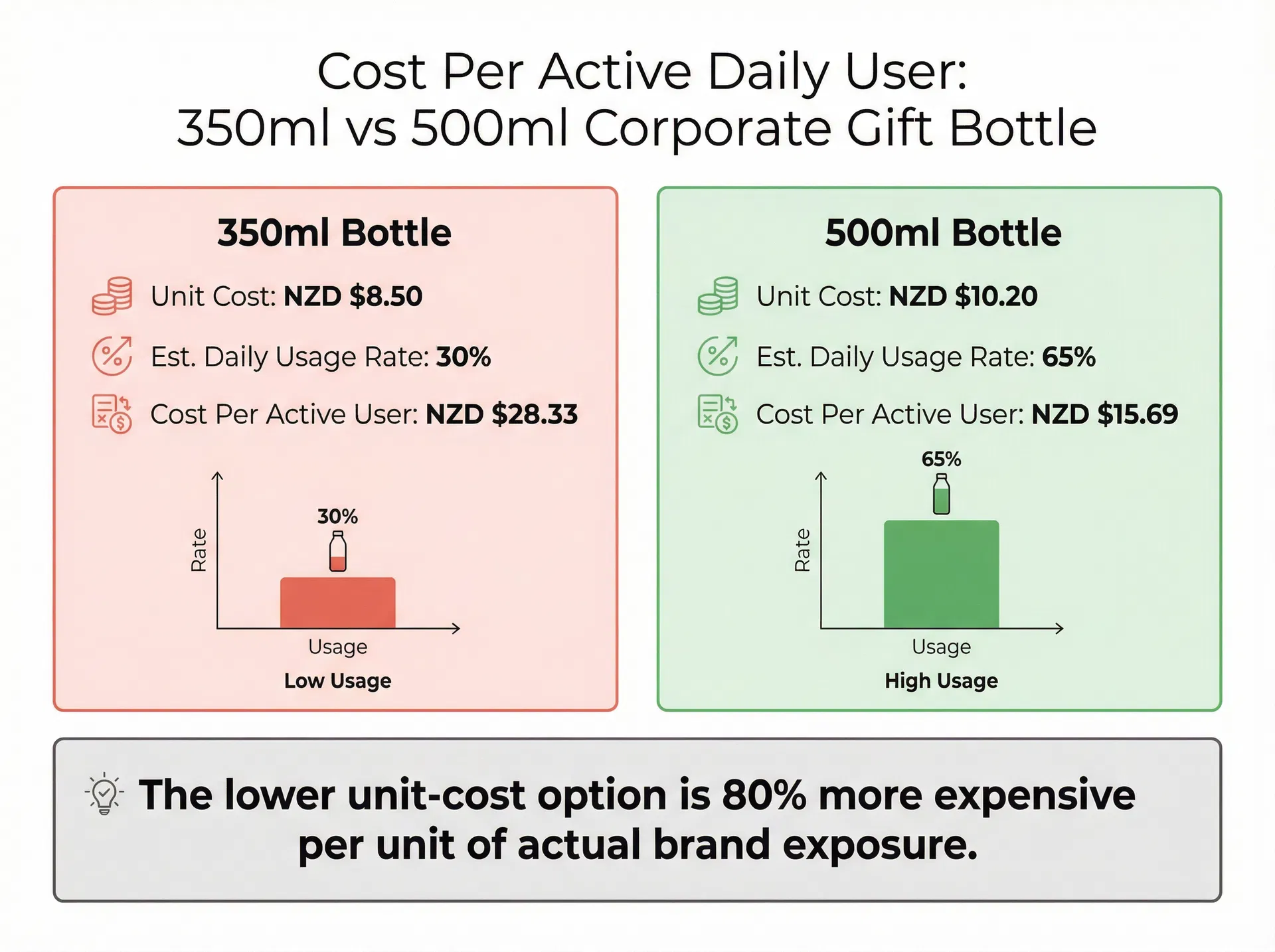
The cost differential reinforces the bias. A 350ml double-wall vacuum insulated stainless steel bottle might cost NZD 8.50 per unit at a quantity of three hundred, while the 500ml equivalent from the same production line costs NZD 10.20. That NZD 1.70 difference, multiplied across the order, feels significant during budget approval. But the calculation changes entirely when you factor in the usage rate. If the 350ml bottle is used daily by 30 percent of recipients and the 500ml bottle is used daily by 65 percent of recipients — a conservative estimate based on the principle that utility drives retention — then the cost per active daily user is NZD 28.33 for the smaller bottle and NZD 15.69 for the larger one. The "cheaper" option is nearly twice as expensive per unit of actual brand exposure.
This dynamic is not unique to bottles. Insulated tumblers follow the same pattern, though the threshold shifts slightly. A 350ml tumbler works well for espresso-based drinks but poorly for someone who drinks filter coffee or tea — beverages where a standard serve is 250 to 300ml, meaning a 350ml tumbler provides almost no margin for milk, ice, or simply a comfortable fill level. A 450ml to 500ml tumbler accommodates the full range of hot beverage habits without feeling oversized. Yet procurement teams frequently select the 350ml option because it "looks more elegant" in the product catalogue, which is another way of saying it was evaluated visually rather than functionally.
The seasonal dimension compounds this further. In New Zealand's temperate climate, water consumption patterns shift meaningfully between winter and summer. A 350ml insulated bottle that feels adequate during a cool Wellington July becomes frustratingly small during a Christchurch February. Corporate gifts distributed in winter may appear perfectly sized at the moment of receipt, only to be abandoned four months later when daily water intake increases by 30 to 40 percent. The procurement team, having evaluated samples during the cooler procurement season, never encounters this gap. The recipient does — and by then, the bottle has already been replaced.
The deeper issue is that capacity selection happens at the wrong stage of the decision process. It is typically locked in during the initial product shortlisting phase, before the team has defined the recipient profile or the intended use context. By the time someone asks "will our people actually use this every day," the capacity has already been fixed, the samples have been approved, and the branding artwork has been sized to fit. Changing the capacity at that point means re-sampling, re-quoting, and potentially re-doing the artwork layout — costs and delays that feel disproportionate to what seems like a minor specification change. So the 350ml bottle moves forward, and the programme delivers a gift that looks right but functions wrong.
For teams selecting corporate drinkware gifts across different business needs and recipient contexts, the capacity question deserves the same scrutiny as material choice or branding method. It is not a secondary specification. It is the single parameter that most directly determines whether the recipient integrates the gift into their daily routine or sets it aside. The distinction between a gift that generates three thousand brand impressions and one that generates thirty is not about the quality of the steel or the precision of the engraving. It is about whether the vessel holds enough liquid to be someone's primary drinking container.
The corrective is straightforward but requires a shift in evaluation timing. Before shortlisting products, define the recipient's most likely daily use scenario. If the gift is intended for office workers, the minimum practical capacity is 450ml — anything below that creates a refill frequency that makes the bottle inconvenient relative to alternatives the recipient already owns. If the gift is intended for field staff or event attendees who will be away from refill points, 600ml is the practical floor. Only after establishing the capacity range should the team begin evaluating aesthetics, branding options, and per-unit cost. This sequence inversion — function first, form second — is counterintuitive for procurement teams accustomed to starting with visual samples, but it is the only reliable way to ensure that the gift budget translates into actual daily use rather than polite acceptance followed by quiet abandonment.