Why Dishwasher-Safe Claims Do Not Prove Custom Drinkware Branding Will Survive Daily Use
Key procurement answer
A dishwasher-safe claim can describe resistance of a defined product under defined conditions, but it does not automatically prove that logos, coatings, closures, and functions will survive a business's real cleaning environment. This procurement guide separates substrate, decoration, function, and test-condition evidence so buyers can assess custom drinkware durability without overextending a catalogue claim.
Procurement position: A “dishwasher safe” claim usually describes the resistance of a specified product under defined cleaning conditions. It does not automatically prove that a printed logo, laser-marked surface, coating, lid seal, insulation performance, or closure mechanism will remain acceptable throughout a business’s actual use cycle. For custom drinkware procurement, the defensible question is not whether the base vessel survived a dishwasher test. The question is whether the complete decorated and assembled product was tested under conditions that match the intended users, cleaning equipment, detergent, temperature, cycle count, and acceptance criteria.
This distinction is easy to miss because dishwasher safety is often presented as one convenient product attribute. A specification sheet may show a dishwasher icon, while the branding approval is handled separately and the lid is treated as an accessory. The procurement file then carries one reassuring statement where it actually needs several different pieces of evidence. The result is a product that may remain structurally usable but lose its logo, develop coating changes, leak at the closure, or become unacceptable for the brand programme long before the expected service life.
Why the claim sounds broader than the test. Mechanical dishwashing exposes an article to combined thermal, chemical, and mechanical stresses. EN 12875-1 is commonly used as a reference method for domestic articles made from materials including metal, plastic, glass, and ceramic. A typical test cycle includes washing, alkaline cleaning, rinsing, rinse aid, drying, and visual inspection. The test therefore has real value: it can establish resistance under a defined method and number of cycles. It does not turn every surface, component, and decoration method into one universal performance class.
A buyer can therefore make two opposite mistakes. The first is to dismiss a dishwasher test because it is not a full product-life simulation. The second, more common mistake is to treat the test as proof of every attribute that matters in use. The first mistake rejects useful evidence. The second mistake overextends it. Quality decisions become clearer when the evidence is separated into the parts that users actually experience.
Layer one is the base material. Stainless steel, plastic, glass, ceramic, and coated metal respond differently to heat, alkaline detergents, drying, abrasion, and repeated temperature changes. A vessel body may show no cracking, distortion, corrosion, or visible change after a specified cycle count. That evidence answers an important question about the substrate. It does not answer whether a decoration layer bonded to that substrate will age at the same rate. Nor does it show whether a thin external coating will maintain its appearance when handled against racks, cutlery, or other vessels.
Layer two is the decoration system. A logo is not simply an image placed on a bottle. It is a material and process combination involving ink, pigment, adhesive, cured coating, etched surface, decal, transfer, or another marking method. The same base vessel can have very different durability depending on where the mark sits, how it is prepared, how it is cured, and what cleaning stress reaches it. A logo placed on a recessed or protected area may experience a different abrasion pattern from a logo placed on the widest contact surface. A visual sample taken after production may look identical to the approved sample while carrying a different resistance profile.
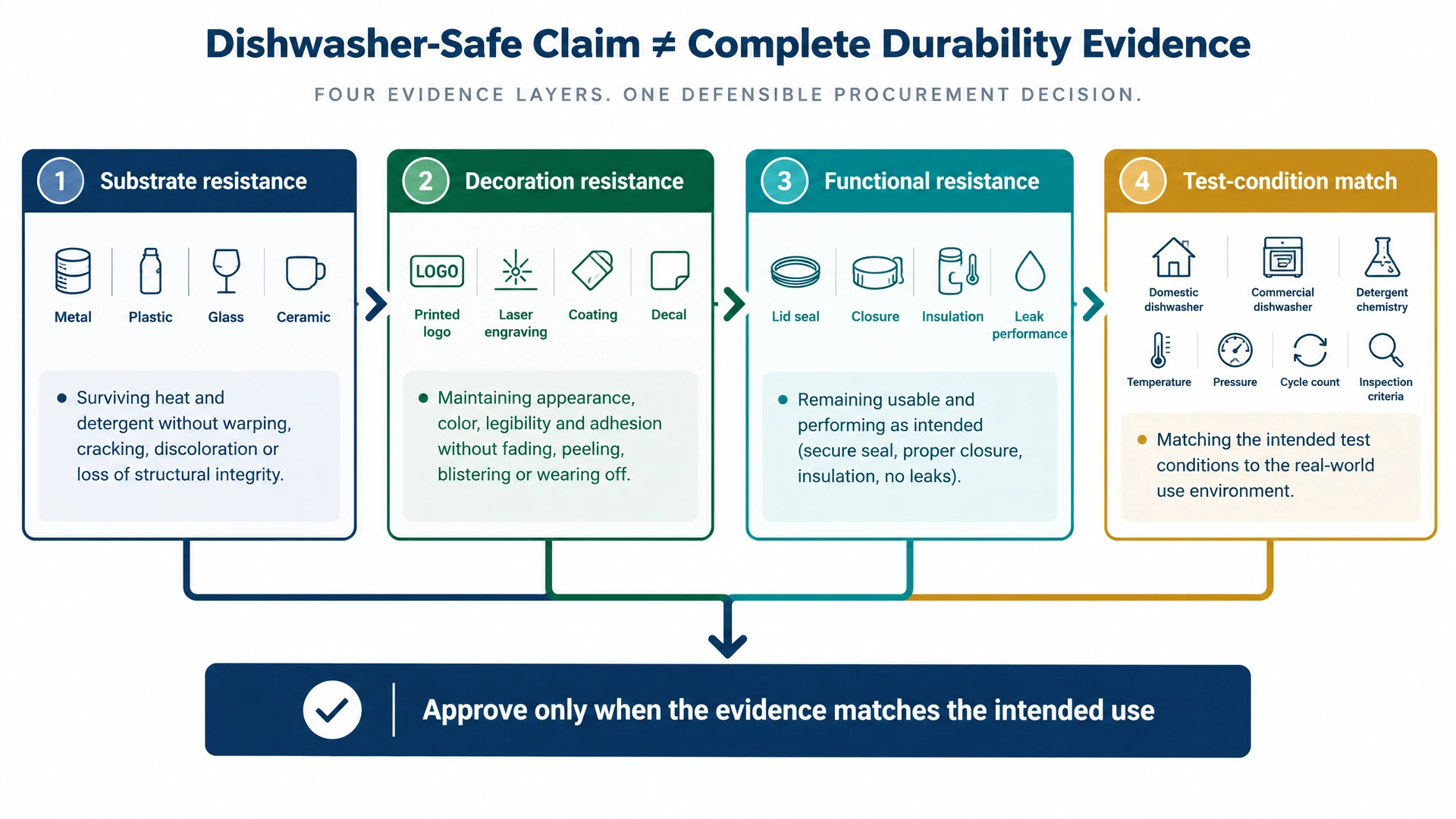
The diagram matters because it shows why one pass statement cannot replace a matched evidence set. The substrate, decoration, function, and test conditions interact. If any one layer is unverified, the buyer may be approving a product whose visible quality or practical use will change under the real cleaning regime.
Layer three is functional performance. Lids, gaskets, valves, handles, insulation structures, and drinking openings can have a different failure path from the vessel body. Heat may accelerate seal compression, detergent may affect elastomer behaviour, and mechanical loading may loosen a closure over repeated handling. A body that remains visually unchanged does not prove that the assembled product still seals, pours, closes, insulates, or feels safe to use. If the product is intended for offices, events, hospitality, or travel, the functional acceptance criteria should be written separately from visual appearance.
Layer four is the match between the test and the intended environment. Domestic and commercial dishwashers do not necessarily expose products to the same combination of heat, chemical concentration, water pressure, rack movement, drying, and cycle frequency. A corporate gifting programme may also create a different use pattern from a household: some recipients may wash the item daily, some may use shared commercial equipment, and some may hand-wash the vessel but place the lid in a dishwasher. A generic claim is not useless, but it is incomplete until the buyer knows which conditions produced it.
This is where procurement language often creates an unintentional evidence gap. “Dishwasher safe” may be copied from a catalogue field, while the purchase specification says “logo must remain durable” and “product must be suitable for office use.” Those statements are related but not equivalent. The first may refer to the article in a general condition. The second establishes a brand and usage expectation. Unless the decoration and assembly are included in the test sample, the document set does not prove the full requirement.
What the buyer should request is condition-specific evidence. The request does not need to become an unnecessarily large laboratory programme. It needs to be precise enough to connect the claim to the decision. The product reference, material, decoration method, decoration location, lid configuration, test equipment, detergent type, temperature range, cycle count, sample quantity, control sample, inspection points, and acceptance criteria should be identifiable. If the supplier provides only a sentence stating that the item is dishwasher safe, the buyer cannot tell whether the tested article is the same configuration being quoted.
Visual inspection should also be separated into meaningful defect categories. Colour fading, gloss loss, edge lifting, logo blurring, coating change, surface scratching, corrosion, deformation, leakage, closure loosening, and insulation loss do not carry the same operational consequence. A report that records only “no significant change” may be acceptable for a narrow test purpose, but it is not sufficiently descriptive for a brand programme where logo appearance and user confidence are part of the product value.
The sample decision is another overlooked variable. Testing one undecorated vessel can confirm something about the vessel. It cannot automatically confirm the decorated production version. Testing a logo panel without the lid can confirm something about the decoration. It cannot confirm the assembled product. Testing a sample made with a different coating batch, curing condition, or component supplier can produce evidence that is technically accurate but commercially misapplied. The approval sample should therefore be traceable to the same specification and process family as the production order.
The same logic applies when a buyer changes a finish or branding method after the first sample. A matte powder coat, polished steel surface, ceramic glaze, and soft-touch coating may respond differently to detergent and abrasion. A laser mark may have a different visual failure mode from a printed logo. When the decoration method is changed, the previous durability statement should not be carried forward without checking whether the evidence still applies. This is one reason the broader custom drinkware customization workflow should treat finish, decoration, assembly, and verification as connected decisions rather than isolated approvals.
Commercial consequences appear gradually, which makes the error expensive. A logo that fades after several weeks may not trigger a formal rejection, yet recipients begin to treat the item as generic. A lid that becomes difficult to close may cause users to leave the bottle at a desk. A coating that changes unevenly across a distributed workforce can create visible inconsistency between offices. These outcomes reduce active use, weaken brand exposure, and generate replacement requests even when the original shipment technically passed a general dishwasher statement.
The right procurement position is not to demand that every custom drinkware item pass an identical universal test. It is to define the real use case before treating a durability claim as decision evidence. For a hand-wash-only promotional mug, a limited appearance check may be proportionate. For an insulated bottle issued to employees who wash it daily, the evidence should cover the full decorated and assembled configuration. For hospitality or shared-kitchen use, commercial cleaning conditions may matter more than a domestic cycle claim. The acceptance standard should follow the use pattern, not the convenience of a catalogue icon.
A dishwasher-safe claim becomes reliable procurement evidence when its scope is explicit: what was tested, how it was tested, how many cycles were completed, what changed, what did not change, and whether the tested configuration matches the delivered product. Without that context, the claim is a useful starting point but not a complete quality conclusion. The decision is strongest when the buyer evaluates substrate, decoration, function, and test conditions as four linked layers and records the evidence against the intended daily-use environment.