Why 'Eco-Friendly' Labels on Corporate Drinkware Gifts Often Survive Procurement but Not Scrutiny
Key procurement answer
Sustainability claims on corporate gift drinkware pass procurement filters because they capture language rather than evidence. Understanding the gap between marketing labels and verifiable environmental credentials prevents ESG reporting risk.
When a corporate gift programme brief includes a sustainability requirement, the procurement process typically responds by adding a filter: the selected drinkware must be described as "eco-friendly" or "sustainable" by the supplier. This filter feels rigorous. It appears in the evaluation matrix, it satisfies the internal ESG reporting requirement, and it allows the procurement team to confirm that the gift programme aligns with the company's stated environmental commitments. The problem is that the filter captures language, not substance. A supplier can describe virtually any stainless steel bottle as "eco-friendly" without changing a single material input, manufacturing process, or supply chain decision, and the claim will pass through the procurement filter unchallenged.
The term "eco-friendly" has no standardised definition in the drinkware industry. It is not a certification. It is not governed by a testing protocol. It does not require third-party verification. When it appears on a product specification sheet or supplier proposal, it means whatever the supplier intends it to mean, which may be as little as "this product is reusable." Reusability is a genuine environmental advantage over single-use alternatives, but it is an inherent property of any stainless steel or glass vessel — it does not represent an additional environmental commitment by the manufacturer. Labelling a standard stainless steel bottle as "eco-friendly" because it can be reused is equivalent to labelling a ceramic plate as "eco-friendly" because it can be washed and used again. The claim is technically defensible but environmentally meaningless.
This distinction matters because corporate gift programmes increasingly use sustainability as a differentiator. The gift is not just a branded item; it is a statement about the company's values. When the bottle arrives with "eco-friendly" printed on the packaging or referenced in the accompanying card, the company is implicitly claiming that this specific product was chosen for its environmental credentials. If a recipient, a client, or an ESG auditor asks what those credentials are, the procurement team needs a verifiable answer. "The supplier described it as eco-friendly" is not a verifiable answer. It is a repetition of an unaudited marketing claim.
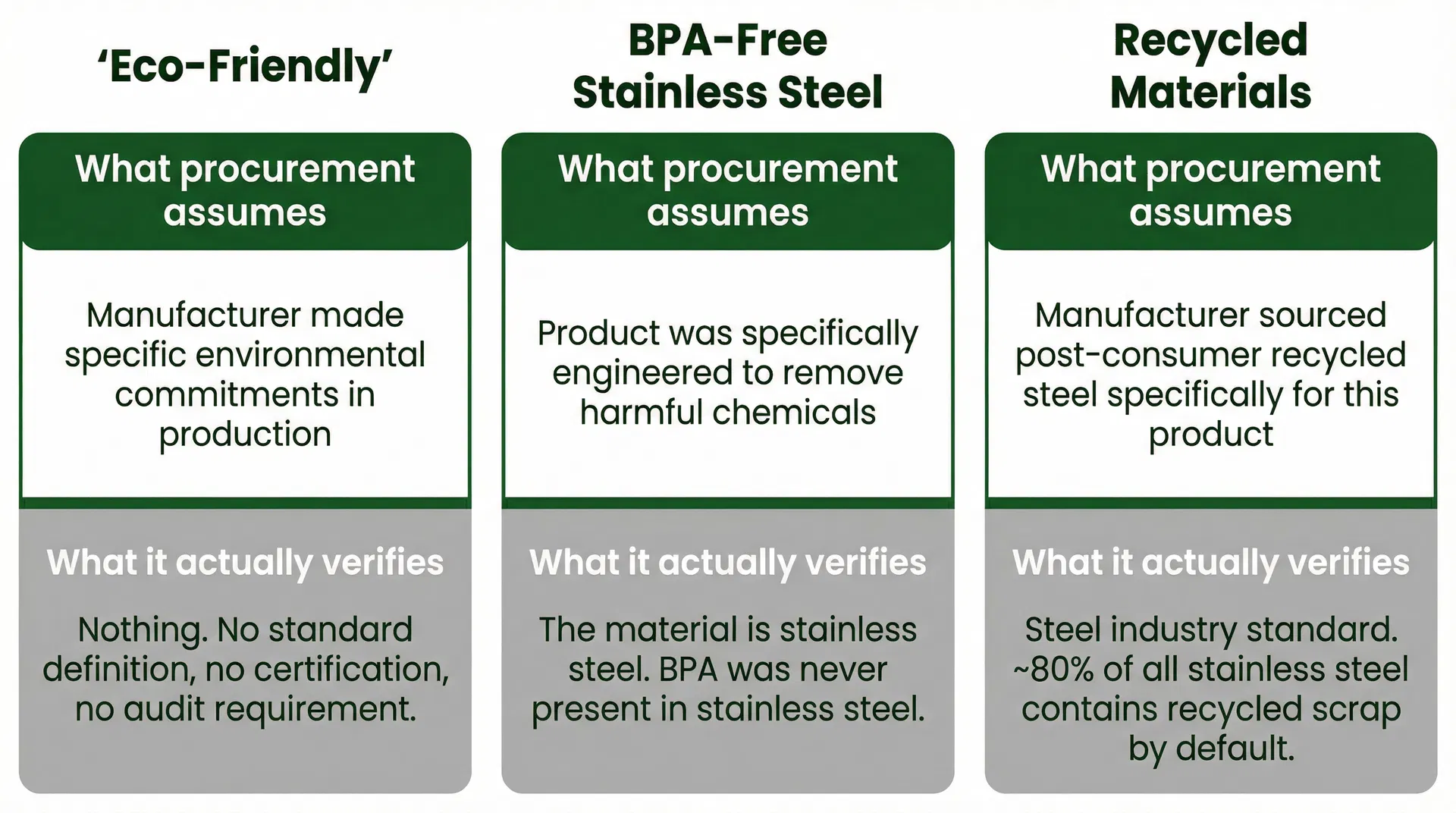
The "BPA-free" label is another claim that routinely appears in corporate drinkware procurement and routinely survives evaluation without scrutiny. Bisphenol A is a chemical compound used in certain polycarbonate plastics and epoxy resins. It has never been a component of stainless steel, glass, or ceramic. Labelling a stainless steel bottle as "BPA-free" is factually accurate in the same way that labelling a wooden chair as "asbestos-free" is factually accurate — the substance was never present in the material to begin with. Yet this label appears on supplier specification sheets for stainless steel corporate drinkware with remarkable frequency, and procurement teams record it as a positive attribute. It occupies space in the evaluation that could be used for genuinely differentiating environmental criteria, and it creates a false sense of due diligence around material safety.
The "recycled materials" claim introduces a more complex layer of ambiguity. Stainless steel is one of the most recycled materials on earth, with global recycling rates exceeding 80 percent for end-of-life steel products. The steel industry routinely incorporates scrap steel into new production. This means that virtually all stainless steel contains some recycled content as a standard feature of the metallurgical process, not as a deliberate environmental choice by the bottle manufacturer. When a supplier claims their corporate gift bottles are made from "recycled stainless steel," the procurement team may interpret this as a specific environmental commitment — that the manufacturer sourced post-consumer recycled steel or achieved a verified recycled content percentage. In practice, the claim may simply describe the normal composition of the steel alloy, which would be identical whether or not the supplier made any sustainability claim at all.
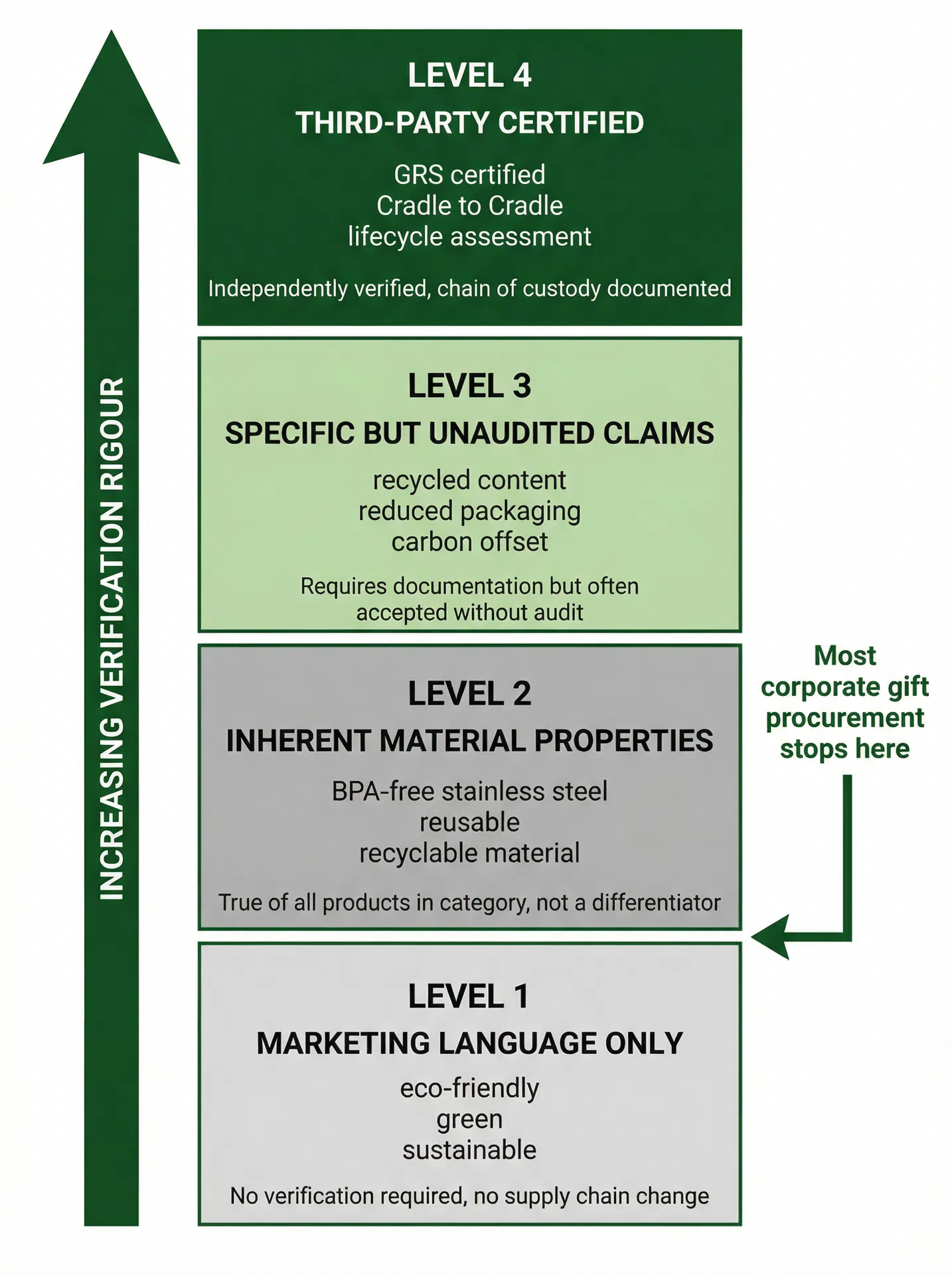
Verifiable recycled content claims do exist. The Global Recycled Standard requires chain-of-custody documentation tracing recycled inputs from source to finished product, with third-party auditing at each stage. A GRS-certified product provides the procurement team with a defensible, auditable sustainability claim. But GRS certification adds cost and complexity to the supply chain, which means most corporate drinkware suppliers do not hold it. The gap between "our steel contains recycled content" (true of virtually all steel) and "our steel is GRS-certified recycled content" (true of very few products) is enormous, but it is invisible on a specification sheet where both claims appear as a simple checkbox.
The bamboo and natural fibre category presents a particularly instructive case. Bamboo-based drinkware has gained popularity in corporate gifting partly because bamboo is a fast-growing, renewable resource with strong environmental associations. However, many bamboo fibre cups and bottles are not made from solid bamboo. They are made from bamboo fibre powder bonded with melamine-formaldehyde resin — a synthetic thermosetting plastic. The resulting product is not biodegradable, not compostable, and not meaningfully different in its end-of-life environmental impact from a conventional plastic cup. Several European food safety authorities have flagged melamine migration concerns when these products are used with hot liquids. The procurement team that selects bamboo fibre drinkware for a corporate gift programme because it appears more sustainable than plastic may be selecting a product that is functionally plastic with a bamboo-derived filler, and one that carries food safety questions that a standard stainless steel bottle does not.
The structural issue is that sustainability claims in corporate drinkware procurement are evaluated using the same framework as other product attributes: the supplier states a claim, the procurement team records it, and the evaluation proceeds. But unlike claims about capacity, weight, or material grade — which can be verified through physical measurement or material testing — sustainability claims require a different kind of verification. They require documentation of supply chain practices, third-party certification audits, lifecycle assessment data, or at minimum, a specific and falsifiable statement about what environmental benefit the product provides and how that benefit was achieved. Most corporate gift procurement processes are not structured to request or evaluate this type of documentation.
In practice, this is often where sustainability decisions in corporate drinkware gifting start to go wrong. The procurement team is not indifferent to environmental concerns — quite the opposite. The sustainability requirement exists because someone in the organisation genuinely wants the gift programme to reflect the company's environmental values. But the procurement process translates that intention into a supplier-facing requirement that can be satisfied with language rather than evidence. The supplier provides the language. The procurement team records it. The gift arrives with an "eco-friendly" label. The ESG report notes that the corporate gift programme used sustainable products. And at no point in the process did anyone verify what "sustainable" actually meant for that specific product, from that specific factory, using that specific supply chain.
For teams selecting corporate drinkware gifts that genuinely need to support sustainability claims across different business contexts and gifting objectives, the corrective is not to abandon sustainability as a criterion but to change what counts as evidence. A supplier who holds GRS certification for recycled content, or who can provide a lifecycle assessment comparing their product to a defined baseline, or who can document specific manufacturing process changes that reduce environmental impact, is offering verifiable sustainability. A supplier who describes their standard stainless steel bottle as "eco-friendly" because it is reusable is offering a marketing label. Both may appear identical on a procurement evaluation spreadsheet, but they represent fundamentally different levels of environmental commitment — and fundamentally different levels of risk if the claim is ever questioned.
The practical test is straightforward: if the sustainability claim were removed from the product, would anything about the product's materials, manufacturing, or supply chain actually change? If the answer is no — if the bottle would be identical whether or not it carried the "eco-friendly" label — then the claim is descriptive rather than substantive, and the procurement team should evaluate the product on its other merits rather than granting it a sustainability premium it has not earned.