Why Finished-Goods Inspection Cannot Replace Component Traceability in Custom Drinkware
Key procurement answer
Finished-goods inspection can identify a defect, but it cannot reveal which lid, gasket, assembly run, or process change caused it. Learn how proportionate component traceability supports faster containment and defensible corrective action.
Procurement position: A finished-goods inspection can show that a custom drinkware item has a defect, but it usually cannot show which component lot, assembly run, process condition, or approved change created it. Component traceability links the delivered bottle or cup to the relevant body, lid, gasket, straw, decoration, assembly, inspection, and specification records. That link allows a buyer and supplier to contain the right population, test a credible cause, and confirm whether corrective action applies to a defined lot rather than every item that happens to look similar.
This distinction matters because many quality disputes begin with a finished product symptom: a lid leaks, a gasket retains an odour, a straw cracks, a coating scratches unusually quickly, or a logo differs across a shipment. The final carton, purchase order, and inspection report may prove that the item was delivered and checked. They do not automatically establish whether the symptom belongs to one closure supplier, one incoming component lot, one assembly shift, one decoration condition, or a wider design issue. Without that evidence chain, the investigation often becomes a debate about samples and recollection rather than a controlled quality decision.
Finished-goods inspection answers a different question. An inspection at the end of production can assess whether sampled units meet agreed appearance, function, dimension, or packing criteria at that point in time. It is useful evidence for shipment release. It does not create backward visibility by itself. If an inspector records that sampled bottles were free from visible defects, that result cannot identify which gasket batch was fitted to an item that later leaks, whether the closure torque setting changed between runs, or whether one lid mould was substituted after the sample approval.
The limitation becomes clearer when a defect is intermittent. Suppose a recipient reports that a small number of bottles leak only after repeated opening and closing. A final visual inspection may have recorded no leak at dispatch. A supplier that can trace the unit to the lid lot, gasket lot, body-thread lot, assembly run, and functional-check record can compare affected and unaffected items. A supplier with only a finished-carton number may be forced to inspect a broad remainder population, replace more product than necessary, or make a corrective-action promise without being able to test whether the proposed cause is real.
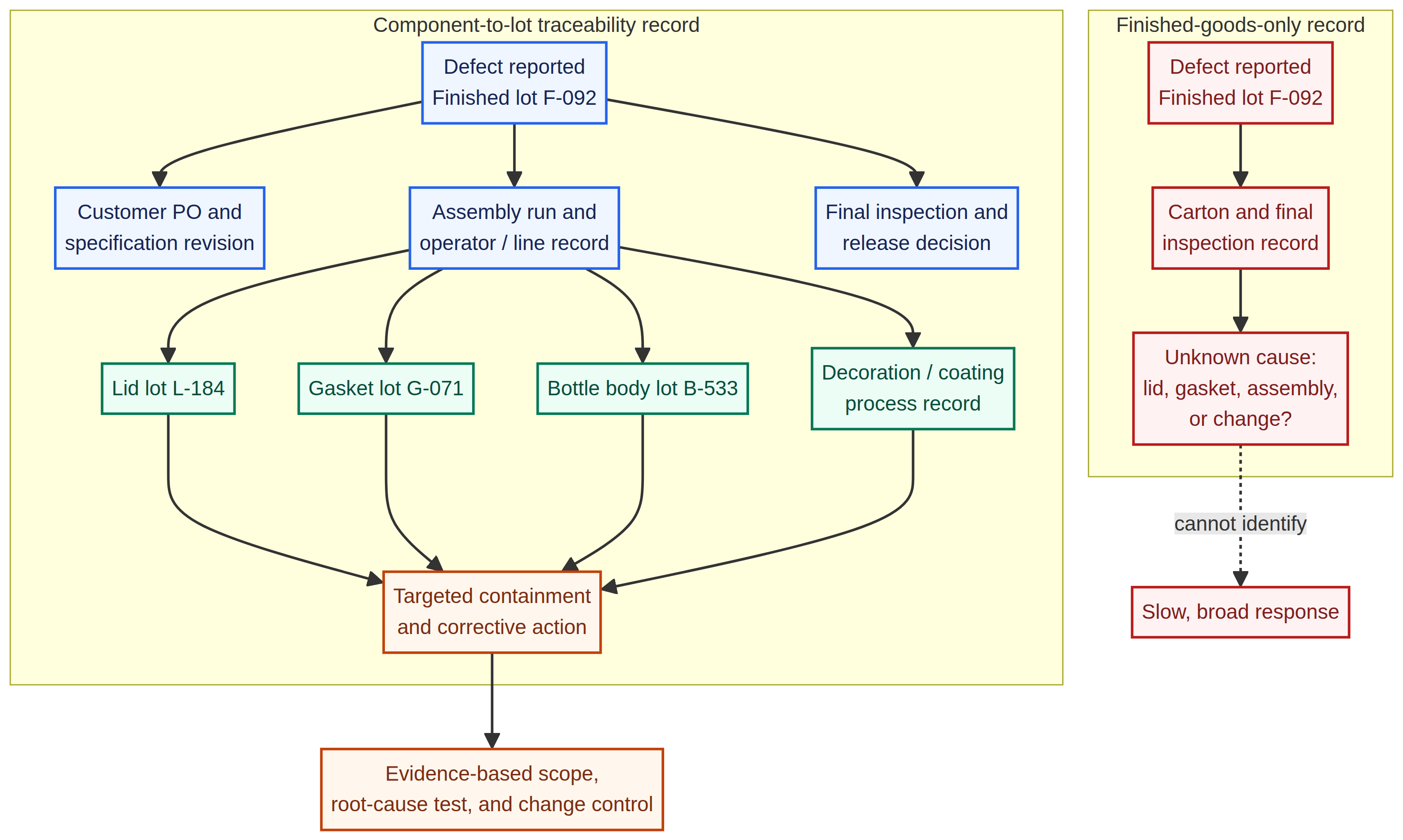
The diagram shows the evidence difference. A finished-goods-only pathway ends with an unknown cause and a broad response. A component-to-lot pathway preserves links from the reported finished lot to the order revision, assembly record, closure components, body lot, decoration record, and inspection release. Those links do not prove a root cause automatically. They make it possible to define the scope of an investigation and to test a claim against the correct records and retained samples.
Traceability should follow the product’s real failure modes. A stainless-steel vessel, a polypropylene lid, a silicone gasket, a straw, a coating, and a printed or engraved mark do not carry the same risks. The buyer does not need identical evidence for each part; the record should follow what could reasonably create a costly or safety-relevant difference. If closure leakage is the main concern, lid, gasket, body-thread, and assembly information are more useful than a generic finished-goods description. If colour or logo consistency is the commercial risk, decoration method, ink or coating batch, curing conditions where relevant, artwork revision, and inspection standard become more important.
The National Institute of Standards and Technology describes manufacturing supply-chain traceability as a continuous, temporally ordered provenance chain that can organize, link, and query records across separate manufacturing systems. Its 2026 manufacturing traceability framework is broader than a drinkware purchase order, but its central lesson is directly applicable: records become useful when a stakeholder can follow a verifiable history across the specific events and components that matter. A warehouse list of cartons is not equivalent to a chain that links a component change to an assembly and a finished lot.
A usable record starts with the controlled requirement. Every traceability chain needs an anchor that defines what the factory was meant to build. For custom drinkware, that anchor is normally the approved purchase order, product specification, artwork file, colour or finish reference, and revision identifier. If the requirement changed during the order, the record should make the timing visible. Otherwise, a later investigation cannot distinguish a defect from an intentional update, and a supplier cannot determine whether a component was used under the correct version of the instruction.
This is why traceability is not a standalone administrative exercise. It depends on the same document discipline that governs artwork approval, material selection, decoration, assembly, testing, and release. The broader custom drinkware customization process is stronger when those decisions are linked instead of managed as disconnected emails. A traceability record that points to an obsolete artwork file or an unnamed approved sample creates confidence without control.
Component identity must be matched to the assembly event. A record of incoming lids or gaskets is helpful, but incomplete if it cannot show where they were used. At a proportionate level, the supplier should be able to state that a defined assembly run used lid lot L, gasket lot G, body lot B, and the applicable product revision. That does not require disclosing unrelated supplier pricing or proprietary process detail. It requires enough information to connect a particular production population to the parts and conditions that can explain its behaviour.
Inspection status is evidence, not merely a stamp. Identification and traceability controls are commonly implemented through part labels, job travellers, work orders, route sheets, lot control, and records that show monitoring and measurement status. The relevant principle in ISO 9001:2015 clause 8.5.2 is that the suitable means and level of control should fit the need to ensure conformity and support the required traceability. For a buyer, the practical implication is simple: ask not only whether the product was “inspected,” but which lot was checked, against which revision, by which method, and what release or hold decision followed.
A final inspection record that names the lot and acceptance basis can be linked to the product release. An in-process record can show whether the assembly or decoration step was under control before the final check. An incoming inspection or supplier certificate may support the component identity. Each record has a limited purpose, but together they create a defensible sequence. The goal is not to accumulate paperwork; it is to preserve the minimum evidence needed to answer a future question without inventing an explanation after the fact.
Containment should be narrower than the customer complaint whenever evidence permits. If a defect occurs after distribution, the first operational decision is often whether to replace all items, pause a related shipment, notify a subset of recipients, or monitor the situation. Finished-goods-only records make that choice unnecessarily blunt. Component-to-lot traceability can identify whether the potentially affected scope is one assembly run, a particular lid-and-gasket pairing, a defined decoration batch, or the entire order. A narrower scope reduces unnecessary disruption; a broader scope remains appropriate when the evidence does not rule out a wider issue.
A defensible containment decision therefore states what is known, what is still uncertain, and which evidence defines the affected population. “We believe only one batch is affected” is not enough. A stronger statement is that all reported units were assembled in run R on the specified date using gasket lot G, while other runs used a different gasket lot and have no matching reports; retained samples and functional checks will be used to test that boundary. The second statement can be reviewed, revised, and communicated because it identifies the basis for the decision.
Corrective action needs a testable cause-and-effect path. Replacing a lid or changing a gasket supplier may solve the visible symptom, but it is not necessarily corrective action unless the supplier can show why that change addresses the verified cause. Traceability supports this step by allowing the factory to compare records across affected and unaffected populations. The team can examine whether a component lot, tooling condition, assembly parameter, incoming inspection result, or specification revision differs in a way that matches the failure pattern. The proposed action can then be tested against retained components or a controlled production run.
Change control keeps a future order from repeating the same uncertainty. Traceability is most valuable when it reaches forward as well as backward. If a closure supplier changes, a gasket formulation is revised, a decoration process is moved, or an approved substitute is introduced, the record should show which order and lots were affected, what comparison or validation was performed, and which revised requirement governs the next production run. Otherwise, a successful corrective action can disappear into an informal conversation and the same unresolved variable can return on a reorder.
For a buyer, a proportionate component traceability request can be concise. It can ask the supplier to retain the connection between the customer order and specification revision; main vessel and closure component lots; relevant assembly run; decoration or coating process record where branding risk is material; inspection and release record; and any approved deviation or change. The request becomes more detailed only where the product or programme creates more risk. A basic office-gift order and a high-use hospitality programme should not need the same depth of evidence.
Finished-goods inspection remains valuable, but it is the end of an evidence chain, not a substitute for it. When a future defect, complaint, or reorder question arises, the buyer needs to know more than whether a sampled shipment looked acceptable on release day. The useful question is whether the supplier can trace the finished item back to the components, process, inspection, and controlled requirement that produced it. If the answer is yes, containment can be targeted, corrective action can be tested, and the next order can be controlled with better evidence than the last.