Why 'Food Grade' Claims on Corporate Drinkware Gifts Are Often Misunderstood in the New Zealand Market
Key procurement answer
A compliance-focused analysis of why procurement teams routinely accept supplier food-safety claims on corporate drinkware gifts without understanding what those claims actually cover—and what verification gaps remain under New Zealand's regulatory framework.
There is a pattern in corporate drinkware gift procurement that surfaces with uncomfortable regularity during compliance reviews: the procurement file contains a supplier's test report or certificate stating the product is "food grade" or "food safe," and everyone involved treats that document as sufficient evidence of regulatory compliance. The order proceeds, the branded bottles or tumblers are distributed to clients or staff, and no one revisits the question—until something prompts a closer look. What that closer look typically reveals is not that the supplier lied, but that the certificate answers a different question than the one the procurement team assumed it was answering. The document might confirm that the raw stainless steel sheet meets a particular grade specification. It might show that a plastic component passed migration testing under conditions that do not reflect how the product will actually be used. It might reference a Chinese national standard that has no direct equivalence to what New Zealand's regulatory framework expects. None of these scenarios involve fraud. All of them involve a gap between what the buyer believes has been verified and what has actually been tested.
In the New Zealand market, this gap is structurally wider than most procurement professionals realise, because New Zealand does not operate a mandatory pre-market approval system for food contact materials the way the European Union does. Food Standards Australia New Zealand concluded in 2017 that dietary exposure to food packaging chemicals was low and did not present a public health concern, and the proposal to create binding food contact material regulations was abandoned. What exists instead is a general obligation under Standard 3.2.2 of the Australia New Zealand Food Standards Code: food contact surfaces must be "fit for purpose" and must not contaminate food. This is a performance-based requirement, not a prescriptive one. It does not tell the manufacturer which tests to run, which migration limits to meet, or which laboratory to use. It places the burden of demonstrating fitness for purpose on the business placing the product into the market—which, in the case of corporate gifts, is the company ordering the branded drinkware, not the overseas factory that produced it.
In practice, this is often where corporate gift compliance decisions start to go wrong. The procurement team receives a test report from the supplier, usually issued by a Chinese testing laboratory, and files it as evidence of compliance. But the report frequently tests to Chinese GB standards—GB 4806.9 for metal food contact materials, or GB 4806.7 for plastic components—which specify migration limits and test conditions calibrated for the Chinese domestic market. These standards are not unreasonable, but they are not identical to the frameworks that New Zealand's "fit for purpose" obligation implicitly references. When a New Zealand regulator or a product liability lawyer examines whether a corporate drinkware gift met its compliance obligations, the reference points are more likely to be the EU's Framework Regulation 1935/2004, the US FDA's 21 CFR Parts 170–199, or the Australian voluntary standards AS 2070:1999 (for plastics) and AS 4371:2012 (for ceramics). A Chinese GB test report does not automatically satisfy these frameworks, even if the numerical results happen to fall within acceptable ranges, because the test conditions—simulant type, temperature, contact duration—may differ.
The distinction between raw material certification and finished product testing is another area where procurement teams consistently misjudge what they are looking at. A mill certificate confirming that the stainless steel is grade 304 (18/8 chromium-nickel composition) tells you about the metal sheet before it was formed, welded, polished, and coated. It says nothing about the finished bottle's interior surface treatment, the food-contact safety of the powder coating on the exterior, the silicone gasket in the lid, the adhesive bonding the vacuum seal, or the printing ink used for the branding. Each of these components introduces its own migration risk profile, and each requires its own assessment. A vacuum-insulated stainless steel bottle with a powder-coated exterior, a silicone lid seal, and pad-printed branding involves at least four distinct material categories in food-contact or near-food-contact positions. The mill certificate for the steel covers one of those four. The procurement team, seeing "304 stainless steel" on the certificate, often assumes the entire product has been verified.
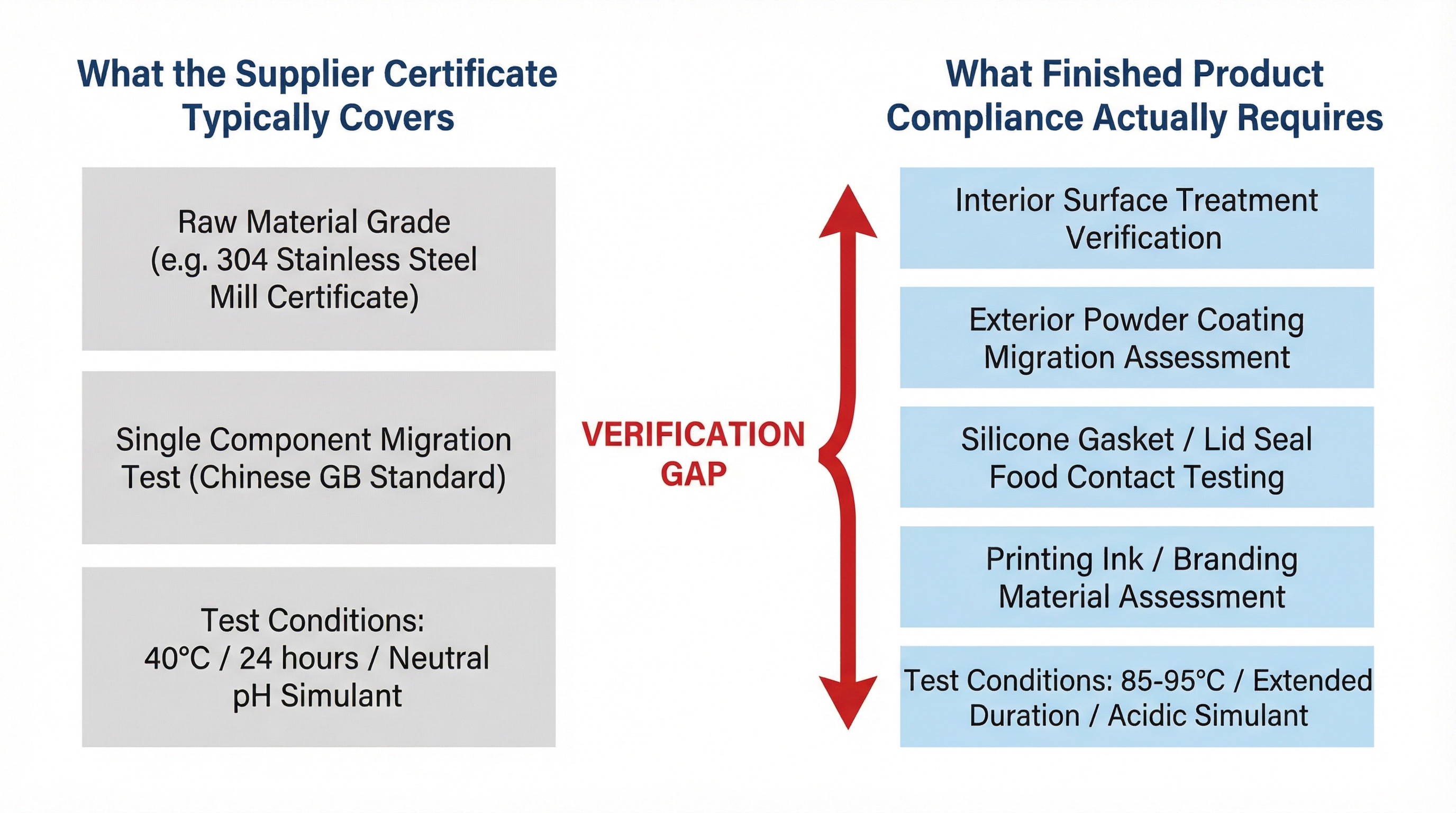
What compounds this problem is that migration behaviour changes with use conditions, and corporate drinkware gifts are used under conditions that standard laboratory testing may not replicate. A vacuum-insulated bottle holding hot coffee at 85–95°C for several hours creates a sustained high-temperature contact scenario that is more aggressive than the 40°C for 24 hours specified in many standard migration tests. Acidic beverages—coffee, citrus-infused water, carbonated drinks—accelerate migration from metal surfaces and can interact with interior coatings in ways that neutral-pH test simulants do not capture. If the procurement specification simply states "food grade stainless steel bottle" without specifying the intended use conditions, the supplier's test report may have been conducted under conditions that bear little resemblance to how the product will actually be used by the gift recipient. The test result is technically valid for the conditions tested. It is not necessarily valid for the conditions of actual use.
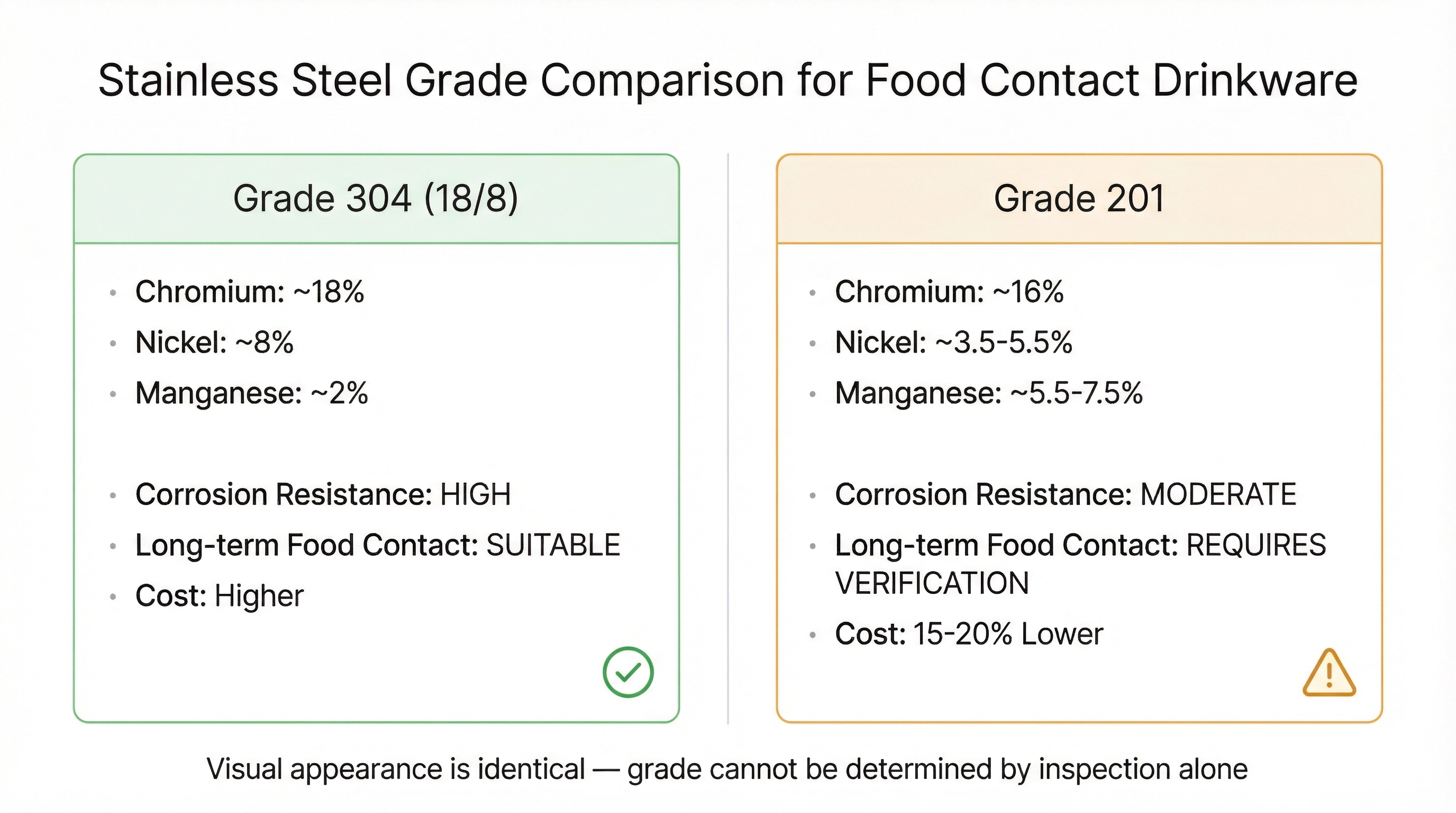
The stainless steel grade itself introduces a subtlety that procurement teams rarely interrogate. Grade 304 (18/8) is the standard food-contact grade, with approximately 18% chromium and 8% nickel. Grade 201, which is visually identical and significantly cheaper, substitutes manganese for a portion of the nickel content. Grade 201 is widely used in lower-cost drinkware because it is easier to form and costs roughly 15–20% less than 304. It is not inherently unsafe, but it has lower corrosion resistance, particularly when exposed to acidic or saline liquids over extended periods. For a corporate gift that will be used daily for months or years—which is, after all, the entire point of giving reusable drinkware—the long-term corrosion behaviour of the interior surface matters. A procurement team that specifies "stainless steel" without specifying the grade, or that accepts a supplier's verbal assurance of "food grade stainless steel" without a verifiable mill certificate tied to the specific production batch, has no way to confirm what grade was actually used in the finished product.
The New Zealand Consumer Guarantees Act adds another dimension that corporate gift buyers frequently overlook. Under the Act, goods supplied in trade must be safe and fit for purpose. This obligation applies regardless of whether the product was purchased domestically or imported. If a corporate gift recipient experiences a health concern that can be traced to the drinkware—metallic taste from corroding interior surfaces, allergic reaction to nickel migration, or contamination from degrading interior coatings—the company that distributed the gift bears responsibility under New Zealand consumer protection law. The overseas manufacturer is not party to the New Zealand transaction. The gifting company is. This liability exposure is not theoretical; it is a direct legal consequence of placing a product into the hands of a consumer without adequate verification that the product meets New Zealand's fitness-for-purpose standard.
When evaluating which drinkware products suit different corporate gifting purposes, the compliance verification step is frequently treated as a checkbox exercise—something to be completed after the product has already been selected, rather than a filter that shapes the selection itself. This sequencing error means that by the time the compliance question is raised, the procurement team has already committed to a supplier, agreed on pricing, and possibly approved artwork. Discovering at that stage that the supplier's test documentation does not adequately cover the finished product's food-contact compliance creates pressure to accept what is available rather than request what is needed. The cost of proper finished-product migration testing—typically NZD 1,500 to 3,000 per product, depending on the number of material components—is modest relative to a corporate gift order of several hundred or several thousand units. But if the testing is not budgeted from the outset, it becomes an unexpected cost that procurement teams are reluctant to absorb, particularly when the supplier's existing documentation "looks fine" to a non-specialist reviewer.
The practical consequence is that many corporate drinkware gifts circulating in New Zealand workplaces have never been tested as finished products under conditions that reflect actual use. They carry branding from reputable New Zealand companies. They are used daily by employees and clients. And the compliance file, if one exists, contains a raw material certificate and possibly a test report conducted to a foreign standard under conditions that do not match the product's intended use. This does not mean the products are unsafe—most are perfectly fine. But "most are probably fine" is not a compliance position. It is an unmanaged risk, and it is a risk that the gifting company has unknowingly accepted on behalf of every recipient. The gap between what the procurement team believes has been verified and what has actually been tested is not a gap that closes on its own. It requires someone in the process to understand what the supplier's documentation actually covers, what it does not cover, and what additional verification is needed to bridge the difference. In corporate gift procurement, that someone is almost never present.