Why Insulation Performance Claims on Corporate Drinkware Gifts Rarely Match Daily Use Reality
Key procurement answer
The insulation duration printed on a supplier spec sheet is measured under sealed, undisturbed laboratory conditions that no office worker will ever replicate. Understanding the gap between tested performance and actual daily-use thermal retention is critical for corporate gift programmes where brand exposure depends on the recipient using the bottle every day.
There is a number that appears on nearly every corporate drinkware specification sheet, and it shapes procurement decisions more than any other single data point: the insulation duration claim. A supplier quotes "12-hour heat retention" or "24-hour cold insulation," and the procurement team records that figure as a product attribute, much like weight or capacity. The number enters the comparison spreadsheet alongside unit cost and branding options, and it often becomes the deciding factor when two otherwise similar products compete for the same corporate gift programme. What rarely enters the evaluation is the question of what those hours actually mean — under what conditions they were measured, how they translate to daily use, and why the recipient's experience will almost certainly fall short of the printed specification.
The gap between specification-sheet insulation claims and real-world thermal performance is one of the most persistent and least discussed misalignments in corporate drinkware procurement. It is not a matter of fraud or deliberate misrepresentation in most cases. The numbers on the spec sheet are typically derived from a controlled test: the bottle is filled to capacity with water at a standardised starting temperature, the lid is sealed and left undisturbed, and the ambient environment is held at a constant 20 to 25 degrees Celsius. Under those conditions, a well-made double-wall vacuum insulated stainless steel bottle can indeed maintain a meaningful temperature differential for 12 or even 24 hours. The problem is that no corporate gift recipient has ever used a bottle under those conditions.
In an actual office environment, the bottle is filled with coffee at roughly 85 degrees Celsius — not 100 — because most workplace coffee machines and kettles deliver water below boiling point. The lid is opened within the first thirty minutes for the first sip, breaking the thermal seal. It is opened again every ten to fifteen minutes as the person drinks. Each opening introduces ambient air into the vessel and allows convective heat loss from the liquid surface. The bottle may sit half-full for an hour while the user is in a meeting, which means the thermal mass — the volume of liquid available to retain heat — has been halved, accelerating the cooling rate. By mid-morning, the coffee in a bottle rated for "12-hour heat retention" is lukewarm. The recipient does not consult the spec sheet to understand why. They simply conclude that the bottle does not work very well.
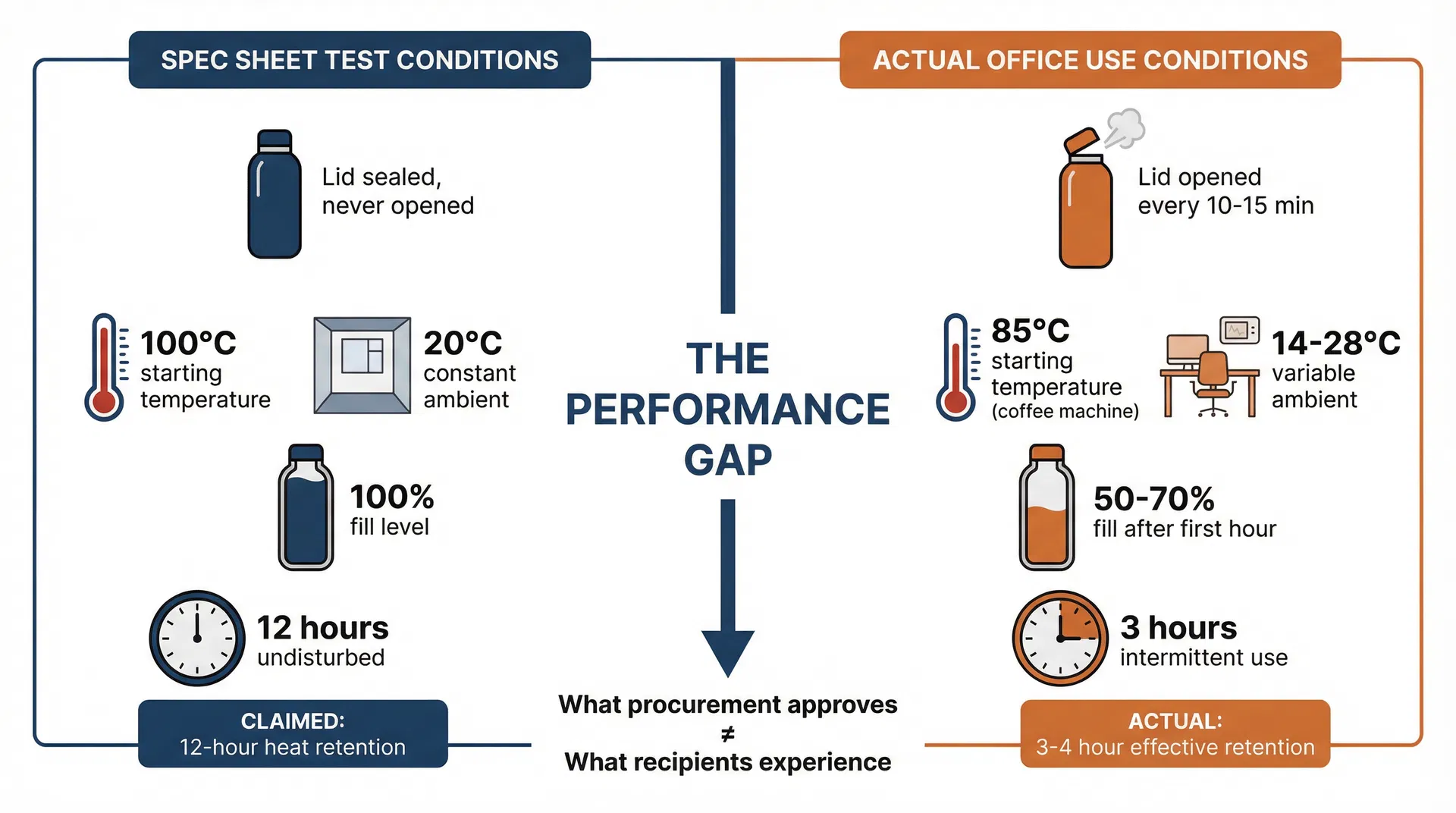
This experience gap is compounded by the way insulation testing is structured at the factory level. The standard test protocol — which varies by manufacturer but generally follows a similar logic — measures temperature at a single endpoint, typically six or twelve hours after sealing. It does not measure the temperature curve during active use. A bottle that holds water at 65 degrees after six hours in a sealed, undisturbed state might hold water at only 45 degrees after six hours of intermittent use with repeated lid openings. Both results are technically accurate, but they describe fundamentally different user experiences. The spec sheet reports the first number. The recipient lives with the second.
The lid design introduces another variable that specification sheets rarely quantify. Screw-top lids with silicone gaskets provide the best thermal seal but are slower to open and close, which means users in fast-paced office environments often leave them partially unscrewed for convenience. Flip-top and push-button lids offer faster access but create a less complete seal even when closed, and some designs include a drinking spout that is never fully sealed during use. The insulation test is conducted with the lid in its optimal sealed position. The daily user operates the lid in whatever position minimises friction with their workflow, which is almost never the optimal thermal position.
The material grade of the stainless steel also plays a role that is invisible at the procurement stage. Specification sheets for corporate gift drinkware typically state "18/8 stainless steel" or "304 grade stainless steel," both of which are adequate for food contact and corrosion resistance. What they do not state is the wall thickness of the inner and outer shells, the precision of the vacuum seal, or whether the vacuum chamber includes a copper reflective coating — a feature that significantly improves thermal performance but adds cost. Two bottles that both claim "304 stainless steel, double-wall vacuum insulated, 12-hour heat retention" can deliver meaningfully different thermal performance based on these invisible construction variables. The procurement team, comparing spec sheets, sees identical claims and defaults to the lower-priced option.
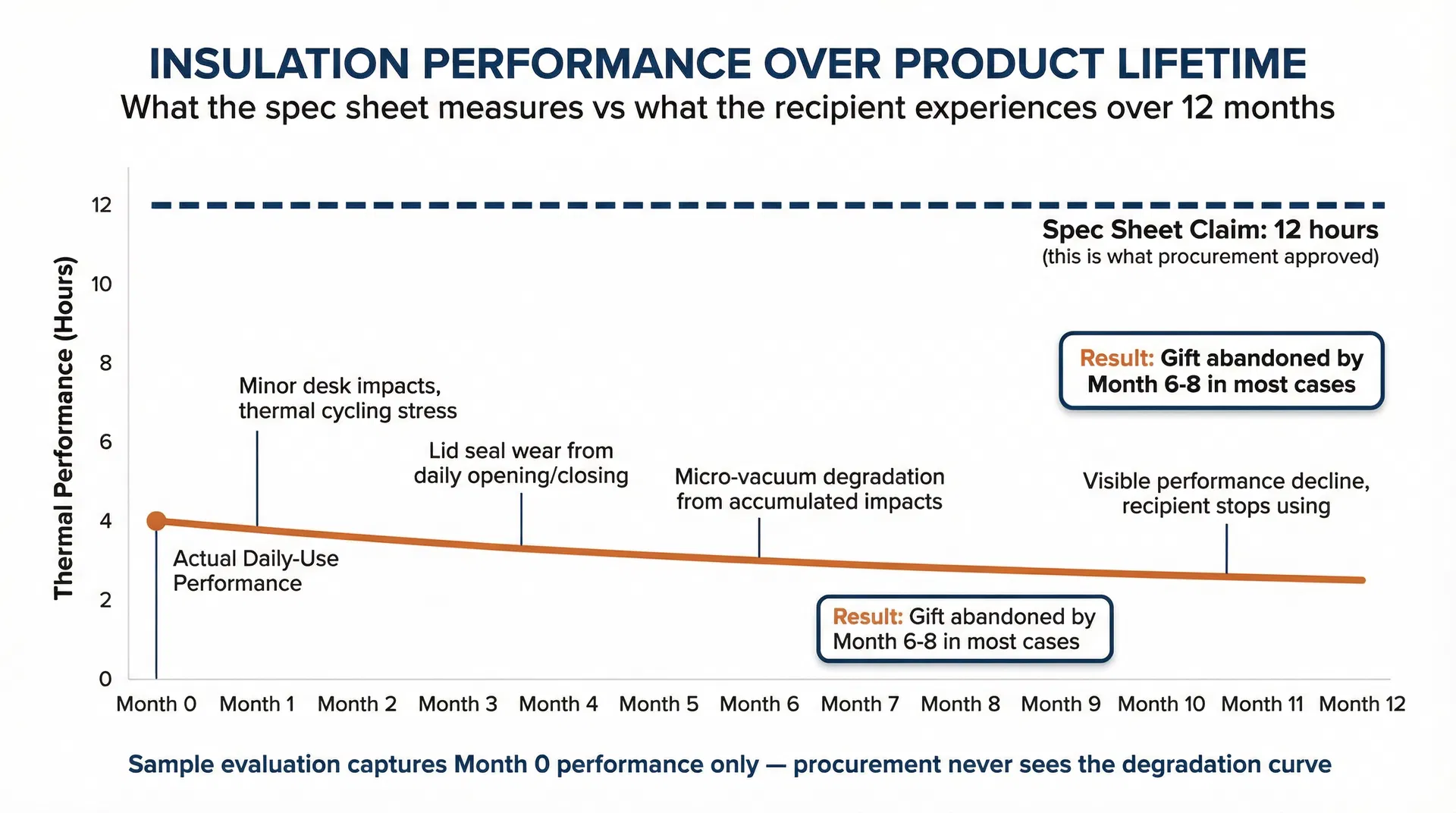
Thermal performance also degrades over the product's lifetime in ways that the initial sample evaluation cannot reveal. Every minor impact — a bottle knocked off a desk, dropped into a bag, or bumped against a car door — creates micro-stresses in the vacuum chamber walls. Over months of daily use, these accumulated stresses can compromise the vacuum seal, allowing air molecules to gradually re-enter the insulation space. The thermal performance of a bottle at month one and month eight can differ by 20 to 30 percent, a degradation curve that is entirely invisible to the procurement team that approved the sample. The recipient simply notices that the bottle "doesn't keep things hot like it used to" and stops using it, which is exactly the outcome a corporate gift programme is designed to prevent.
The seasonal dimension amplifies this mismatch in the New Zealand market specifically. A bottle evaluated during a temperate autumn procurement cycle performs differently when used in a Wellington winter office where the ambient temperature near a window desk might be 14 degrees Celsius, versus a Christchurch summer where the same desk position reaches 28 degrees. The spec sheet's controlled 20-degree test environment represents neither extreme. Cold ambient conditions accelerate heat loss from hot beverages, while warm ambient conditions accelerate warming of cold beverages — both of which reduce the perceived insulation performance relative to the spec-sheet claim. A recipient who receives a corporate gift bottle in June and finds it adequate may find the same bottle inadequate by December, not because the bottle changed but because the thermal environment did.
The deeper structural issue is that insulation performance is treated as a binary attribute in procurement — the bottle either "has" 12-hour insulation or it does not — rather than as a spectrum that depends on use conditions. This binary framing encourages procurement teams to compare spec-sheet numbers directly, which rewards suppliers who test under the most favourable conditions and report the most optimistic figures. A supplier who tests at 20 degrees ambient with a fully sealed lid and reports "12 hours" appears superior to a supplier who tests at 25 degrees with periodic lid openings and reports "6 hours," even though the second supplier's number is closer to what the recipient will actually experience. The procurement team, lacking the technical context to interpret the difference, selects the higher number.
For teams evaluating corporate drinkware gifts across different business needs and recipient contexts, the insulation specification deserves scrutiny beyond the headline number. The relevant question is not "how many hours does the spec sheet claim" but "under what conditions was that number generated, and how closely do those conditions match the recipient's actual daily use pattern." A bottle rated for eight hours under realistic office-use conditions — intermittent opening, partial fill levels, variable ambient temperature — delivers a better recipient experience than a bottle rated for twelve hours under sealed laboratory conditions. The distinction is invisible on a comparison spreadsheet but entirely visible to the person drinking lukewarm coffee at 10 AM from a bottle that was supposed to keep it hot until lunch.
The corrective requires a shift in how insulation performance is evaluated during the procurement process. Rather than accepting the supplier's headline claim, the procurement team should request the specific test methodology: starting temperature, ambient temperature, fill level, lid state, and measurement intervals. If the supplier cannot provide this detail, the claim is essentially unverifiable. For corporate gift programmes where the drinkware is intended to be a daily-use item — which is the only scenario where it generates meaningful brand exposure — the procurement team should conduct its own use-condition test: fill the sample to 70 percent capacity with water at 80 degrees, open the lid every fifteen minutes for thirty seconds, and measure the temperature after three hours. That three-hour figure, generated under conditions that approximate actual office use, is a far more reliable predictor of recipient satisfaction than any twelve-hour laboratory claim on a specification sheet.