Why the Quoted Lead Time on Custom Drinkware Corporate Gifts Is Almost Never the Number That Matters
Key procurement answer
The four-to-six-week lead time quoted by suppliers covers production only. The actual elapsed time from enquiry to delivered corporate drinkware gifts is routinely ten to sixteen weeks, and the gap between these numbers is where gift programmes encounter their most avoidable failures.
The lead time quoted on a corporate drinkware order is almost never the number that matters. When a supplier responds to a procurement enquiry with "four to six weeks," that figure typically refers to production time — the period between the factory receiving a confirmed, artwork-approved order and the finished goods leaving the production facility. It does not include the weeks of pre-production activity that precede it, nor the weeks of logistics that follow it. The procurement team, working from the quoted number, builds a project timeline that accounts for four to six weeks of total elapsed time. The actual elapsed time from initial enquiry to delivered, distributed gifts is routinely ten to sixteen weeks, and the gap between expectation and reality is where corporate gift programmes encounter their most avoidable failures.
The pre-production phase is where the first miscalculation occurs. Before production can begin, the artwork file must be prepared in the correct format for the specific branding method — laser engraving, screen printing, pad printing, or UV printing each require different file specifications, colour separations, and placement templates. If the procurement team submits a general brand asset file rather than a production-ready artwork file, the supplier’s design team must adapt it, which introduces a revision cycle. A typical artwork approval process involves two to three rounds of revision, with each round requiring internal sign-off from the marketing or brand compliance team. In organisations where brand approval sits with a different department than procurement, this internal handoff alone can consume five to ten business days. The supplier’s quoted lead time does not begin until artwork is approved. Every day spent in artwork revision is a day added to the total timeline that the procurement team did not account for when planning the gift programme delivery date.
The sample approval stage introduces another layer of elapsed time that sits entirely outside the production lead time. For corporate gift programmes involving custom colours, specific branding placements, or premium finishes, the procurement team typically requests a pre-production sample to verify that the finished product matches expectations. Producing and shipping a physical sample from an overseas factory to New Zealand takes two to three weeks. The internal review of that sample — circulating it among stakeholders, collecting feedback, requesting adjustments — adds another one to two weeks. If the sample requires modification, the cycle repeats. Two sample rounds, which is common for orders where colour accuracy or branding position matters, can add six to eight weeks to the total timeline before production even starts. The supplier’s "four to six weeks" has not yet begun.
Production scheduling adds a variable that procurement teams rarely consider because it is invisible from their side of the transaction. A factory does not hold an open production line waiting for each incoming order. Production capacity is allocated in advance, and custom orders are slotted into the schedule based on when the artwork and sample approvals are finalised. If the procurement team takes three weeks longer than expected to approve artwork and samples, the production slot that was tentatively reserved may no longer be available. The order moves to the next available slot, which could be one to three weeks later. During peak seasons — particularly the September-to-November period when corporate gift programmes for year-end distribution are being placed globally — production schedules are compressed, and slot availability becomes the binding constraint. The supplier’s quoted lead time assumes a specific production slot. The actual production start date depends on when the pre-production phase concludes, which depends on the procurement team’s internal approval speed.
The post-production logistics chain is the third segment of elapsed time that the quoted lead time does not capture. For New Zealand-based corporate gift programmes sourcing custom drinkware from overseas manufacturers, the logistics timeline includes factory-to-port transport, export customs clearance, ocean freight, import customs clearance, biosecurity inspection, port-to-warehouse delivery, and final distribution. Ocean freight from major manufacturing regions to New Zealand ports typically takes three to four weeks. Air freight reduces this to five to seven days but at a cost premium that can exceed the unit cost of the drinkware itself for heavy items like stainless steel bottles. Customs clearance in New Zealand is generally efficient, but biosecurity inspections — particularly for products with wooden or bamboo components, or packaging containing plant-based materials — can introduce unpredictable delays of three to ten business days.
The compounding effect of these sequential dependencies is what makes lead time the most consistently misjudged variable in corporate drinkware gift procurement. Each phase depends on the completion of the previous phase, and delays in any single phase push the start date of every subsequent phase. A two-week delay in artwork approval does not simply add two weeks to the total timeline; it may also push the order into a later production slot, adding another one to two weeks, and if the delayed production completion misses a scheduled shipping consolidation, it may add another week waiting for the next available container. A two-week artwork delay can become a five-week total delay through this cascading effect.
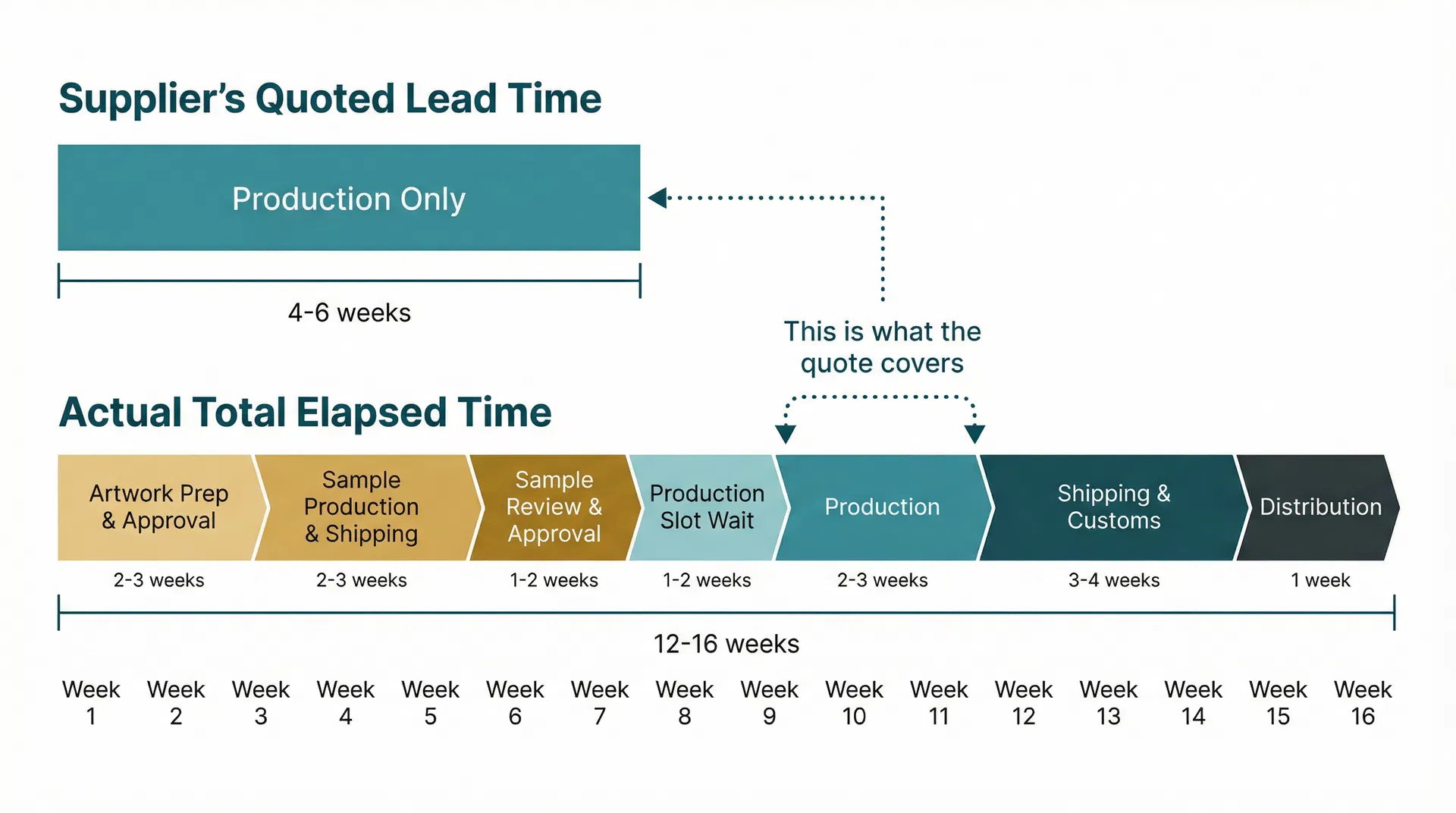
In practice, this is often where lead time decisions in corporate drinkware gift programmes start to be misjudged. The procurement team is not being careless — they are working from the information the supplier provided. But the supplier’s lead time quote answers a specific question ("how long does production take?") that is different from the question the procurement team is actually asking ("how long until we have the gifts in hand?"). The gap between these two questions is filled with pre-production approvals, logistics, and distribution — none of which the supplier’s quote addresses, and none of which the procurement team’s project plan accounts for.
The consequences of this miscalculation are not merely logistical. When the total timeline exceeds the planned timeline, the procurement team faces a choice between delaying the gift programme or compressing the remaining phases. Compression typically means accepting the first sample without requesting corrections, approving artwork with minor issues rather than requesting another revision, selecting air freight over ocean freight at significant additional cost, or — most commonly — accepting whatever production slot is available and reducing the quality inspection window. Each of these compromises degrades the final product in ways that are invisible to the person who approved the original timeline but entirely visible to the recipient who opens the gift.
The New Zealand market introduces specific timeline variables that procurement teams sourcing domestically in larger markets would not encounter. The geographic distance from major manufacturing regions means that shipping time is a larger proportion of the total timeline than it would be for an Australian or North American buyer. The relatively small order volumes typical of New Zealand corporate gift programmes — often 200 to 1,000 units — mean that orders may not qualify for dedicated container shipping and must wait for consolidation with other cargo, adding variable wait times. The seasonal shipping congestion in the fourth quarter, when global gift programme orders peak simultaneously, creates capacity constraints that affect both production scheduling and freight availability.
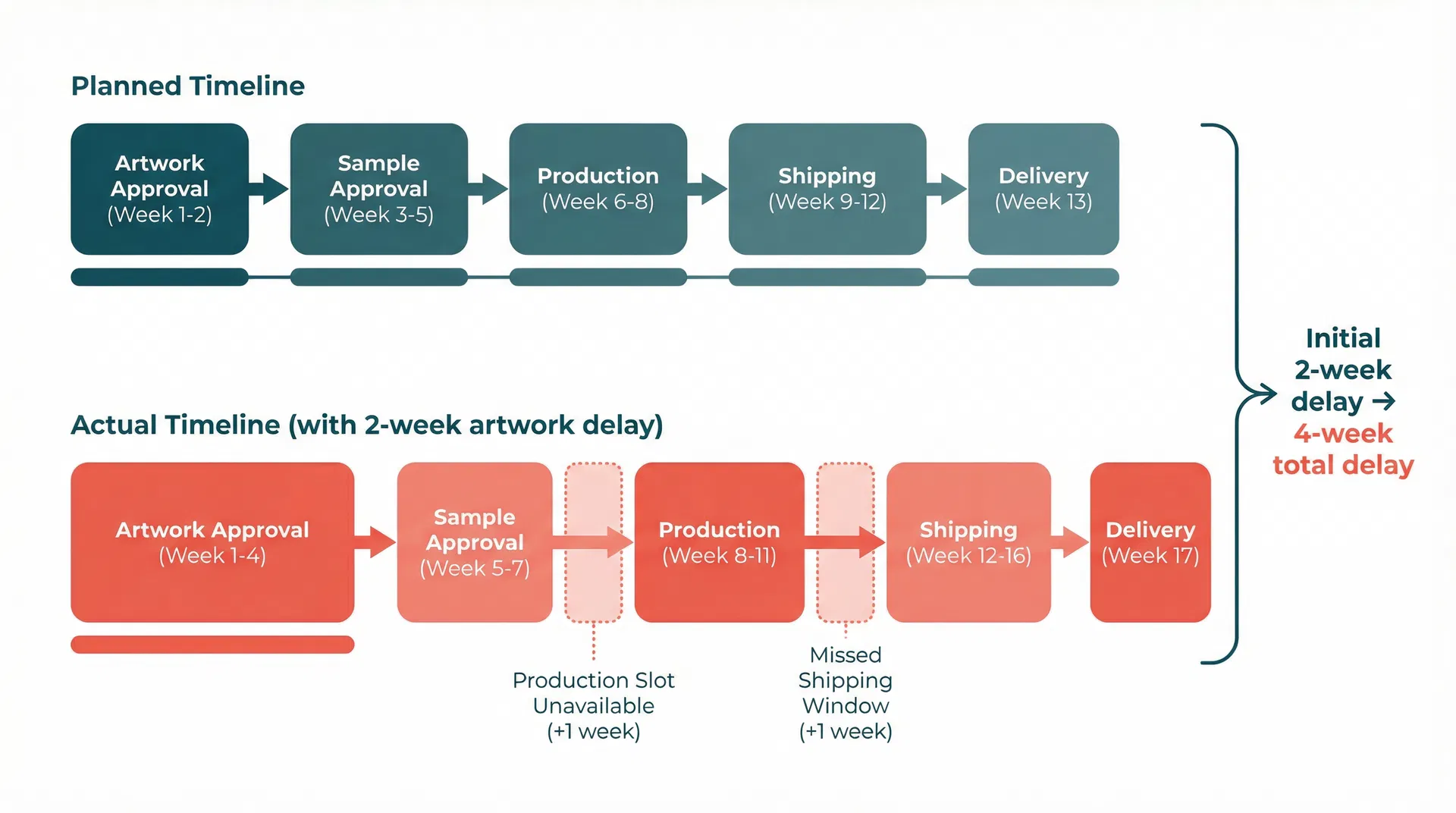
For teams managing corporate drinkware gifts across various business needs and delivery contexts, the corrective is to build the project timeline from the full sequence of dependencies rather than from the supplier’s production lead time alone. The realistic timeline begins at the point of initial enquiry and ends at the point of recipient delivery, and it includes every approval cycle, every logistics segment, and a buffer for the delays that are statistically likely to occur in at least one phase. A procurement team that plans for fourteen weeks and delivers in twelve has a successful programme. A procurement team that plans for six weeks and delivers in fourteen has a programme that arrived two months late, cost significantly more than budgeted due to expedited shipping, and likely involved quality compromises that undermine the gift’s intended purpose.
The practical framework is to work backward from the delivery date. If the gifts must be in recipients’ hands by a specific date, subtract three to four weeks for shipping and distribution, two to three weeks for production, one to two weeks for production slot scheduling, two to three weeks for sample approval, and two to three weeks for artwork preparation and approval. The resulting start date — typically twelve to sixteen weeks before the delivery date — is when the procurement process should begin, not when the order should be placed. The order placement is a milestone roughly halfway through the total timeline, not the starting point. Procurement teams that understand this distinction plan successful corporate gift programmes. Those that treat the supplier’s production lead time as the total timeline are planning a programme that will be late, over budget, or compromised — and often all three.