Why the Lid Mechanism Is the Most Overlooked Failure Point in Corporate Drinkware Gift Programmes
Key procurement answer
Procurement teams evaluate corporate drinkware gifts at cycle zero—when the lid is new, the gasket is fresh, and the mechanism snaps with precision. By cycle 300, the same lid exhibits gasket compression set, hinge fatigue, or cleaning complexity that drives recipients to abandon the bottle entirely. The lid is the primary user interface of any drinkware gift, yet it receives less specification attention than the body material or branding placement.
When a procurement team evaluates corporate drinkware gifts for an upcoming employee onboarding programme or client appreciation initiative, the assessment typically follows a predictable hierarchy: body material, insulation performance, branding surface area, and unit cost. The lid mechanism—the component that every recipient will physically interact with multiple times each day—rarely receives more than a cursory “leak-proof: yes” notation on the evaluation matrix. This oversight is not a matter of negligence. It reflects a deeper structural bias in how corporate gift drinkware is assessed: the body of the bottle is treated as the product, and the lid is treated as an accessory. In practice, this is precisely where corporate gift selection decisions begin to produce outcomes that contradict the programme’s objectives, because the lid determines whether the bottle becomes a daily companion or a desk ornament that migrates to a cupboard within weeks.
The misjudgment stems from how samples are evaluated during the procurement process. When a supplier sends a sample bottle for review, the lid is new. The silicone gasket is fresh, the threading is clean, the flip mechanism snaps with satisfying precision. The procurement team opens and closes the lid perhaps three or four times during evaluation, confirming that it seals properly and that the action feels smooth. This is roughly equivalent to test-driving a car by starting the engine in a showroom. The sample lid represents the lid at cycle zero. What procurement teams cannot evaluate from a sample is what that same lid will feel like at cycle 500—approximately three months of twice-daily use in an office environment where the bottle is opened for a sip, closed, placed in a bag, removed, opened again, and subjected to the thermal cycling of moving between air-conditioned offices and warm vehicles.
The degradation pattern varies by lid type, but the trajectory is consistent. Screw-cap lids, which score highest on leak-proof evaluations, require two-handed operation. In an office setting where recipients are working at keyboards, taking phone calls, or moving between meetings, the need to stop, use both hands, and unscrew a cap creates enough friction that usage frequency drops. The bottle sits unopened for longer periods. Hydration decreases. The bottle gradually becomes associated with inconvenience rather than utility. Flip-top lids address the one-handed operation requirement but introduce a different failure mode: the hinge mechanism that feels crisp at cycle zero develops play after several hundred cycles. The “click” that confirmed a secure seal becomes ambiguous. Recipients begin to distrust the seal, particularly when the bottle is placed horizontally in a laptop bag. A single leak incident—coffee staining a laptop sleeve—is sufficient to permanently retire the bottle from daily carry.
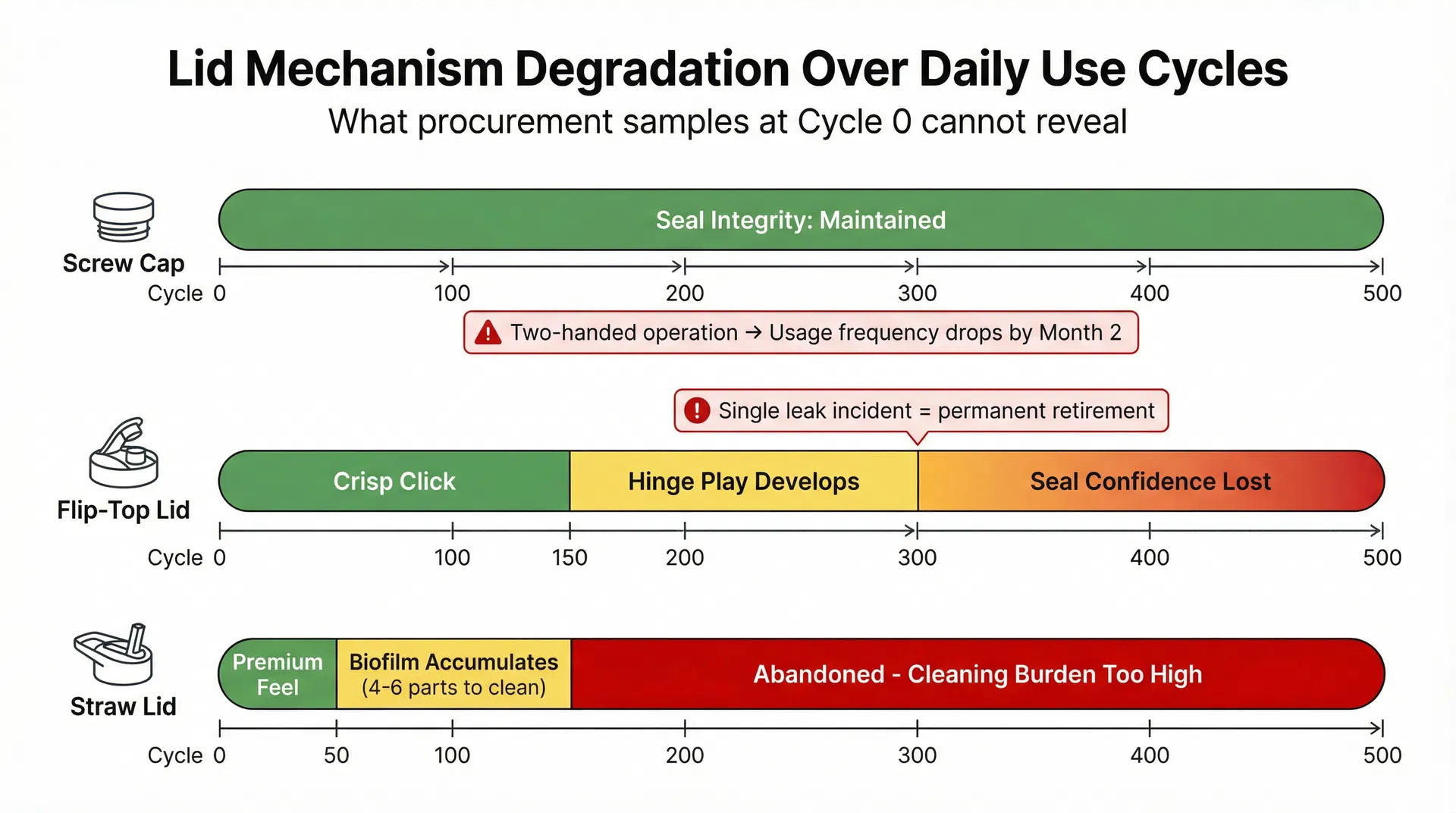
Straw lids present perhaps the most instructive case of the gap between procurement evaluation and daily reality. From a sample assessment perspective, straw lids appear ideal for corporate gifts: they enable one-handed drinking without tilting, they look modern, and they suggest a premium user experience. What the sample cannot reveal is the cleaning burden. A straw lid assembly typically comprises four to six separate components—the outer cap, the straw tube, one or two silicone gaskets, and sometimes a bite valve or flow restrictor. After two weeks of daily use with coffee or tea, biofilm accumulates in the straw tube and around the gasket seats. The recipient faces a choice: disassemble the entire lid mechanism for thorough cleaning, or accept that the straw tastes slightly off. Most recipients choose a third option—they stop using the bottle entirely. The corporate gift that was selected partly for its premium straw lid becomes abandoned precisely because of that lid.
The thermal cycling dimension adds another layer that procurement evaluation cannot capture. Corporate drinkware in daily use moves between environments with significant temperature differentials: a 22-degree air-conditioned office, a 35-degree parked car, a refrigerator if the recipient stores the bottle overnight. Lid components—particularly silicone gaskets and polymer threading—respond to these temperature swings differently than the stainless steel body. Silicone gaskets expand and contract at a different rate than the metal or plastic housing they seal against. Over months of daily thermal cycling, the gasket’s compression set changes. It no longer returns to its original shape after being compressed by the lid closure. The seal that was perfect at cycle zero becomes marginal at cycle 300, and the recipient notices condensation forming on the outside of the lid or a slight weeping around the seal line. This is not a catastrophic failure—it is a gradual erosion of confidence in the product that leads to reduced usage.
The material fatigue dimension is particularly relevant for corporate gifts that feature flip mechanisms or clip closures. These lid types rely on a “living hinge”—a thin section of polymer that flexes each time the lid is opened. The fatigue life of a living hinge depends on the polymer grade, the hinge geometry, and the presence of manufacturing defects such as weld lines at the flex point. A well-engineered living hinge in high-grade polypropylene can survive 5,000 or more cycles. A cost-optimised hinge using recycled polymer or featuring a mold weld line at the flex point may begin showing stress whitening within 200 cycles—roughly six weeks of daily use. The procurement team that approved the sample saw a hinge at cycle zero. The recipient who stops using the bottle saw a hinge at cycle 200, with visible white stress marks and a noticeably softer snap action that no longer inspires confidence in the seal.
What compounds this issue is that lid mechanism failure is invisible in programme metrics. When a corporate gift programme reports distribution numbers—1,000 bottles distributed to new employees, 500 bottles given to clients at a conference—the implicit assumption is that distribution equals usage. No programme tracks what happens at month three. No procurement report captures the percentage of distributed bottles that have migrated from daily desk use to a kitchen cupboard. The lid mechanism is the primary driver of this migration, but because it fails gradually rather than catastrophically, there is no incident report, no complaint, no return. The bottle simply stops appearing on desks. The brand exposure that justified the programme’s budget quietly evaporates, and the next annual review approves the same specification because the distribution metrics looked successful.
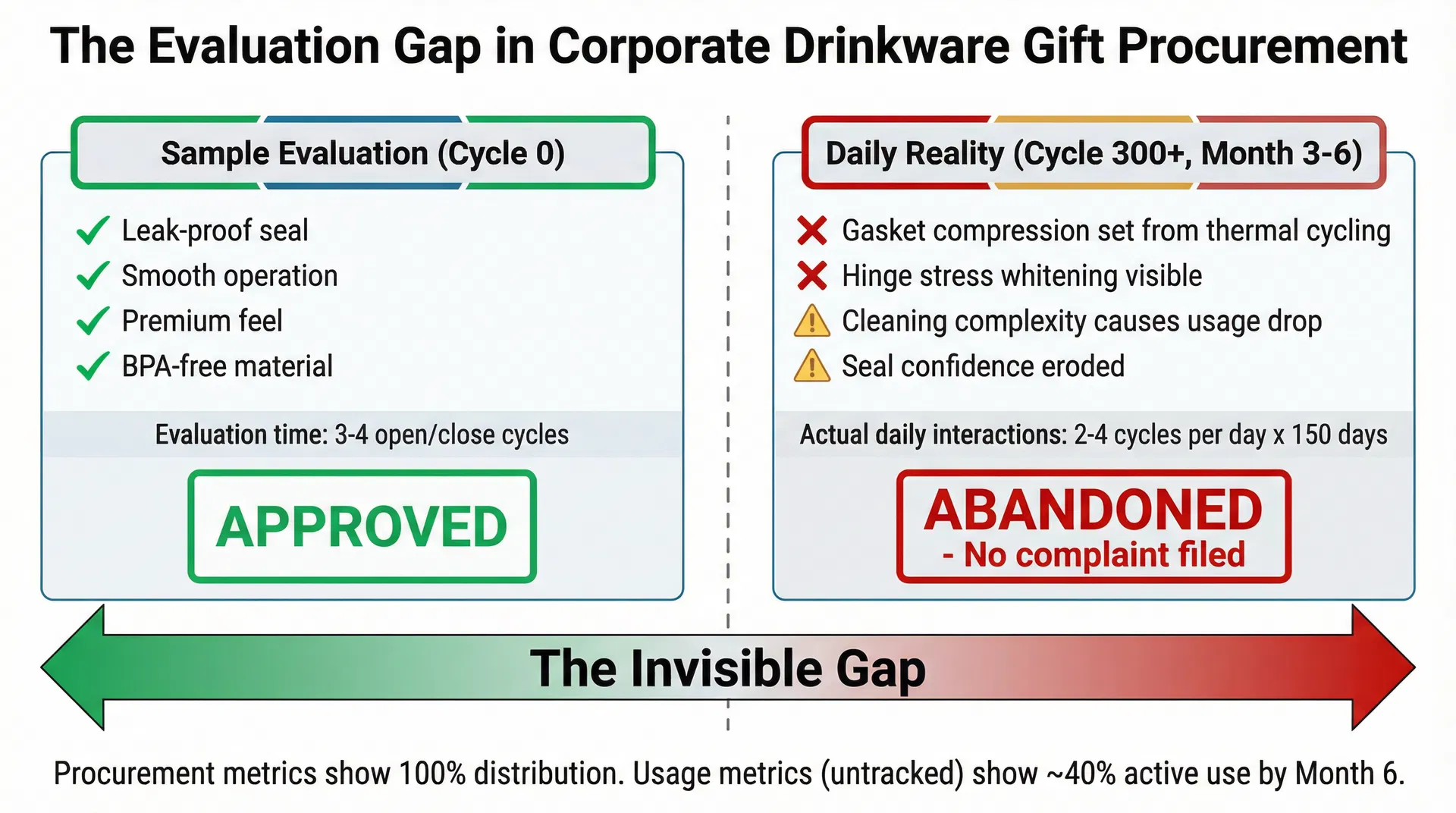
The specification process itself contributes to the problem. When procurement teams issue a request for quotation for corporate drinkware gifts, the lid specification typically reads “leak-proof, BPA-free” and nothing more. There is no specification for opening force (the Newtons required to operate the lid one-handed), no requirement for cycle-life testing (minimum number of open-close cycles before mechanism degradation), no cleaning complexity rating (number of disassembly steps required for thorough cleaning). These are the parameters that determine whether the lid supports daily use, but they are absent from procurement specifications because they are absent from the evaluation framework. Suppliers, responding to the specification they receive, optimise for leak-proof performance at cycle zero—which is exactly what the sample demonstrates—rather than for mechanism longevity across hundreds of daily interactions.
The connection between lid mechanism selection and the broader question of matching corporate gifts to specific business contexts and recipient behaviour is direct but rarely articulated. A client appreciation gift that will sit on an executive’s desk needs a different lid profile than an employee onboarding gift that will travel in a commuter bag. The executive desk bottle benefits from a wide-mouth screw cap—the two-handed operation is acceptable because the bottle stays stationary, and the wide mouth facilitates easy cleaning by office staff. The commuter bottle requires a one-handed mechanism with a proven seal under horizontal orientation, because it will spend hours on its side in a bag next to electronics. These are fundamentally different engineering requirements, but procurement teams routinely specify a single lid type across both use cases because the lid is classified as a feature rather than as the primary interface between the recipient and the gift.
The cost dimension reinforces the misjudgment. Lid mechanisms represent a disproportionate share of the manufacturing cost variance between drinkware products. A basic screw cap adds minimal cost. A well-engineered flip mechanism with a quality living hinge, precision-molded gasket seat, and tested cycle life adds measurably more. When procurement teams compare unit costs across suppliers, the lid mechanism is where cost-conscious suppliers find their margin—using lower-grade polymers, simplified hinge geometry, or gaskets with tighter tolerances that reduce material but accelerate compression set. The NZD 1.50 per-unit saving on the lid mechanism is visible on the purchase order. The cost of 400 bottles abandoned by month three because the lid mechanism degraded is invisible everywhere except in the absence of brand impressions that the programme was designed to generate.
The pattern works when the lid mechanism is evaluated as the primary user interface rather than as a secondary component. Procurement teams that request cycle-life test data from suppliers, that specify opening force requirements based on recipient use context, and that evaluate cleaning complexity as a formal criterion consistently achieve higher sustained usage rates from their corporate drinkware gift programmes. The distinction is not between expensive and inexpensive lids—it is between lids that are specified for the moment of distribution and lids that are specified for the sixth month of daily use. The former satisfies the procurement checklist. The latter satisfies the programme objective. These are not the same thing, and the gap between them is where most corporate drinkware gift programmes quietly underperform without generating a single complaint that would trigger a specification revision.