Why a Material Name Alone Cannot Protect Custom Drinkware Quality
Key procurement answer
A material grade identifies composition, but it does not define the dimensions, tolerances, finish, assembly, testing, or revision controls required to manufacture consistent custom drinkware. This procurement guide explains how to turn a material label into a measurable production specification.
Procurement position: A material name such as “304 stainless steel” or “food-grade polypropylene” identifies one important property of a custom drinkware product, but it does not define the complete product that a supplier must manufacture. A production-ready specification must also state the relevant dimensions, capacity, wall thickness, tolerances, finish, decoration, components, assembly requirements, test methods, acceptance criteria, document revision, and change-control expectations. If those requirements are missing, two suppliers can both claim to meet the same material specification while producing items that differ in fit, feel, appearance, function, and long-term consistency.
This is a frequent procurement blindspot because material names look precise. They sound more technical than a general description such as “premium bottle,” and they are easy to copy from an earlier order or catalogue. The difficulty begins when the material label is treated as if it were a manufacturing instruction. It is not. The material tells the factory what a component is made from; it does not, by itself, tell the factory what the finished item must measure, how it must perform, or which differences are unacceptable.
A manufacturing specification is stronger when it answers three separate questions: what is being built, how it is to be constructed, and how the buyer will determine whether it was built correctly. This distinction is also reflected in manufacturing-specification guidance, which separates measurable technical requirements from a general product description and identifies materials, dimensions, process, finish, packing, and testing as related parts of the specification. A buyer who records only the material has answered the first part only partially.
What a material name can prove. A material designation can establish a starting point for composition, grade, or intended material family. It may help the buyer compare corrosion resistance, weight, temperature suitability, or compatibility with a proposed manufacturing process. It can also support supplier conversations about availability and substitution risk. Those are useful procurement functions. They are not the same as proving that the delivered drinkware will have the required dimensions, capacity, finish, closure fit, logo appearance, or user experience.
What it cannot prove. “304 stainless steel” does not specify the sheet thickness, body diameter, height, neck geometry, base construction, weld condition, vacuum performance, or acceptable dimensional variation. “Food-grade plastic” does not specify the resin family, colour masterbatch, wall thickness, shrinkage allowance, moulding tolerance, odour requirement, or the conditions under which the component is expected to remain stable. A material name is therefore an input to a specification, not a substitute for one.
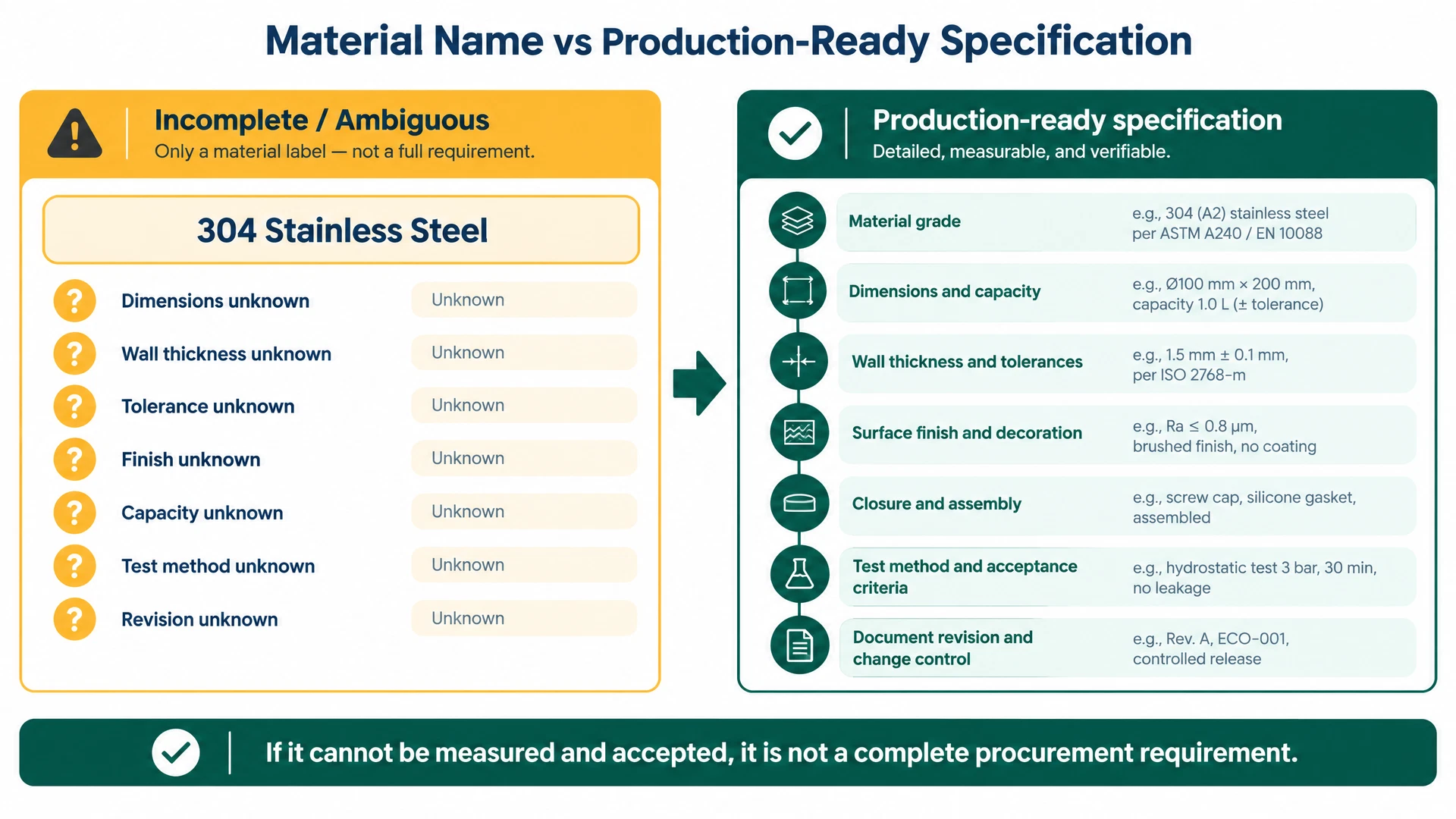
The difference is shown in the diagram: the incomplete side names a material but leaves the production decision open, while the complete side connects material identity to measurable geometry, finish, assembly, testing, and document control. This is the evidence chain a procurement team needs if it wants to compare quotations fairly and verify that a reorder is genuinely the same product.
Dimensions and tolerances convert an idea into a measurable object. A bottle described as “500 ml” may be interpreted as nominal fill volume, usable fill volume, overflow capacity, or marketing capacity. A tumbler described as “large” may be produced with a diameter that fits one cup holder but not another. A lid described as “compatible” may seal on a sample while showing unacceptable variation across a production batch. Capacity, height, diameter, opening, base, thread, closure interface, and key fit dimensions should therefore be identified with a measurement method and an acceptable range.
Tolerances are not a request for unnecessary precision. They define the range within which a product remains fit for its intended use. A tolerance may be important because a component must fit another component, because a label or logo must sit within a defined zone, because packaging needs a predictable outer dimension, or because the product must fit an existing holder, appliance, or shipping carton. Without a tolerance, the supplier may reasonably choose a range that is technically manufacturable but commercially inconvenient.
Finish and decoration need their own requirements. A material grade does not define whether the external surface is polished, brushed, powder-coated, soft-touch, glazed, textured, or left in a particular mill finish. It also does not define where a logo sits, how large it is, which colour reference governs it, what contrast is acceptable, or how the decoration is inspected. When finish and decoration are left in a mood board or email thread, the approved sample becomes the only practical reference, even though a sample may not state the tolerances or process controls needed to reproduce it.
This is why the broader custom drinkware customization process should connect artwork approval, material confirmation, surface preparation, decoration method, sample review, production monitoring, and release inspection. A logo can be correct while the surface is wrong. A surface can be correct while the logo position is wrong. A sample can be acceptable while the production range is undefined. Treating these as separate evidence questions makes the specification more useful.
Components and assembly determine whether the product works as a system. A drinkware item may include a vessel body, lid, gasket, valve, handle, sleeve, straw, base, or other accessory. Each component can have its own material, dimensions, finish, and acceptance criteria. More importantly, the components interact. A gasket material may be acceptable on its own but fail to seal when the closure tolerance changes. A lid may fit the approved sample but become difficult to operate when the body diameter varies. A handle may remain attached but create an uncomfortable grip if its position shifts.
A complete specification should therefore identify which components are included, which parts are interchangeable, how the assembly is oriented, and which functional checks apply after assembly. The buyer does not need to dictate every factory work instruction, but the product-level requirement must be clear enough that the supplier knows what outcome is being accepted. If the supplier is free to choose an assembly method, the performance and inspection requirements still need to be fixed.
Testing and acceptance criteria define what “correct” means. A specification that says “high quality,” “durable,” or “premium finish” gives the supplier a direction but not a pass/fail decision. A stronger requirement identifies the property being checked, the method or conditions, the sample or inspection basis, and the result that is acceptable. For example, a leak check, logo-position check, capacity check, coating inspection, closure-cycle check, or packaging-fit check may each require a different method and a different defect threshold.
This does not mean every order needs an expensive laboratory programme. It means the buyer should match the evidence to the risk. If a dimension controls compatibility, measure it. If the decoration is the principal brand risk, define its location, appearance, and inspection method. If the lid is a known failure point, test the assembled closure rather than inspecting the vessel body alone. If a claim depends on repeated use, describe the relevant use or cycle conditions instead of relying on a one-time visual approval.
Revision control prevents an approved requirement from becoming an informal memory. Supplier-quality requirements commonly instruct suppliers to use only the drawing, model, specification, work instruction, and revision identified by the order, and to request written clarification when documents conflict or a revision is missing. The principle is directly relevant to custom drinkware even when the product is not highly engineered: a buyer should know which artwork file, material grade, finish reference, dimension set, sample, and inspection instruction govern the order.
A revision number is valuable because it makes change visible. If the buyer updates a logo, changes a lid, accepts a new finish, or approves an alternative component, the supplier should not have to infer whether the change is intentional. A controlled revision also makes a reorder easier to compare. When the product looks different later, the procurement team can identify whether the difference came from an approved change, an unapproved substitution, a process drift, or an incomplete original requirement.
The commercial risk of an incomplete specification appears after the quote. Two suppliers may quote different prices for what appears to be the same item because one has included a thicker wall, tighter dimensional control, more extensive testing, or a more durable decoration process. A buyer may select the lower price without realising that the offers are not technically equivalent. The disagreement then reappears as a variation charge, a sample dispute, a rejected batch, a packaging problem, or a reorder that no longer matches the first shipment.
The same problem affects internal approvals. Marketing may approve the logo appearance, operations may need a specific capacity and packaging footprint, finance may compare a unit price, and quality may expect evidence of function. If the written specification contains only a material name, each team fills the missing requirements with its own assumptions. The supplier then receives a purchase order that is commercially clear but technically underdefined.
A practical minimum specification for custom drinkware should link the material to the product’s measurable identity. It should state the material and relevant grade; key dimensions and tolerances; nominal and usable capacity where relevant; surface finish and decoration method; component and assembly requirements; intended use and cleaning environment; test or inspection method; acceptance criteria; packaging requirements; and the governing document revision. Not every field will have the same importance for every product, but every important risk should have a defined requirement and a way to verify it.
The procurement question is therefore not “Which material should we specify?” It is “What evidence must a supplier provide for this material to become the product we actually intend to buy?” A material label can start the conversation, but only a measurable, version-controlled specification can make quotations comparable, production inspectable, reorders consistent, and quality decisions defensible. When the requirement cannot be measured or accepted, it remains a preference rather than a complete procurement control.