Why Consolidating Corporate Drinkware Gift Orders Across Departments Creates Specification Conflicts That Cost More Than Separate Orders
Key procurement answer
When multiple departments consolidate their corporate drinkware gift requirements into a single procurement order, the resulting compromise specification satisfies no department's actual needs. The material, branding, packaging, and budget-per-unit conflicts between HR onboarding, Marketing events, Sales client gifts, and executive presentations produce a generic product that triggers supplementary purchases exceeding the original consolidation savings.
When a company with four or five departments all requiring corporate drinkware gifts within the same fiscal quarter decides to consolidate those requirements into a single procurement order, the logic feels unassailable. Combining HR’s onboarding kits, Marketing’s event giveaways, Sales’ client appreciation gifts, and the executive team’s board-level presentation items into one purchase order promises volume pricing, simplified vendor management, and a single point of accountability. The procurement team presents this consolidation as a cost-saving initiative, and finance approves it without hesitation. In practice, this is often where corporate gift decisions start to be misjudged—not because consolidation itself is flawed, but because the specification that emerges from merging four distinct use cases into one product line satisfies none of them properly.
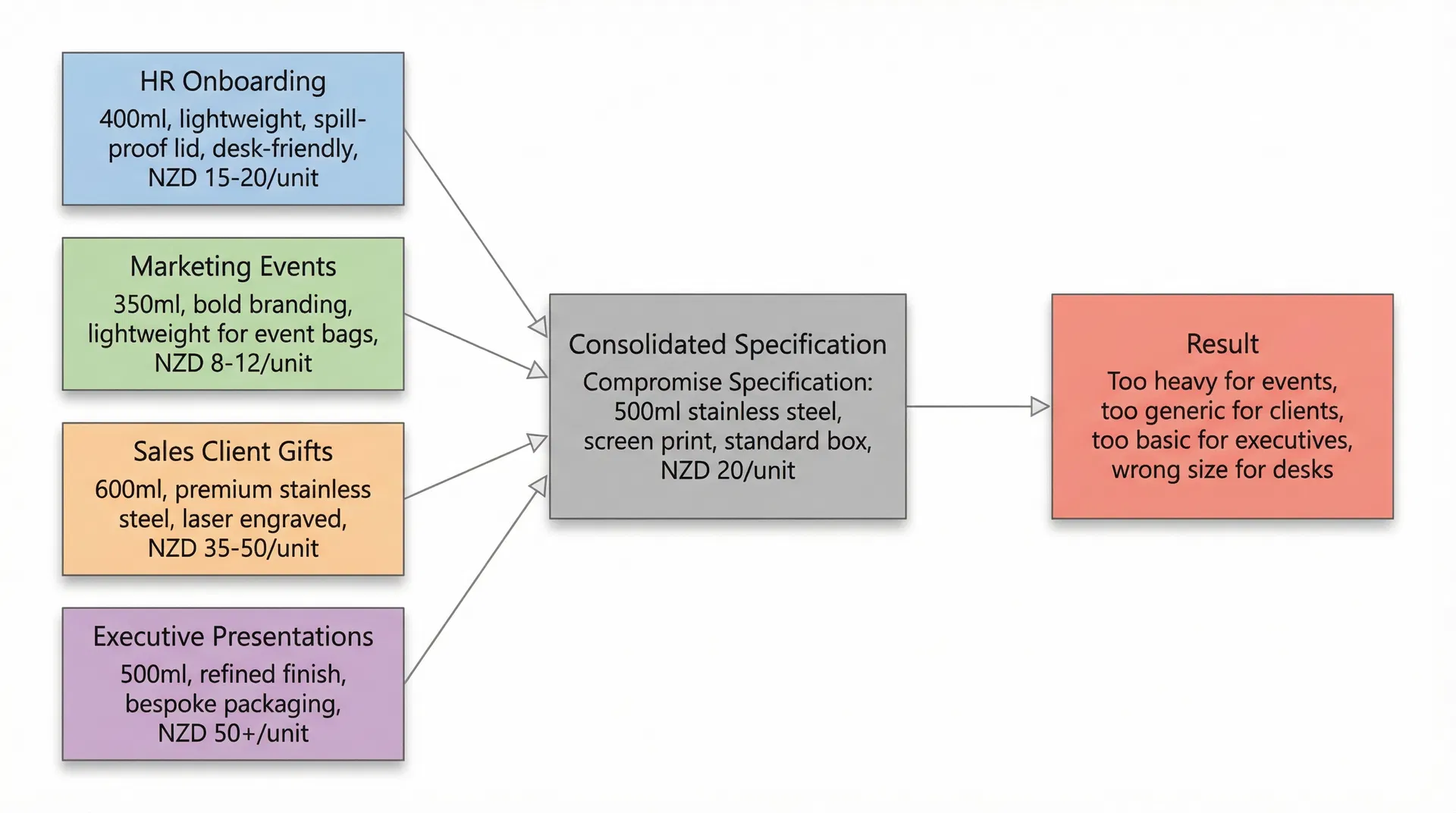
The root of this misjudgment lies in how procurement teams construct specifications for consolidated orders. When each department submits its requirements independently, the differences are stark. HR needs a functional, desk-friendly reusable bottle that new employees will actually use daily—something in the 400-500ml range, lightweight, with a secure lid that prevents spills near laptops. Marketing needs an eye-catching item that photographs well at trade shows and fits easily into event tote bags—ideally lightweight, boldly branded, and inexpensive enough to distribute in quantities of 300 or more. Sales needs something that communicates premium quality when placed on a client’s desk—heavier materials, subtle branding, perhaps laser-engraved stainless steel in the 600ml range. The executive team needs a presentation-grade item that can sit alongside a leather portfolio in a boardroom without looking out of place.
When procurement consolidates these four sets of requirements, the resulting specification is typically a compromise: a mid-weight stainless steel bottle in the 500ml range, with screen-printed branding, packaged in a standard white box. This “middle ground” product is not lightweight enough for Marketing’s event bags, not premium enough for Sales’ client desks, not compact enough for HR’s desk-friendly requirement, and not refined enough for executive presentations. The compromise specification creates a product that is adequate for general purposes but optimal for none of the specific contexts in which it will actually be used.
The specification conflict becomes particularly visible in material selection. A 304-grade stainless steel vacuum-insulated bottle that meets Sales’ premium requirement weighs between 350 and 450 grams empty. When Marketing distributes this at a trade show where attendees are already carrying laptops, brochures, and other vendor giveaways, the weight becomes a liability. Attendees either decline the bottle or accept it and leave it at the venue. Meanwhile, a lightweight BPA-free Tritan bottle that works perfectly for event distribution looks and feels inexpensive when Sales presents it to a client who just signed a six-figure contract. The material that solves one department’s problem actively undermines another department’s objective.
Branding method creates a parallel conflict that procurement teams rarely anticipate. Marketing typically wants maximum visual impact—full-colour wrap printing, bold graphics, prominent logo placement that is visible from across a conference hall. Sales wants the opposite: understated elegance, a small laser-engraved logo that suggests confidence rather than promotion. HR sits somewhere between, wanting clear company identification without the item feeling like a marketing tool. Executive gifts require the most restraint—often just a monogram or a single-colour debossed logo. When procurement selects one branding method for the entire consolidated order, the result is either too loud for half the recipients or too subtle for the other half. A full-colour screen print that works at a trade show looks garish on a boardroom table. A tasteful laser engraving that impresses a CEO is invisible in a conference hall photograph.
The budget-per-unit conflict compounds these technical specification problems. Client appreciation gifts from the Sales team typically justify a unit cost of NZD 30-50, because the gift represents the company in a high-stakes relationship context. Event giveaways from Marketing need to stay under NZD 10-15 per unit to remain within campaign budgets that must cover hundreds of recipients. When these budgets are averaged across a consolidated order, the resulting per-unit spend of NZD 18-22 produces a product that is over-specified for events and under-specified for client relationships. Marketing overpays for items that will be given away casually, while Sales receives items that do not meet the quality threshold their client relationships demand.
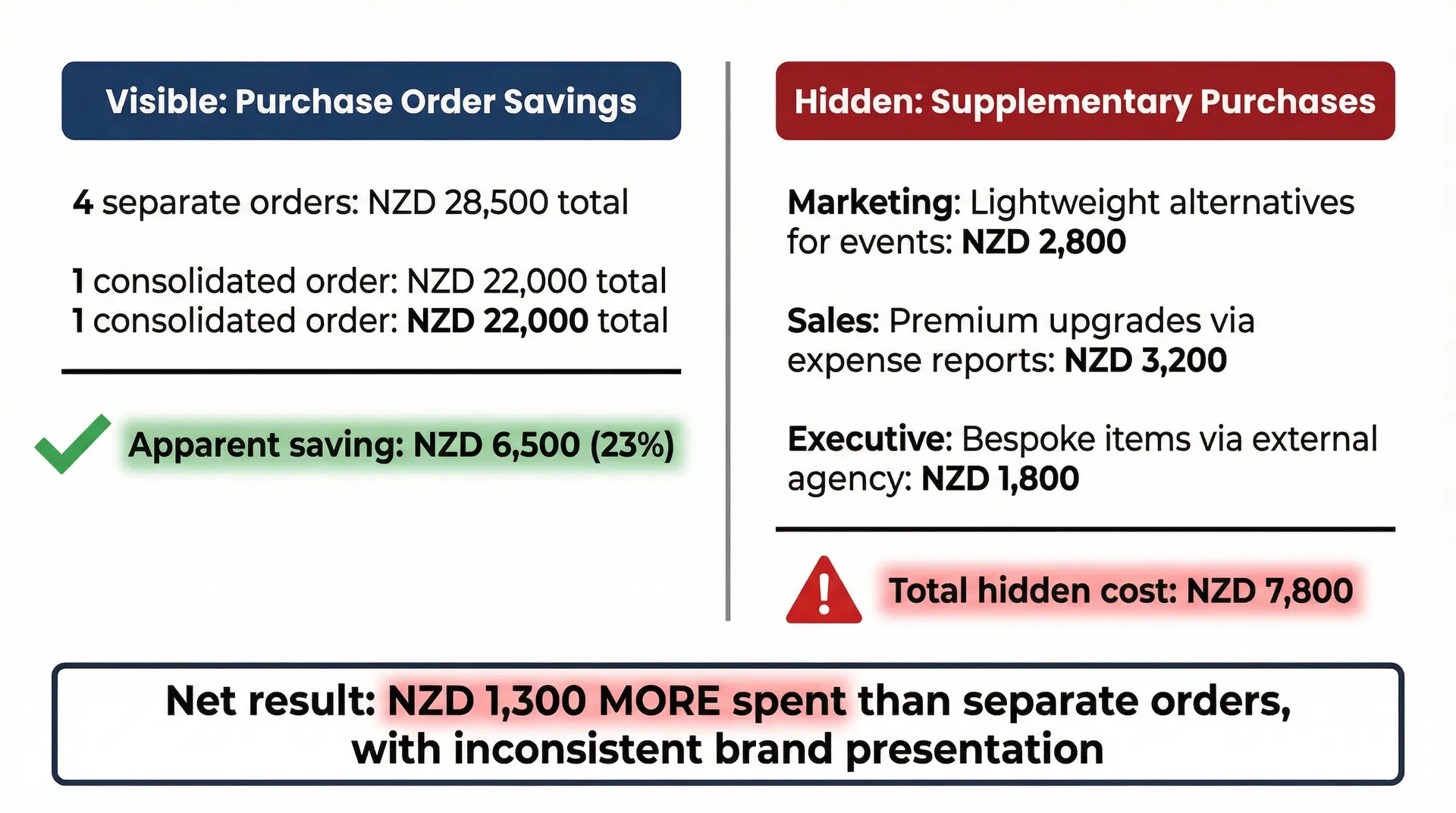
What makes this consolidation error particularly persistent is that the cost savings appear real on the purchase order. A consolidated 1,000-unit order does achieve a lower per-unit price than four separate orders of 150, 300, 200, and 50 units. The procurement team can demonstrate a tangible saving of perhaps 15-20 percent on the unit cost. What the purchase order does not capture is the downstream cost of mismatched specifications: the Marketing team that orders additional lightweight alternatives because the consolidated bottles are too heavy for events, the Sales team that quietly purchases separate premium gifts because the standard item does not meet client expectations, and the executive assistant who sources a different product entirely for board presentations. These supplementary purchases often exceed the original consolidation savings, but they appear in different budget lines and are never attributed back to the specification compromise.
The packaging dimension of this conflict is frequently the last to surface but often the most damaging to the gift’s effectiveness. HR’s onboarding kits need packaging that integrates with a welcome box containing multiple items—a flat or compact package that stacks neatly. Marketing’s event items need minimal packaging for rapid distribution—ideally just a polybag or no packaging at all. Sales’ client gifts need presentation-quality packaging—a rigid box, tissue paper, perhaps a branded sleeve. Executive gifts may require bespoke packaging with magnetic closures or embossed details. A single packaging specification cannot serve all four contexts. The standard white box that procurement selects as a compromise adds unnecessary cost to Marketing’s giveaways, looks generic for Sales’ client presentations, and is entirely inadequate for executive-level gifting.
The deeper issue is that procurement teams evaluate consolidation through a lens of purchasing efficiency—fewer purchase orders, fewer vendor relationships, fewer invoice cycles. This lens is appropriate for commodity items where the product specification is identical regardless of end use. Office paper, cleaning supplies, and printer cartridges are genuinely interchangeable across departments. But corporate drinkware gifts are not commodity items. They are communication tools whose effectiveness depends entirely on the context in which they are received. A bottle that communicates “we value your partnership” to a client must be fundamentally different from one that communicates “welcome to the team” to a new employee or “thanks for visiting our booth” to a conference attendee. When procurement applies commodity purchasing logic to context-dependent items, the resulting specification conflict is inevitable.
The practical consequence extends beyond immediate recipient satisfaction. When departments receive a consolidated product that does not meet their specific needs, they develop workarounds that fragment the company’s brand presentation. Marketing starts sourcing its own event items from a different supplier, using a slightly different logo treatment. Sales begins purchasing premium alternatives through expense reports rather than procurement channels. The executive team commissions bespoke items through an external agency. Within two procurement cycles, the company that consolidated to achieve brand consistency and cost efficiency has inadvertently created three or four parallel gifting streams, each with its own supplier, its own branding standards, and its own quality benchmarks. The brand fragmentation that consolidation was meant to prevent becomes the direct result of consolidation done without specification segmentation.
Understanding how different business contexts demand different product specifications is central to making corporate drinkware gift decisions that actually serve their intended purpose. When teams evaluate which types of corporate gifts align with specific business needs and recipient contexts, the specification requirements become clearer before they reach the procurement stage. The consolidation impulse is not wrong in principle—it is wrong when applied without acknowledging that a trade show attendee, a new hire, a long-term client, and a board member occupy fundamentally different positions in the company’s relationship ecosystem, and each position demands a different physical expression of that relationship.
The consolidation approach works when all departments genuinely share the same use case—for example, when every department needs identical desk bottles for an office-wide sustainability initiative where the recipient context is uniform. It also works when the company explicitly accepts that the consolidated product will serve as a baseline item, with departments retaining separate budgets for context-specific upgrades. What consistently fails is the assumption that a single specification can simultaneously satisfy premium client gifting, high-volume event distribution, functional onboarding, and executive presentation requirements. The purchasing efficiency that consolidation delivers at the order level is offset by the communication inefficiency it creates at the recipient level, and that trade-off is rarely visible on the spreadsheet where the consolidation decision is made.