When the Packaging Is an Afterthought: How Presentation Gaps Undermine Corporate Drinkware Gift Investments
Key procurement answer
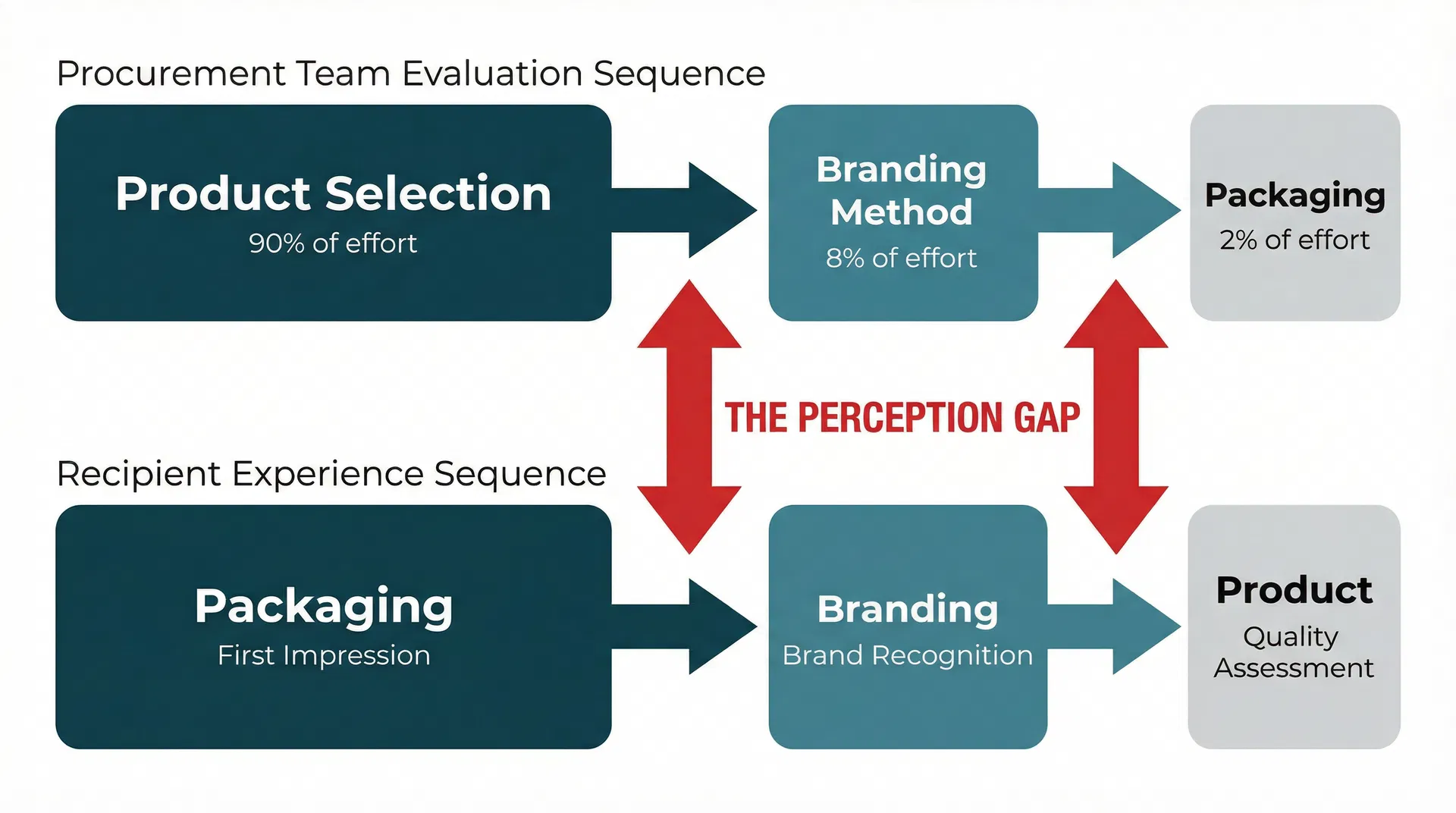
Packaging in corporate drinkware procurement is typically classified under logistics, not brand communication. This misclassification means the element that shapes the recipient’s first impression receives less than one percent of the total evaluation effort.
There is a pattern in corporate drinkware procurement that repeats with remarkable consistency. A procurement team spends weeks evaluating product specifications — wall thickness, insulation performance, steel grade, capacity, lid mechanism. They negotiate pricing, confirm branding placement, approve colour samples, and align delivery schedules. Then, in the final stage of the purchase order, someone asks about packaging. The answer is usually brief: “supplier standard box” or “white corrugated mailer.” The line item gets approved in minutes, sometimes seconds. And in that moment, the entire investment in product quality and brand customisation becomes dependent on a decision that received less than one percent of the total evaluation effort.
This is not a minor procedural gap. In corporate gifting, the packaging is the first physical interaction the recipient has with the gift — and by extension, with the brand behind it. The bottle or tumbler inside may be exceptional. The laser engraving may be flawless. The stainless steel may be genuine 304 grade. None of that matters if the recipient’s first impression is a plain brown box with a shipping label, or a generic foam insert that looks identical to consumer electronics packaging. The product tells the recipient what the gift is. The packaging tells the recipient what the gift means. When the packaging communicates nothing, the meaning defaults to “this was a bulk purchase.”
The misjudgment stems from how packaging is categorised within procurement workflows. In most corporate purchasing structures, packaging falls under logistics — the same category as freight, customs documentation, and pallet configuration. It is treated as a protective function: does the box prevent damage during transit? If yes, the packaging has done its job. This framing is technically correct for commodity shipments, but fundamentally wrong for corporate gifts. A corporate gift is not a commodity being delivered. It is a brand communication being presented. The distinction matters because it determines who makes the packaging decision and what criteria they use. When packaging is classified as logistics, the decision is made by operations staff optimising for cost and damage prevention. When packaging is classified as brand communication, the decision involves marketing or brand teams evaluating recipient experience. In practice, the logistics classification almost always wins, because the packaging line item appears late in the procurement timeline, after the product budget has already been committed.
What remains invisible to most procurement teams is the asymmetry between how they evaluate the gift and how the recipient experiences it. The procurement team’s evaluation sequence is: product first, branding second, packaging last. The recipient’s experience sequence is exactly reversed: packaging first, branding second, product third. A recipient at a corporate event receives a box. They see the exterior before they know what is inside. They feel the weight and texture of the packaging material. They notice whether the box opens with a magnetic closure or a tuck flap. They register whether there is tissue paper, a branded sleeve, or a handwritten note. All of this happens before they ever see the drinkware itself. By the time they hold the stainless steel bottle, their perception of its quality has already been anchored by the packaging experience. A premium product in standard packaging is perceived as a standard product. A good product in thoughtful packaging is perceived as a premium gift.
The cost structure of this misjudgment is worth examining. A typical corporate drinkware order for 200 units might allocate NZD 18–25 per unit for the product, NZD 2–4 per unit for branding, and NZD 0.80–1.50 per unit for packaging. The packaging represents roughly three to five percent of the total per-unit cost. Upgrading from a standard corrugated mailer to a rigid presentation box with a custom insert and branded sleeve might add NZD 3–5 per unit — an increase of perhaps fifteen to twenty percent on the total gift cost. But the perception shift is disproportionate. A rigid box with magnetic closure, a foam insert shaped to the product, and a printed sleeve with the company’s visual identity transforms the unboxing from a logistics event into a brand experience. The incremental cost is modest relative to the product investment, yet it is the component most likely to be cut when budgets tighten, precisely because it was never framed as part of the brand investment in the first place.
There is a secondary complication that procurement teams rarely anticipate: packaging minimum order quantities often operate on a completely different scale than product MOQs. A drinkware supplier might accept 200 units for a custom-branded bottle. But a rigid box manufacturer may require 500 or 1,000 units for a custom die-cut box with printed artwork. This creates a structural mismatch. The procurement team has confirmed the product order at 200 units, but the packaging they actually want requires a commitment of 500 boxes. The options become: order 500 boxes and store 300 for future use (adding warehousing cost and assuming a future reorder), accept the supplier’s standard packaging (abandoning the presentation upgrade), or find a packaging supplier willing to run 200 units at a significantly higher per-unit cost. Most teams choose the second option — standard packaging — because the packaging decision was made too late to restructure the budget or timeline. The MOQ mismatch was never flagged because packaging was never part of the initial specification process.
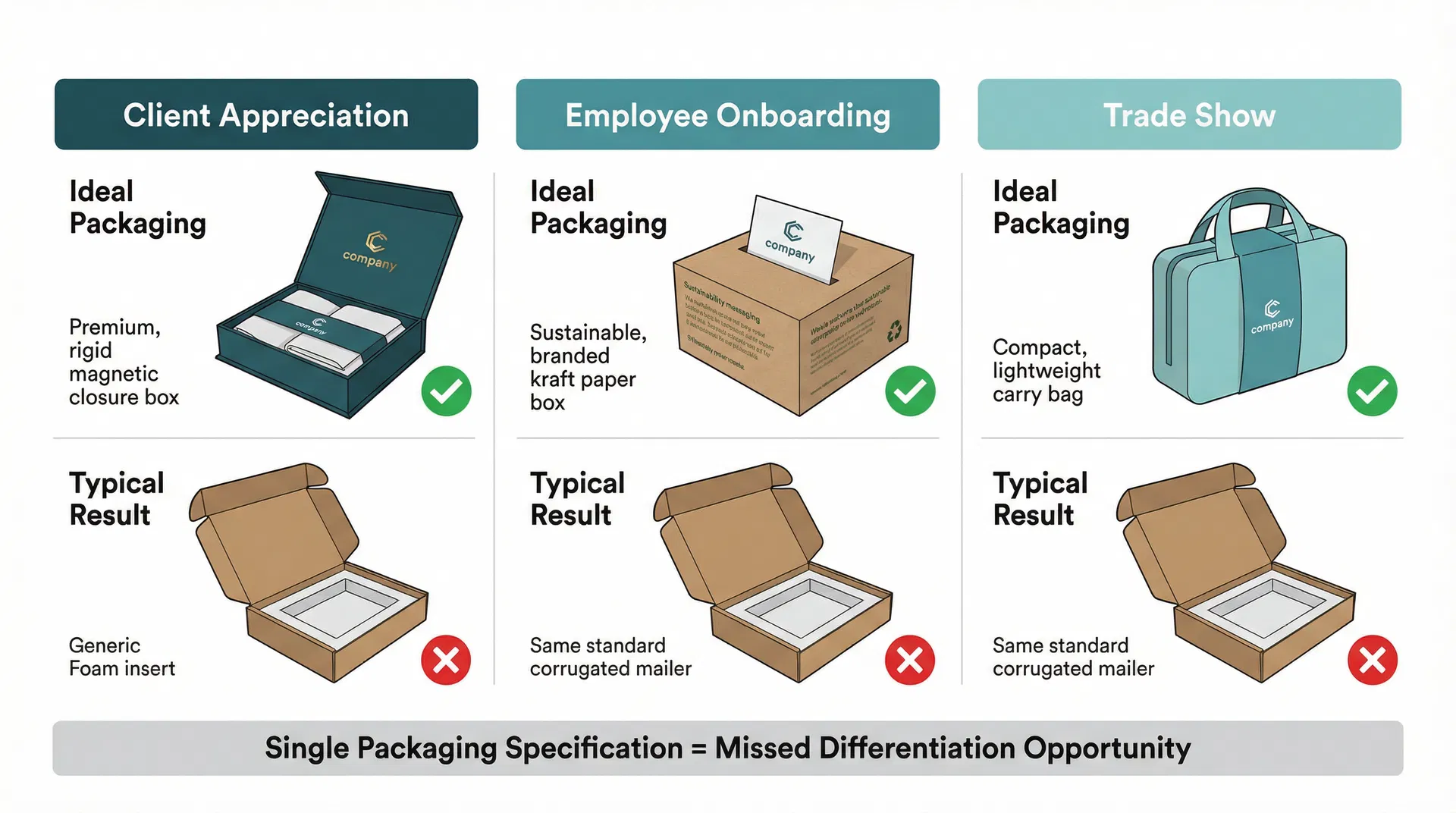
The situation compounds when corporate gifts are distributed across multiple occasions or recipient tiers. A company ordering 500 drinkware items might allocate 200 for a client appreciation event, 150 for new employee onboarding kits, and 150 for a trade show. Each context has different presentation requirements. The client appreciation gifts benefit from premium rigid boxes that signal exclusivity. The onboarding kits might work well with branded kraft boxes that align with the company’s sustainability messaging. The trade show giveaways may need compact, lightweight packaging that recipients can carry easily. But because packaging was specified as a single line item — “supplier standard” — all 500 units arrive in identical boxes. The client appreciation gifts look no different from the trade show giveaways. The packaging fails to differentiate the occasions, which means the gifts fail to communicate the different levels of relationship investment that each occasion represents.
In practice, this is often where corporate gift type decisions start to diverge from their intended outcomes. The product was chosen to match the occasion. The branding was designed to reflect the company’s identity. But the packaging — the one element that frames the entire recipient experience — was selected by default rather than by design. When evaluating which types of corporate drinkware gifts best serve different business needs, the packaging dimension is almost always absent from the decision matrix. It does not appear in the RFQ. It is not discussed during supplier evaluation. It surfaces only when the operations team asks “how should these be shipped?” — a question about logistics, not about brand experience.
The correction is not necessarily expensive, but it requires a structural change in how the procurement specification is built. Packaging needs to be included in the initial brief alongside product type, branding method, and quantity — not appended as a logistics afterthought. The specification should state the intended presentation context: “These will be hand-delivered at a boardroom dinner” or “These will be included in a welcome pack mailed to home addresses.” That context determines whether the packaging needs to be a rigid presentation box, a branded mailer, or a custom sleeve over the supplier’s standard box. Each option has different cost, MOQ, and lead time implications, and those implications need to be visible before the product budget is finalised, not after.
There is also a timing dimension that compounds the problem. Custom packaging typically requires its own lead time — artwork approval, die-cutting, printing, and assembly — that runs parallel to but is not synchronised with the product manufacturing timeline. A custom rigid box with foil-stamped branding might need four to six weeks from artwork approval to delivery. If the packaging decision is made three weeks before the event date, the only viable option is whatever the supplier has in stock. This is how a procurement team that invested eight weeks in selecting the right vacuum-insulated bottle ends up presenting it in a plain white box with a sticker label. The product timeline was managed. The packaging timeline was never started because no one identified it as a separate production stream requiring its own schedule.
The pattern is consistent enough to be predictable. Teams that include packaging in their initial specification — even as a single line stating the presentation context — end up with gifts that recipients describe as “thoughtful” and “premium.” Teams that leave packaging to the final stage end up with products that are objectively identical in quality but are perceived as “corporate” and “generic.” The difference is not in the drinkware. It is in the three to five seconds between the recipient picking up the box and seeing what is inside. Those seconds are shaped entirely by a decision that most procurement workflows treat as an afterthought, and that asymmetry between evaluation effort and perception impact is where the investment quietly loses its return.