Why Passing an AQL Inspection Does Not Prove Custom Drinkware Quality Is Consistent
Key procurement answer
A passed pre-shipment AQL inspection confirms a sample-based lot decision, not uniformity across every custom drinkware unit. This procurement guide explains what AQL can prove, what it cannot, and which process evidence buyers should request.
Expert quick answer: A passed AQL inspection confirms that the inspected sample from a defined production lot met the agreed acceptance rule. It does not prove that every unit is defect-free, that the production process remained stable throughout the run, or that the next lot will perform identically. For custom drinkware procurement, AQL should be treated as one layer of evidence alongside an approved specification, independent inspection, in-process checks, and records showing that critical dimensions, materials, closures, and decoration stayed within tolerance.
This distinction matters because final inspection is often the most visible quality document in a purchase file. A buyer receives a report marked “pass”, the shipment is released, and the report becomes shorthand for “the order is consistent”. That shorthand is convenient, but it collapses three different questions into one: whether the inspected lot passed a sampling rule, whether the inspected units matched the specification, and whether the factory’s process was capable of producing the same result repeatedly. Those are related questions, not interchangeable ones.
What AQL actually tells you. AQL, or Acceptable Quality Limit, is used in acceptance sampling. An inspector selects a sample from a defined lot and compares the observed number and classification of defects with an agreed acceptance and rejection rule. ISO 2859-1 provides sampling schemes indexed by AQL for inspection by attributes. In practical terms, the method helps a buyer make a controlled lot decision without inspecting every unit.
That is useful for commercial decisions. Inspecting every bottle, cup, lid, or decorated surface may be slow, costly, and still vulnerable to inconsistent inspection technique. A defined sample plan creates a repeatable decision process. It also forces the parties to define what counts as a critical, major, or minor defect instead of relying on a general statement such as “good quality”. The method is strongest when the lot boundary, sample selection, defect definitions, and acceptance numbers are agreed before inspection begins.
What a passed AQL report does not tell you. It does not mean every unit in the lot was checked. It does not mean the sample represents every production condition equally. It does not measure whether the process was stable from the first decorated unit to the last packed unit. It does not establish that a material substitution, line change, shift change, or rework event did not create a different quality population inside the same shipment. Most importantly, it is not a process capability index.
Consider an illustrative 1,000-unit order of vacuum-insulated bottles. If a defined sample passes the agreed acceptance rule, the buyer has evidence about that sampled lot under that inspection plan. The buyer does not automatically have evidence that the first 200 units, the middle 400 units, and the final 400 units were produced under identical settings. If the decoration line was recalibrated halfway through the order, or if a component batch changed during assembly, a single end-point sample may not explain how those changes affected the earlier units.
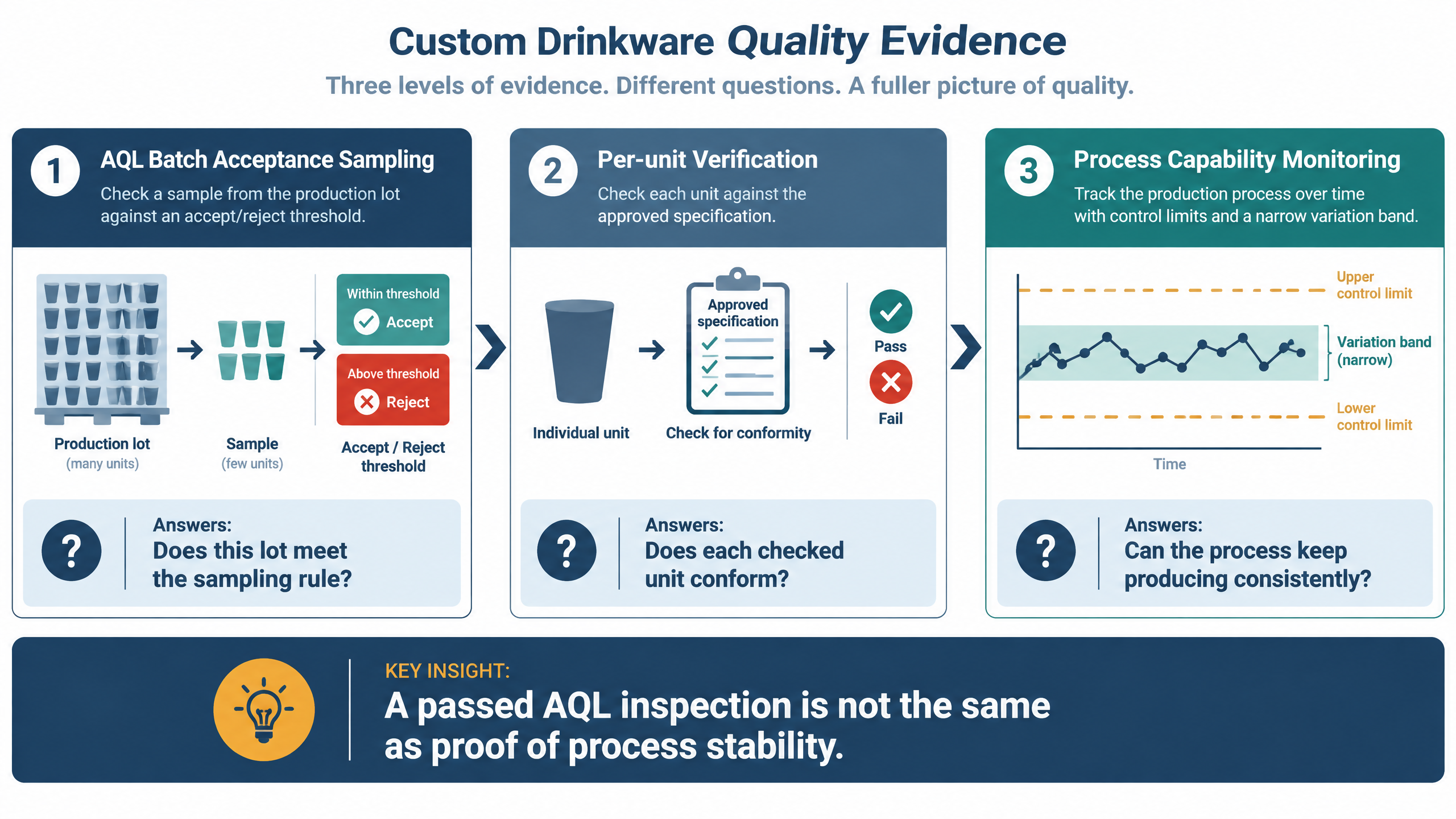
The practical lesson is not that AQL is inadequate. The lesson is that it answers a narrower question than many procurement files imply. AQL helps determine whether a lot should be accepted under an agreed sampling rule. Process control asks whether the manufacturing system can keep producing within the approved range. A specification review asks whether the product is correct for the intended use. A closure leak test, dimensional check, coating check, or decoration-position check may each require its own method and evidence.
Why defect classification changes the decision. A scratched powder coat, a loose lid seal, a misaligned logo, and a material that does not match the approved specification are not equivalent defects. Treating them as one combined “defect rate” can hide the risk that matters most to the buyer. Aesthetic variation may be tolerable within a defined range, while a leak, sharp edge, or incorrect food-contact material may be unacceptable regardless of how many other units appear good.
The procurement document should therefore define the defect classes before production, not ask an inspector to improvise them at the end. For custom drinkware, the inspection brief may need separate criteria for capacity, dimensions, wall or base stability, lid fit, leakage, surface finish, logo position, colour tolerance, packaging damage, and any required material or compliance documentation. This does not make the order risk-free; it makes the release decision traceable.
Why independent inspection matters. The same sampling plan can produce different confidence depending on who performs it, when it is performed, and whether the inspector can report a failure without commercial pressure. A supplier’s internal quality check can be valuable process evidence, but it is not identical to an independent inspection. The two activities have different purposes: the factory team should find and correct problems while production is moving; an independent party gives the buyer a separate view of whether the defined lot appears to meet the release criteria.
Independence also improves the usefulness of the report. A credible record should identify the lot inspected, the production status, the sample size, the defect definitions, the findings by category, the photographs or measurements supporting non-conformities, and the final decision rule. A one-line statement that “QC passed” is difficult to use when a later disagreement concerns logo placement, lid performance, or the boundary between acceptable and unacceptable surface variation.
When final inspection is too late. A final inspection can identify a problem, but it may not be the cheapest or fastest point at which to correct it. If a decoration screen has drifted, a lid component is out of tolerance, or a material batch has changed, discovering the issue after packing creates a wider rework problem. Earlier checks—such as an initial production check, a during-production check, and targeted tests on risk-critical features—can reveal whether the process is moving away from the approved reference before the full lot is complete.
This is particularly important when the order contains multiple production conditions. Examples include a split production schedule, several decoration lines, different component batches, multiple shifts, a mid-run material substitution, or a change in packaging configuration. Each condition can create a reason to segment the inspection plan or add a checkpoint. The relevant question is not “Did the supplier inspect something?” but “Did the evidence cover the ways this order could vary?”
Buyers evaluating a supplier should ask for process evidence in addition to a final report. Useful evidence may include the approved product specification, a signed sample or golden reference, a defect classification table, measurement records for critical dimensions, leak or function test results, material-batch traceability, decoration checks at more than one production interval, and a record of corrective action when a check falls outside tolerance. The exact package depends on product risk and order complexity; the principle is to connect each important risk to a check that can actually detect it.
AQL settings should also be chosen for the product and risk profile rather than copied from a previous order. Batch size, defect severity, intended use, inspection level, and the cost of failure all influence what an acceptance rule can reasonably support. A lenient rule may allow a commercially unacceptable pattern to pass. An overly strict rule may reject a usable lot without improving the features that matter most. The number only becomes meaningful when the parties understand what decision it is designed to support.
This is where many procurement teams misjudge the document trail. They collect a sample approval, a supplier declaration, and a passed final inspection, then assume the three documents prove the same thing. They do not. The approved sample defines the intended result. The supplier declaration describes what the supplier says about the product or process. The AQL report records a sample-based lot decision. Process records and targeted tests provide the missing evidence about how consistently the result was produced.
The broader custom drinkware customization workflow should therefore be treated as a sequence of linked decisions, not a set of disconnected approvals. Artwork approval, material confirmation, sample review, production monitoring, inspection, packing, and release each protect against a different failure mode. When one document is asked to stand in for all of them, the procurement file looks complete while the underlying risk remains unmeasured.
A more defensible release decision. Before releasing a custom drinkware shipment, the buyer should be able to answer four questions. What exact lot was inspected? What defects were defined and how were they classified? Which risk-critical features were tested or measured? What evidence shows that important production changes were either absent, controlled, or separately checked? If the answers are clear, a passed AQL result can perform its intended role as one part of the release decision. If the answers are unclear, the word “pass” carries more confidence than the evidence deserves.
The procurement objective is not to eliminate all variation from a manufactured product. It is to define the acceptable range, identify the defects that cannot be accepted, and gather evidence at the points where variation can still be corrected. AQL sampling is valuable because it makes lot acceptance more systematic. It becomes misleading only when it is treated as proof of per-unit perfection or long-run process capability. Separating those questions produces a clearer specification, a more useful inspection report, and a more defensible shipment decision.