Why Recipient Demographic Assumptions Undermine Corporate Drinkware Gift Programme Effectiveness
Key procurement answer
Corporate gift procurement briefs describe recipient pools in aggregate terms that conceal the demographic variation determining whether a specific bottle specification will be used daily or stored in a drawer. The single-SKU approach that maximises volume discounts often produces sustained usage rates below 40 percent because it treats fundamentally different usage profiles as interchangeable.
When a corporate gift programme specifies drinkware for a 200-person recipient pool, the procurement brief almost always describes that pool in aggregate terms: “employees across the Auckland office” or “clients attending the annual conference.” The specification that follows—a 500ml matte black stainless steel bottle with laser-engraved logo—is built on an implicit demographic assumption: that the recipient pool is sufficiently homogeneous for a single product specification to serve everyone adequately. In practice, this is precisely where corporate drinkware gift decisions begin to produce adoption rates that fall well below what the programme budget was designed to achieve, because the aggregate description conceals demographic variation that directly determines whether a specific bottle specification will be used daily or stored in a drawer.
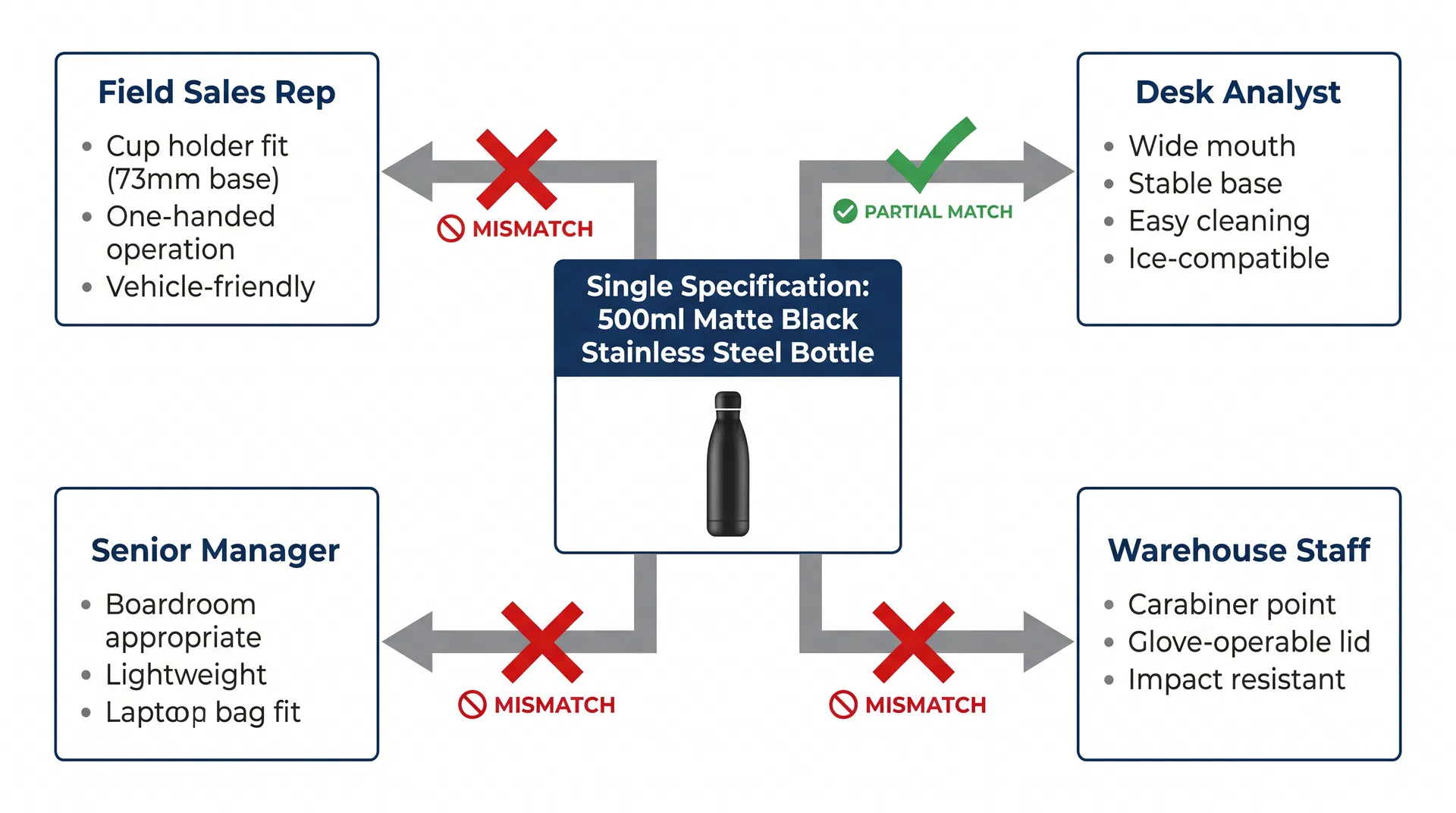
The misjudgment is not about personalisation in the consumer sense—monogrammed initials or custom colour choices. It is about a more fundamental procurement error: treating the recipient pool as a single demographic segment when the pool actually contains three or four distinct usage profiles with materially different drinkware requirements. A 200-person Auckland office typically includes field sales representatives who spend four hours daily in vehicles, desk-based analysts who rarely leave their workstation, senior managers who move between meeting rooms carrying laptops and documents, and warehouse or logistics staff who need hands-free hydration in physically active roles. Each of these usage profiles interacts with drinkware differently, and the specification that serves one profile well actively fails another.
The field sales representative needs a bottle that fits a standard vehicle cup holder—which constrains the base diameter to approximately 73mm—and that can be operated one-handed while stationary at traffic lights. The desk-based analyst values a wide-mouth design that accommodates ice cubes and is easy to clean, with a stable base that will not tip on a cluttered desk. The senior manager needs something that looks appropriate in a boardroom setting and fits in a laptop bag without adding significant weight. The warehouse worker needs a robust design with a carabiner attachment point and a lid mechanism that can be operated with gloves. These are not preferences. They are functional requirements that determine whether the bottle integrates into the recipient’s daily routine or becomes an obstacle within it.
The procurement process typically collapses these four profiles into a single specification by defaulting to the most visually neutral option—the mid-size stainless steel bottle that offends no one and delights no one. The logic is familiar: a universally acceptable product avoids the complexity of managing multiple SKUs, simplifies the supplier relationship, and maximises the volume discount. This logic is sound for commodity procurement where the product’s function is identical regardless of the user. It fails for drinkware gifts because the product’s function is entirely determined by how it fits into the user’s specific daily routine. A bottle that does not fit a cup holder is not a slightly inconvenient bottle for a field sales representative—it is a bottle that cannot be used during the four hours per day when hydration is most needed.
The demographic assumption becomes visible in post-distribution patterns that procurement teams rarely track. Within three weeks of a corporate drinkware gift distribution, the bottles begin to sort themselves. Desk-based staff who received a bottle that happens to match their usage profile continue using it daily—it sits on their desk, visible to colleagues, generating the brand impressions that justified the programme. Staff whose daily routine conflicts with the bottle specification quietly retire it. The field representative whose bottle does not fit the cup holder leaves it at home after the first day. The warehouse worker whose bottle lacks a carry attachment stops bringing it to the floor after the first week. The senior manager whose bottle is too bulky for a laptop bag reverts to a personal bottle purchased specifically for portability. None of these individuals complain. None return the gift. The programme reports 200 bottles distributed, and the procurement team records a successful deployment.
What makes this misjudgment persistent is that the demographic data needed to avoid it already exists within the organisation but is never incorporated into the gift procurement brief. HR maintains role classifications that map directly to usage profiles. Facilities management knows which teams are desk-based versus mobile. Sales leadership can identify which representatives spend significant time in vehicles. The information required to segment the recipient pool into two or three usage profiles—not 200 individual preferences, but two or three functional categories—is available before the procurement brief is written. It is simply never requested, because the procurement framework treats drinkware gifts as a single category rather than as a product whose utility depends on recipient context.
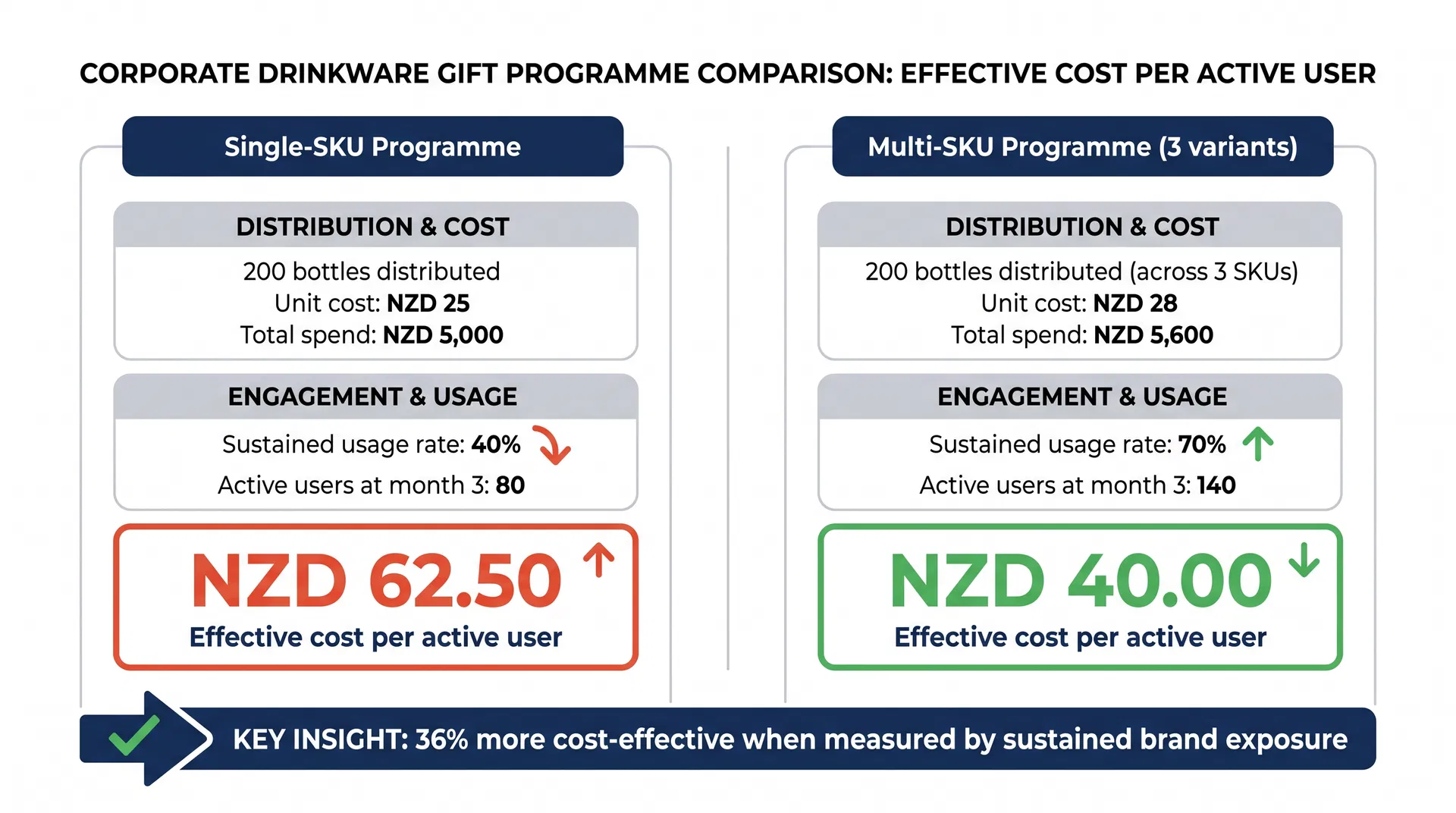
The cost objection to multi-SKU procurement is real but overstated. Specifying two or three bottle variants instead of one does increase procurement complexity. It requires managing two or three supplier relationships or negotiating a multi-SKU order with a single supplier. It complicates distribution logistics. These are genuine operational costs. What the cost objection fails to account for is the effective cost per active user. If a single-SKU programme distributes 200 bottles at NZD 25 each and achieves a 40 percent sustained daily usage rate after three months, the effective cost per active user is NZD 62.50. If a three-SKU programme distributes 200 bottles at NZD 28 each—the slight premium reflecting smaller per-SKU volumes—and achieves a 70 percent sustained usage rate because each SKU matches its recipient segment’s functional requirements, the effective cost per active user drops to NZD 40. The programme that appears more expensive on the purchase order is actually 36 percent more cost-effective when measured against the metric that matters: sustained daily brand exposure.
The age demographic dimension adds another layer that procurement teams consistently underweight. Drinkware preferences correlate with generational patterns that are well-documented in consumer research but rarely applied to corporate gift procurement. Recipients under 30 disproportionately favour bottles with straw lids and bold aesthetic choices—they are accustomed to carrying branded drinkware as a visible accessory and are more likely to use the bottle in public settings where the corporate brand gains exposure. Recipients over 45 disproportionately favour classic screw-cap designs with understated branding—they are less likely to carry branded items visibly and more likely to use the bottle primarily at their desk. A programme that specifies a single lid type and branding intensity across a demographically diverse recipient pool will inevitably mismatch a significant portion of recipients, not because the product is defective but because the specification was built on an averaged demographic that does not actually exist.
The gender dimension, while sensitive to discuss in procurement contexts, has measurable implications for drinkware specification. Hand anthropometry data consistently shows that the average female grip span is approximately 15 percent smaller than the average male grip span. A bottle with a 75mm diameter body that feels comfortable in a larger hand becomes noticeably less comfortable to grip repeatedly throughout the day for someone with a smaller hand. This is not a preference issue—it is an ergonomic reality that affects whether the bottle is picked up 8 times per day or 3 times per day. Procurement teams that specify a single body diameter for a mixed-gender recipient pool are making an implicit ergonomic choice that favours one demographic over another, and the demographic that finds the bottle less comfortable to hold will use it less frequently.
The seasonal timing of gift distribution intersects with demographic assumptions in ways that further compound the specification error. A corporate drinkware gift distributed in December—common for end-of-year appreciation programmes—enters the recipient’s life during the New Zealand summer. The 500ml insulated bottle that seemed like a universal choice performs well for cold beverages during summer months. By April, when temperatures drop and recipients shift to hot beverages, the same bottle’s thermal performance, lid design, and capacity may no longer match daily needs. Recipients who primarily drink coffee want a 350ml vessel that maintains temperature for a single serving. Recipients who primarily drink water want the 500ml capacity year-round. The single-specification approach assumes that drinkware needs are static, when in reality they shift with seasons, and the demographic segments within the recipient pool shift their beverage preferences at different rates.
The connection between recipient demographic analysis and the broader question of selecting corporate gifts that genuinely match different business contexts is structural rather than incidental. The gift type decision cannot be separated from the recipient profile decision, because the same product specification performs differently across different recipient segments. A vacuum-insulated stainless steel bottle is an excellent corporate gift for field-based staff who need temperature retention during long periods away from the office. The same bottle is an over-engineered and unnecessarily heavy choice for desk-based staff who refill from a kitchen 20 metres away every two hours. The gift type is not inherently right or wrong—it is right or wrong relative to the recipient’s daily routine, and that routine varies systematically across the demographic segments that every organisation already has data to identify.
The pattern of treating recipient pools as homogeneous works when the pool genuinely is homogeneous—a team of 30 field engineers who all share similar daily routines, or a conference audience of procurement professionals who will all use the gift in similar contexts. It fails when the pool contains the demographic diversity that characterises most corporate offices, where role type, age distribution, physical workspace, and daily mobility patterns create usage profiles that a single drinkware specification cannot simultaneously satisfy. Procurement teams that invest 30 minutes reviewing HR role data before writing the gift specification—not to create 200 individual profiles, but to identify two or three functional segments—consistently achieve higher sustained usage rates and lower effective cost per brand impression. The demographic data is not missing. It is simply not being asked for, because the procurement framework was designed for commodities where the user’s profile does not affect the product’s utility. Corporate drinkware gifts are not commodities. They are daily-use products whose value is entirely determined by the fit between the specification and the recipient’s actual life.