Why a Supplier Change Notice Is Not Buyer-Approved Change Control in Custom Drinkware
Key procurement answer
A supplier notice can explain that a lid, gasket, coating, packaging, tooling, or process will change. It does not prove that the buyer assessed the impact, approved a revised requirement, verified the affected configuration, or knows which production lot received it. This guide explains the controls that turn notice into an accountable procurement decision.
Procurement position: A supplier change notice tells a buyer that a lid, gasket, coating, packaging, tooling, material source, or production condition may change. Buyer-approved change control is the documented decision that determines whether the proposed change still meets the approved product requirement, what evidence is needed, who may authorize it, which revision governs production, and which lots are affected. For custom drinkware, the difference matters because a notice can arrive after a commercial decision has already been made, while controlled approval must happen before the changed configuration is treated as the item the buyer agreed to purchase.
The terms are often blurred in supplier correspondence. A factory may write that an “equivalent” lid is available, that a coating supplier has changed, or that revised packaging will be used because of availability or efficiency. The message may be honest and commercially useful. It is still only an input to a decision. It does not show that the replacement fits the approved body across production tolerances, that the new coating performs with the selected decoration method, that the carton protects the revised shape, or that the buyer accepted a different configuration for its recipients and brand programme.
The practical difference is a completed decision trail. A notice is a statement of intent or fact from the supplier. Controlled approval connects that statement to an identified product, an impact review, a revised requirement where needed, an authorized acceptance decision, an effective production boundary, and records that can be checked later. If any of those links is missing, a procurement team may know that something changed without knowing whether the delivered item is still the product it approved.
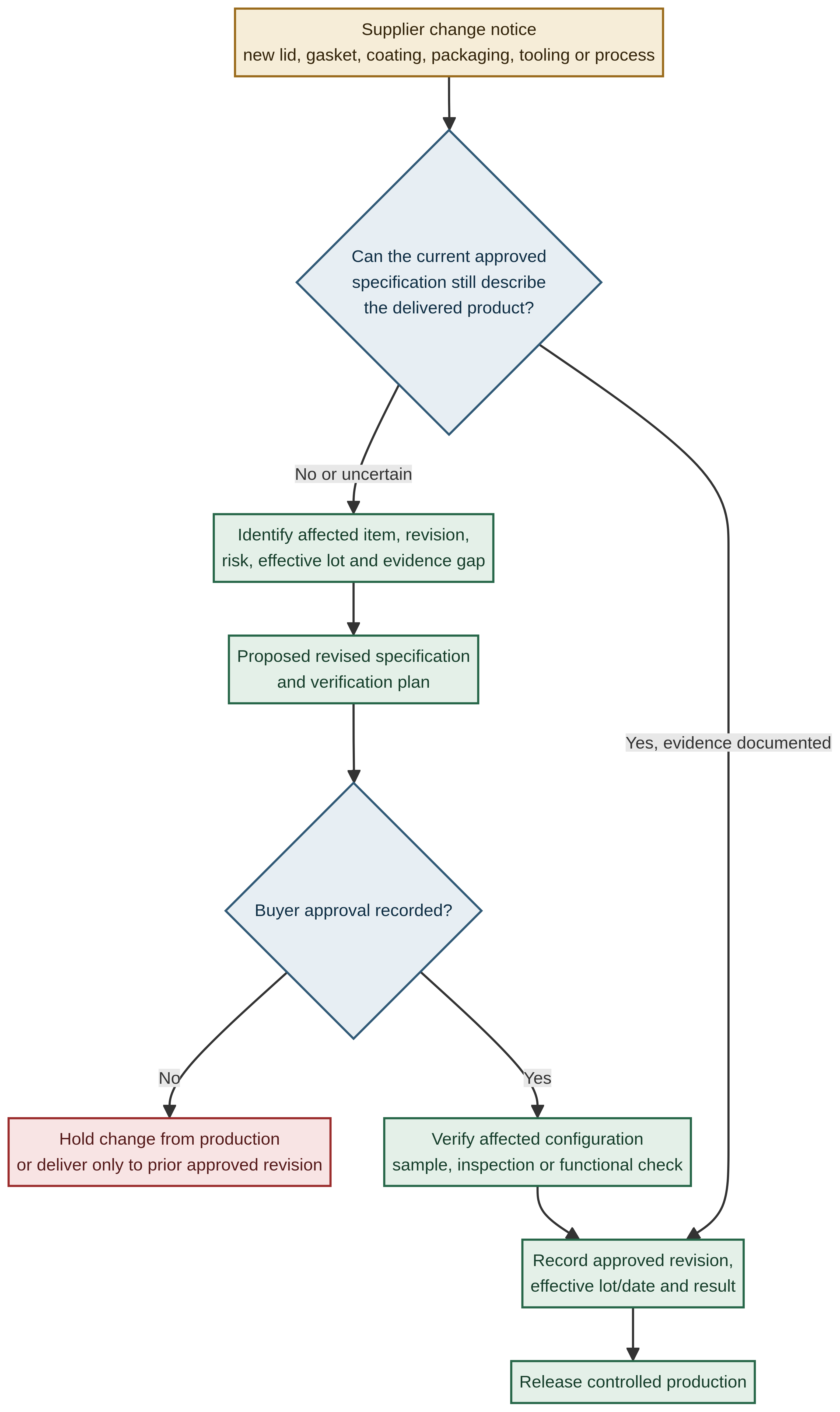
The diagram separates the two pathways. The first question is not whether a supplier has used the word “change”; it is whether the current approved specification can still describe the delivered product. If the answer is no or uncertain, the proposed configuration needs an impact review, a controlled revision, an approval decision, and proportionate verification before production is released. A notice can start that pathway. It cannot complete it.
Why apparently small substitutions can change the commercial result. Custom drinkware is an assembled product, not just a vessel body. A replacement gasket can alter sealing force or odour behaviour. A lid from a different tool can change thread engagement, opening force, or logo orientation. A different ink, primer, curing condition, or coating batch can alter how decoration appears and wears. A carton change can affect transit damage, unit presentation, or the outer dimensions planned for an event kit. Even where the supplier reasonably considers the replacement functionally similar, the buyer may have approved a different combination of appearance, fit, use, packing, and evidence.
“Equivalent” is a claim that needs a reference point. In procurement, equivalent should never be treated as a self-explanatory conclusion. Equivalent to which revision, on which properties, under which use conditions, and with what verification? A supplier may mean that a new lid uses the same nominal material family. The buyer may need equivalence of seal performance, thread fit, colour, texture, cleaning behaviour, supplied documentation, logo orientation, and compatibility with the vessel and packaging. Until the applicable comparison criteria are visible, the word describes a supplier’s judgement rather than a buyer-approved requirement.
The broader logic is consistent with ISO 10007:2017 configuration-management guidance, which describes configuration management across the lifecycle of products and services. ISO does not prescribe a drinkware buyer’s sign-off workflow, and the public summary is not a contract template. Its useful principle is that configuration management extends beyond sending an update: the product needs an identifiable configuration, change control, status information, and an auditable record. For a drinkware buyer, the commercial translation is to make the approved version of the product visible before asking whether a proposed change can replace it.
An impact review should name the configuration before it judges the change. The review begins by identifying the order, product reference, current revision, affected component or process, and the reason for the proposed change. It should then ask which product-level requirements could move: dimensions, capacity, lid fit, leakage, food-contact documentation, surface finish, decoration appearance, cleaning conditions, insulation, packaging, delivery timing, or inspection method. The goal is not to expose every proprietary factory detail. It is to prevent a decision being made against a vague description such as “material update” or “improved component.”
The revised requirement should be usable on the production floor. When a change is accepted, the record should not finish as an email saying “approved.” It should identify the new or affected component, the governing artwork or product revision, the changed acceptance criteria if any, the evidence to be retained, and the point from which the change is effective. A buyer who approves a substitute lid but leaves the work order, inspection instruction, and packing reference unchanged has created two versions of the truth. A buyer who records the revision makes the decision available to production, inspection, receiving, and a later reorder review.
Verification must fit the claimed impact. A document review may be enough when the change has no effect on the item’s agreed functional or visual attributes. A physical comparison sample may be needed when geometry, finish, decoration, fit, or recipient-facing presentation can change. A dimensional, leakage, closure-cycle, cleaning, or packing check may be appropriate when the altered component affects a specific use requirement. The purpose is not to create laboratory work for its own sake. It is to test the feature that made the supplier’s notice consequential.
The FDA’s quality-systems guidance for pharmaceutical manufacturing is not a regulation for drinkware, and it should not be treated as one. It is useful only as a cross-industry quality-management illustration: it describes change control as managing change to prevent unintended consequences and discusses documented review, risk assessment, and effect monitoring for changes to established materials, suppliers, and processes. The transferable lesson is that a changed input should not be assumed harmless merely because it has been described; its effect on the agreed output needs a deliberate basis.
The effective boundary makes the decision traceable. A controlled change needs a clear answer to “From which unit, lot, date, or production run does this apply?” Without that boundary, a buyer cannot know whether a shipment contains the prior configuration, the changed configuration, or both. The supplier may not be able to investigate a future complaint, and a reorder may accidentally mix records from two product versions. The boundary can be as simple as an effective lot number, assembly run, production date, or purchase-order revision. Its value is that it connects approval to the population actually produced.
This forward record also strengthens later traceability. NIST’s 2026 manufacturing traceability framework describes a continuous, temporally ordered provenance chain that helps stakeholders organize, link, query, and independently verify relevant product-history data. It does not require a custom drinkware supplier to implement NIST’s full technical framework. It does show why an unlinked notification is weak evidence: an event becomes operationally useful only when it can be connected to the affected configuration and the product history that followed.
Final inspection cannot turn an unapproved change into an approved one. A finished-goods sample may look acceptable after a substitution, and that result can be relevant evidence. It does not answer whether the customer approved the changed configuration before it was used, whether the correct properties were checked, or whether the inspection sample covered all affected production conditions. Inspection determines conformity against a requirement. Change control determines which requirement was authorized. Reversing the sequence can leave a supplier with a passing report and a buyer with a product that was never formally accepted.
A deviation and a permanent revision should not be silently merged. Sometimes a buyer may accept a one-order exception because a defined shortage, event deadline, or supply interruption makes the normal configuration unavailable. That can be commercially sensible if the exception is described, assessed, and bounded to the affected order or lot. It should not automatically become the next reorder’s default. A permanent change deserves a revised controlled requirement; a temporary deviation deserves an expiry or boundary. Treating both as an informal “yes” is how temporary workarounds become unexplained product variation.
The most effective time to establish this discipline is before production pressure appears. The buyer can specify which changes require written notice, which require approval before use, which information a request must include, how much lead time is expected, what verification is proportionate, and how the effective lot or revision will be recorded. Those controls are part of the custom drinkware customization process, because artwork, component choice, finish, assembly, inspection, and release are connected decisions rather than isolated supplier updates.
A practical request can remain concise: identify the current and proposed configuration; explain why the change is needed; state which dimensions, materials, functions, appearances, documents, or packs are affected; provide the comparison evidence; define the proposed effective production boundary; and wait for the designated approval decision where the agreed control requires it. This is not bureaucracy for its own sake. It gives both parties a shared way to prevent an avoidable dispute about what was purchased, what was built, and which evidence supports release.
A supplier notice is valuable because it creates visibility. Buyer-approved change control creates accountability. When the two are treated as the same document, the procurement file can appear informed while the critical questions remain unanswered: what changed, why it matters, which version governs, what evidence supports it, and where the change begins. When those questions are answered before the affected configuration enters production, custom drinkware orders are easier to compare, inspect, trace, and reorder with confidence.