Why Raw Material Shortages Extend Custom Drinkware Production Lead Times by 2-4 Weeks
Key procurement answer
Factory procurement teams explain why material sourcing delays for stainless steel, injection molds, and silicone gaskets extend custom drinkware production timelines by 2-4 weeks before manufacturing even begins.
When procurement teams receive a production timeline of "35 working days," they typically assume this represents the factory's manufacturing window from raw material availability through final quality control. In practice, the 35-day estimate assumes that all required materials—304-grade stainless steel coils, plastic injection-molded components, silicone gaskets, and packaging materials—are already in stock at the factory or will arrive within the first 2-3 days of the production window. When material procurement extends beyond this assumption, the entire production schedule shifts backward, adding 2-4 weeks to the total lead time without the buyer's awareness until the delay has already occurred.
The Hidden Material Procurement Phase
Most New Zealand procurement teams view custom drinkware production as a single monolithic process: the buyer places an order, the factory manufactures the goods, and the goods ship. In reality, production is preceded by a material procurement phase that operates on a separate timeline. The factory does not begin cutting stainless steel or injection-molding plastic components until all required raw materials have been physically received and inspected at the factory warehouse.
For a typical 5,000-unit order of custom stainless steel vacuum bottles, the factory requires:
- • 304-grade stainless steel coils (approximately 2,500-3,000 kilograms)
- • Plastic injection-molded lids (5,000 units)
- • Silicone gaskets (5,000 units)
- • Powder coating materials in the specified Pantone color (approximately 50-75 kilograms)
- • Packaging materials (cartons, tissue paper, foam inserts)
- • Labels or decals for branding
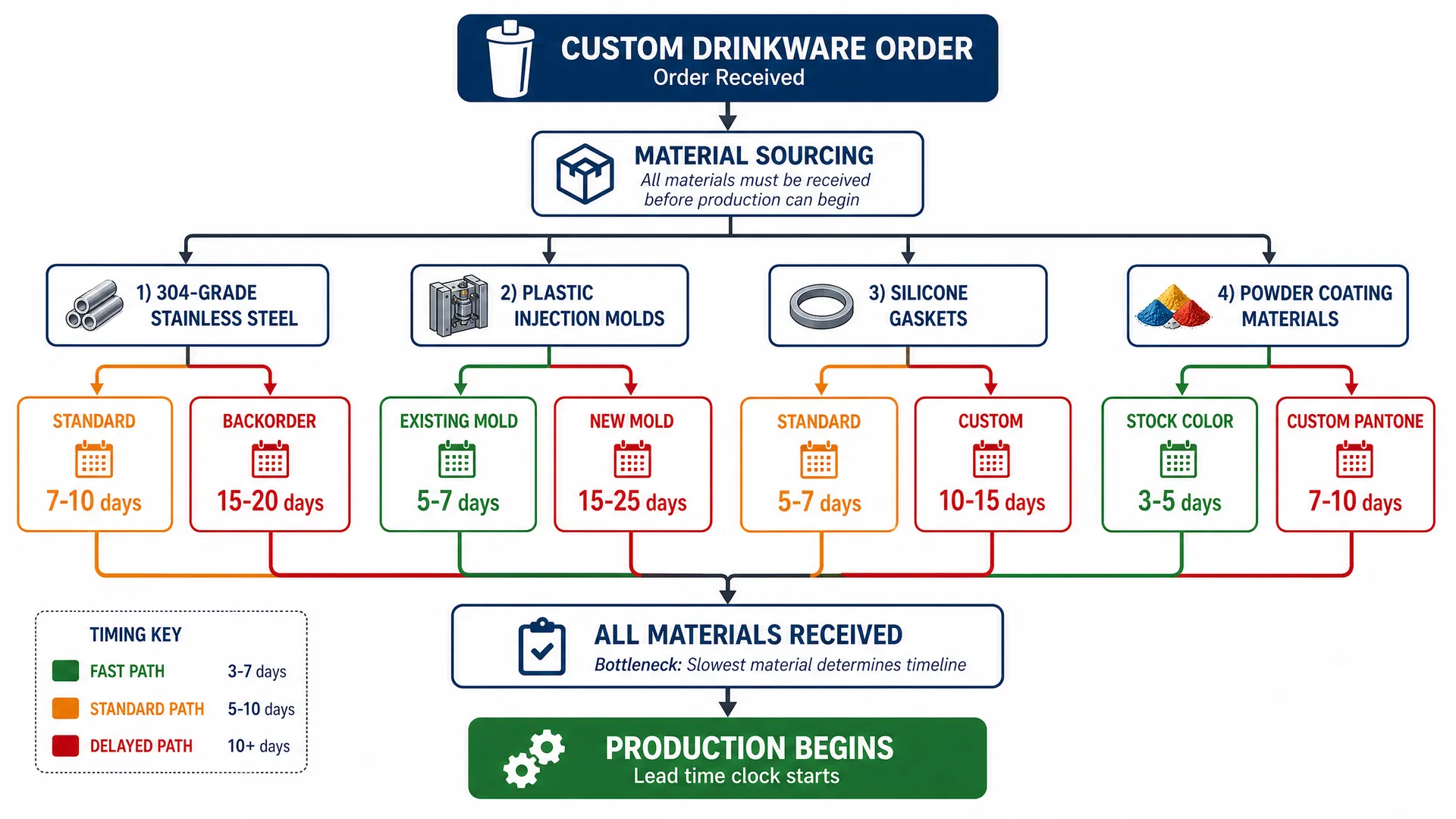
The factory does not stock all of these materials in perpetuity. Instead, it operates on a just-in-time inventory model: materials are ordered from suppliers when a customer order is confirmed, and the factory expects these materials to arrive within 5-10 working days. This model works efficiently when suppliers maintain adequate stock and shipping is reliable. However, when material suppliers experience stock-outs or shipping delays, the factory's production schedule is held hostage to the material supplier's timeline.
When Material Procurement Extends Beyond Expectations
304-Grade Stainless Steel Coil Shortages
The most common material bottleneck is 304-grade stainless steel coil availability. This material is a commodity input for drinkware manufacturing, but supply is not unlimited. During periods of global economic expansion, construction activity increases, and demand for stainless steel rises across multiple industries—automotive, construction, appliances, and consumer goods all compete for the same material supply. When global demand spikes, stainless steel mills prioritize large orders from established industrial customers (automotive manufacturers, appliance makers) over smaller orders from drinkware factories.
A factory that typically receives stainless steel coil shipments within 7-10 working days may discover that during a period of high global demand, the lead time has extended to 15-20 working days. The factory's supplier informs them that the material is on backorder and will not ship until the next production run at the mill, which occurs 2-3 weeks in the future. The factory cannot begin production of the buyer's order until this material arrives, because they cannot cut or shape stainless steel that does not exist.
For a buyer who initiated an order expecting a 35-day production timeline, this material delay translates into a 50-55 day actual timeline: 15-20 days waiting for stainless steel to arrive, plus 35 days for manufacturing. The buyer discovers this delay only after production has failed to start on the expected date, at which point the delay has already consumed the first 2-3 weeks of the planned schedule.
Plastic Injection-Molded Component Lead Times
The second common bottleneck is plastic injection-molded components, particularly custom lids. When a buyer specifies a proprietary lid design—such as a custom-shaped lid with a specific locking mechanism or a logo-embossed surface—the factory must either use an existing mold or commission a new mold to be created. If the mold already exists (because the buyer is reordering a product the factory has produced before), plastic components can typically be produced within 5-7 working days. However, if the mold must be created, the timeline extends to 15-25 working days, depending on mold complexity.
Many buyers assume that if they are ordering a "custom" product, the factory already has a mold on file. In practice, many factories do not maintain long-term mold storage for every product they have ever produced. Molds are expensive (NZ$3,000-8,000 for a simple lid mold, NZ$15,000+ for complex designs), and factories typically store molds only for products that are reordered regularly. If a buyer is ordering a custom drinkware product for the first time, or if they are reordering after a gap of 12+ months, the factory may need to commission a new mold or retrieve a stored mold from off-site storage.
The mold creation or retrieval process adds 10-15 working days to the material procurement phase, extending the total lead time from 35 days to 45-50 days. Again, this delay is often invisible to the buyer until production fails to start on schedule.
Silicone Gasket and Seal Material Sourcing
A third material bottleneck is silicone gaskets and seals. For vacuum bottles or insulated tumblers, silicone gaskets are critical components that determine whether the product will maintain temperature retention and prevent leakage. Silicone gaskets must meet specific durometer ratings (hardness specifications), temperature resistance ranges, and FDA food-contact compliance standards.
When a buyer specifies a custom gasket design or material grade, the factory must source this from a specialized silicone supplier. Standard gaskets (for common drinkware designs) are typically available within 5-7 working days. Custom gaskets with specific durometer ratings or FDA compliance certifications may require 10-15 working days. If the silicone supplier experiences a stock-out or if the specified material grade is temporarily unavailable, the lead time extends to 20-25 working days.
Powder Coating Material Availability
For powder-coated drinkware, the factory must source powder coating materials in the specified Pantone color. Most factories maintain stock of common colors (black, white, navy, red), but custom Pantone colors must be ordered from the powder coating supplier. The supplier mixes the custom color, ships it to the factory, and the factory tests the color on a sample piece to verify it matches the buyer's Pantone specification.
This process typically takes 7-10 working days. However, if the powder coating supplier is experiencing high demand or if the specified Pantone color requires a complex pigment mix, the lead time can extend to 15-20 working days. Additionally, if the factory's initial color test reveals that the mixed color does not match the Pantone specification (a common occurrence due to substrate differences), the powder coating supplier must remix the color and ship it again, adding another 7-10 days to the timeline.
The Compounding Effect of Multiple Material Delays
The challenge for buyers is that material delays rarely occur in isolation. When global stainless steel prices spike, demand for plastic injection-molding capacity also increases (because more manufacturers are sourcing alternative materials or redesigning products). When silicone gasket suppliers experience stock-outs, it is often because multiple industries are simultaneously increasing demand. The result is that a buyer's order may encounter delays across multiple material categories simultaneously, extending the total lead time by 4-6 weeks rather than 2-3 weeks.
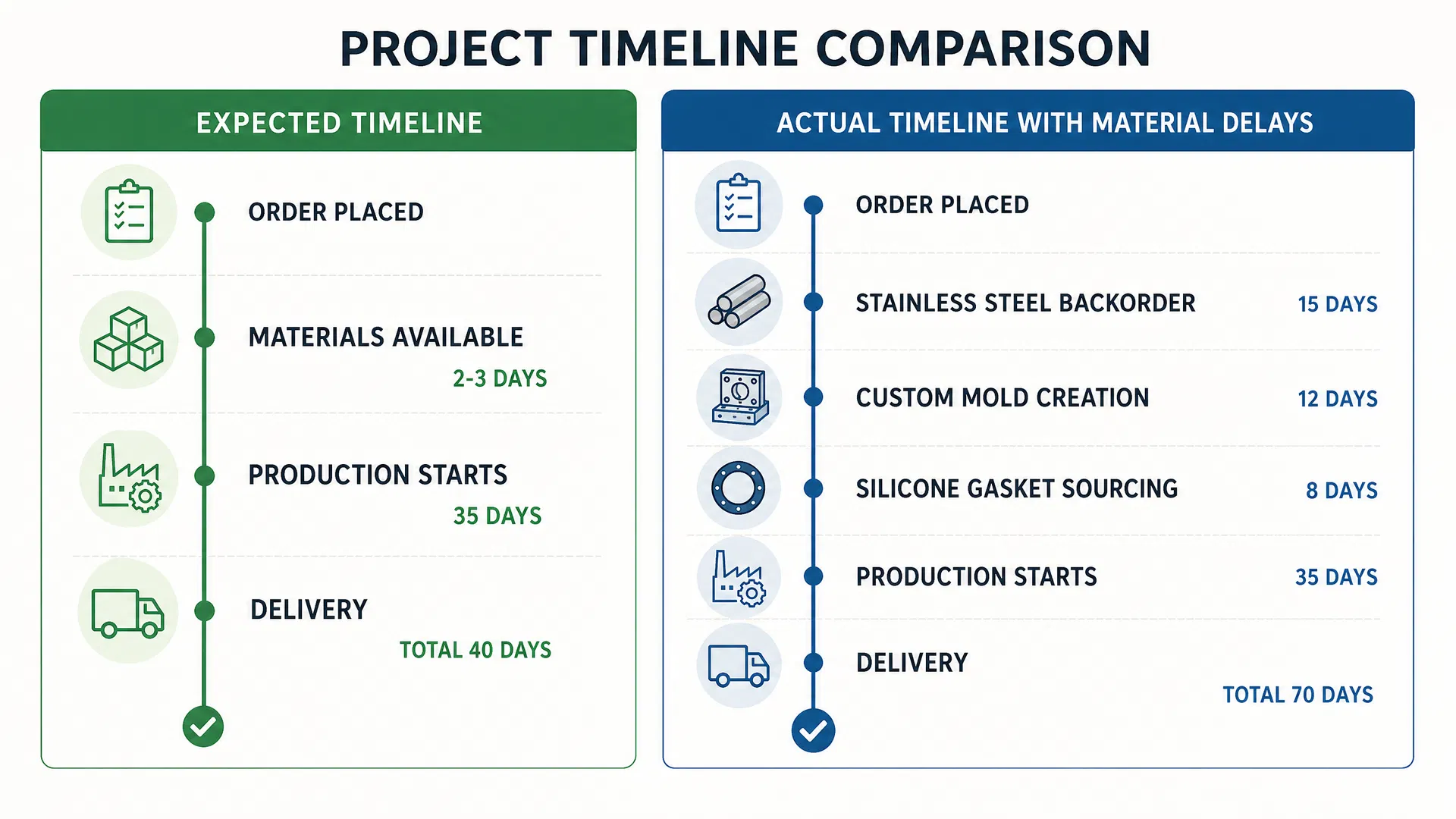
A realistic scenario: A buyer places an order in mid-January for 5,000 custom stainless steel bottles. The factory's initial quote is 35 working days (50 calendar days). However, the factory discovers that:
- • 304-grade stainless steel coil is on backorder (additional 15 working days)
- • Custom plastic lids require a new mold (additional 12 working days)
- • Silicone gaskets in the specified durometer are temporarily out of stock (additional 8 working days)
The material procurement phase alone now requires 35 working days, and production has not yet begun. The actual total lead time is 70 working days (100 calendar days), not the originally quoted 50 calendar days. The buyer's delivery expectation, which was set based on the 50-day estimate, is now 50 days behind reality.
Why Material Delays Are Invisible to Buyers
The primary reason material delays remain invisible is that factories do not typically communicate material procurement timelines to buyers. When a factory quotes "35 working days production," this quote implicitly assumes that materials will be available within the first 2-3 days. If the factory discovers after the order is placed that materials will not arrive for 2-3 weeks, the factory faces a choice:
- 1. Communicate the delay to the buyer immediately, risking the sale if the buyer has a hard deadline
- 2. Absorb the delay internally, hoping that materials will arrive sooner than expected, and communicate the delay only if it becomes unavoidable
Many factories choose option 2, particularly if they are concerned about losing the order to a competitor. The factory's project manager will contact the buyer only after it becomes clear that the material delay cannot be resolved, at which point the delay has already consumed 1-2 weeks of the planned schedule.
Additionally, material procurement happens at the factory, not at the buyer's company. The buyer has no visibility into the factory's supplier relationships, inventory levels, or material sourcing timelines. The buyer assumes that when they place an order, the factory immediately begins production. In reality, the factory is simultaneously placing orders with 5-10 different material suppliers and waiting for all of those orders to arrive before production can begin.
Mitigating Material Procurement Delays
Specify Material Sourcing Requirements Early
The most effective mitigation strategy is to communicate material sourcing requirements at the time of the RFQ (Request for Quote), not after the order is placed. Buyers should ask suppliers:
- • Do you currently have 304-grade stainless steel coil in stock, or will you need to order it?
- • If you need to order it, what is the typical lead time from your supplier?
- • Do you have the required plastic injection mold on file, or will you need to commission a new mold?
- • What is the lead time for custom mold creation?
- • Are the specified silicone gaskets and seals in stock, or will you need to source them?
By asking these questions during the RFQ phase, buyers can identify material sourcing constraints before committing to a deadline. If the factory indicates that materials will require 3-4 weeks to source, the buyer can either extend the timeline or request that the factory prioritize the order with its material suppliers to accelerate delivery.
Request Material Sourcing Confirmation
After an order is placed, buyers should request written confirmation that all required materials have been ordered and are expected to arrive by a specific date. This confirmation should include:
- • The material supplier's name and expected delivery date for each material category
- • Any backup suppliers or alternative materials if the primary supplier experiences delays
- • The factory's contingency plan if materials do not arrive on schedule
This confirmation creates accountability and gives the buyer visibility into the material procurement phase, rather than discovering delays only after production has failed to start.
Build Material Sourcing Buffer into Timeline Calculations
For first-time orders or orders with custom materials, buyers should add 10-15 working days to the factory's quoted production timeline to account for potential material sourcing delays. This buffer should be explicitly communicated to the factory: "We understand that material sourcing may require 10-15 days, so we are planning for a total lead time of 50 working days (35 days production plus 15 days material sourcing buffer)." This communication signals to the factory that the buyer is aware of material sourcing complexity and has planned accordingly.
Specify Reorder-Friendly Product Designs
For buyers who plan to reorder the same drinkware product multiple times, specifying a design that uses existing molds and standard materials reduces material sourcing delays on subsequent orders. If the first order requires a custom mold (15-20 day lead time), the mold will be available for future orders, reducing the material sourcing phase to 5-7 working days. Buyers should discuss mold storage and reorder timelines with the factory during the initial order to ensure that future orders can be fulfilled more quickly.
Material Sourcing as a Strategic Constraint
For New Zealand enterprises planning custom drinkware orders, material sourcing is not a minor logistical detail—it is a strategic constraint that directly affects lead time predictability. Factories that maintain strong supplier relationships and carry strategic inventory can absorb material sourcing delays without impacting the buyer's timeline. Factories that operate on minimal inventory and have weak supplier relationships will experience frequent material delays that extend buyer timelines by 2-4 weeks.
The enterprises that consistently receive on-time deliveries are those that understand material sourcing complexity and plan accordingly. By asking the right questions during the RFQ phase, requesting material sourcing confirmation after order placement, and building appropriate buffer time into their schedules, buyers eliminate the majority of material-related delays.
For New Zealand procurement teams, the key insight is that "production lead time" is not synonymous with "total lead time." Material sourcing is a prerequisite phase that must be planned separately, and delays in this phase directly extend the buyer's delivery date. Understanding this distinction allows buyers to make informed trade-offs: if the deadline is immovable, they can request expedited material sourcing (which may incur surcharges). If the budget is constrained, they can extend the timeline to allow standard material sourcing schedules. If the product design is flexible, they can specify materials and designs that are readily available, reducing sourcing delays.
The difference between receiving custom drinkware on schedule and receiving it 2-4 weeks late often comes down to whether the buyer understood and planned for the material sourcing phase before placing the order. Understanding how production timelines are structured helps buyers recognize that material sourcing is a critical prerequisite that must be managed proactively from the outset of the procurement process.